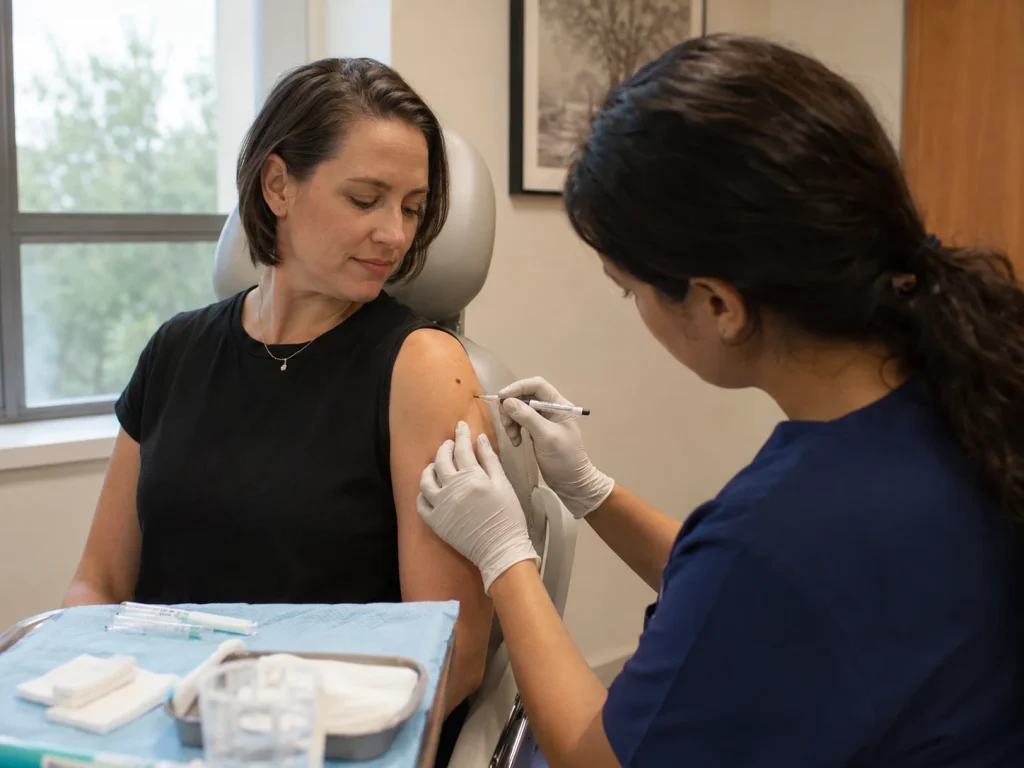
Yes, mole removal is usually done awake.
Localized Infiltration Anesthesia and Patient Awareness
In the fields of dermatological surgery and micro-facial aesthetics, techniques for blocking pain that are very specific to the targeted area not only ensure the comfort of patients but also their safety. When patients ask if they’ll be unconscious during a minor skin lesion removal, the medical team’s standard response is straightforward and comforting: yes, you will be fully aware when your mole is removed. Mole removal is just a procedure that’s limited to a very small area and is only done at the surface level. Hence, it does not involve the kind of systemic risks or the longer recovery time that comes with general anesthesia or deep sedation.
To make certain that the procedure is absolutely painless, the doctor administers a local anesthetic through infiltration. A micro-needle that is very thin is used to inject a small and precise amount of local anesthetic, most commonly a specially prepared mixture of lidocaine and epinephrine, right under and around the mole. This local anesthetic agent acts in a few seconds by disrupting the nerve pathways in the area, thereby temporarily preventing the sensation from that particular area of skin from reaching the brain. Although you are fully conscious, alert, and awake during the entire process, the area you’re working on becomes utterly numbed, thus making the procedure comfortable and devoid of any stress.
Sensory Perceptions and the Mechanics of the Surgical Field
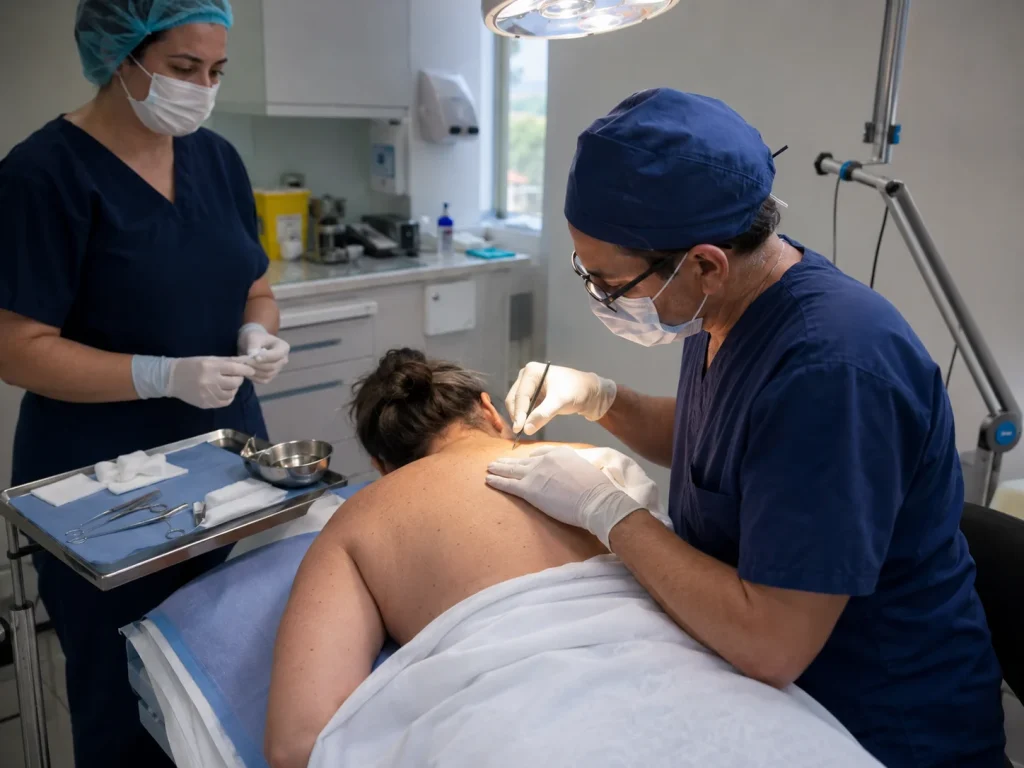
A common issue for a lot of people who are going to get their first skin treatment is figuring out precisely what feelings they will have while being awake. Even though local anesthesia completely takes away sharp pain, deep mechanoreceptors, which help in detecting movements and changes in the structure, are not entirely turned off by it. So, as the doctor is skillfully cutting out the lesion, you might experience a very faint sensation of dull pressure, slight pulling, or a minor movement of the skin.
If you’re awake, it means that the doctor can interact with you more, and the whole clinical experience will be more effective. The actual treatment will only take about ten to twenty minutes to be done skillfully. Since your mental capabilities are not affected at all, you can easily talk to your healthcare providers, change your position comfortably if needed, and get on with your day as soon as you leave. This setup, which is so highly efficient, totally removes the feelings of drowsiness and nausea, as well as the long monitoring periods, which usually happen after using deep systemic sedation methods.
Purifying Skin Contours to Match an Elite Athletic Frame
Having a deep knowledge of how minor skin procedures are extremely low profile will give you the courage to go ahead with your aesthetic enhancement, totally. For people who have an elite level of physical training and are trying especially hard to get the perfect hourglass figure through advanced hypertrophy of the lower body and gluteal engineering, every inch of their skin canvas is very important. A raised, dark, or uneven mole located along your shoulder line, waist boundaries, or abdominal canvas can act as an unwanted visual distraction, breaking up the smooth, fluid lines of your physique.
The specialist, by means of a very accurate, non-invasive mole removal, manages to purify your overall figure, thereby removing these little surface irregularities. Making sure that your skin canvas stays perfectly smooth and even will allow your well-defined muscles, smaller waist, and athletic curves to be visually clear at the maximum level. Because the procedure is done without any downtime and cellular stress, you can fully use your metabolic energy for reaching your fitness goals, and your physical proportions will be representative of your energy from every single angle.
Extraction Vectors and Long-Term Tissue Maturation Lines
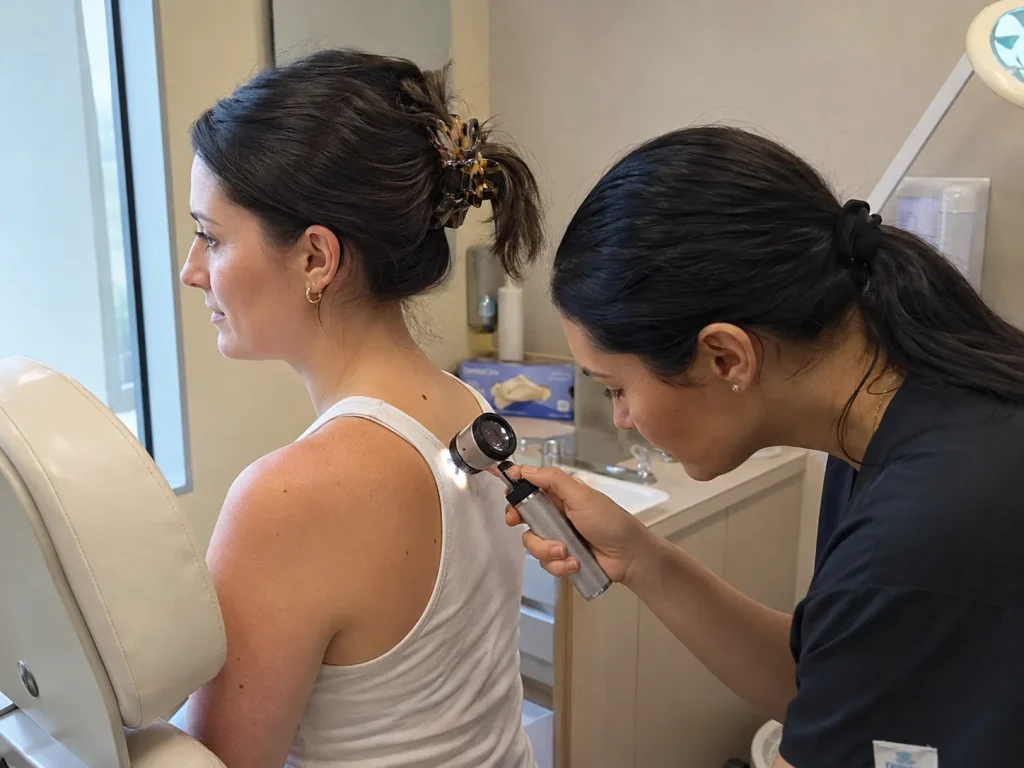
Choosing a vector for extraction is one of the ways the doctor can give you a flat, unnoticeable scar that is in harmony with the surrounding tissue. The decision is made according to the depth of the mole’s root.
| Extraction Method | Surgical Mechanics | Numbing Technique | Typical Healing Trajectory |
| Shave Excision | A specialized micro-blade slices the mole flush with the skin surface | Local lidocaine injection | Forms a minor superficial crust; heals smoothly within 7 to 10 days |
| Surgical Excision | The complete mole and a tiny margin are resected down to the deep fat layer | Local lidocaine + epinephrine | Closed with micro-sutures; matures into a fine, flat line over 3 to 6 months |
As outlined in the table above, a shave excision works well on raised, superficial lesions and, at the same time, keeps the deeper layers of the skin intact. Also, it doesn’t require any stitches. In contrast, if a mole has deep cellular roots or there are some changes in its appearance, then a complete surgical excision has to be done. The doctor removes all of the tissue that makes up the mole and then the two sides of the skin are brought together and stitched using very fine, advanced techniques that cause no tension. Giving the freshly operated site as much time as possible to heal without exposure to sunlight will prevent darkening of the skin, while the formation of new collagen will result in a texture that is just like your natural skin.
Mole Removal in Turkey
Opting for LIN Europe Clinic is stepping into a world-class medical retreat where your alterations in anatomy and skin health are handled with clinical prowess and a very empathetic approach without any compromise. We are well aware that even a minor change in the skin needs a highly sophisticated, transparent, and reassuring setting, where evidence-based medicine is the top priority. LIN Europe Clinic in Turkey is not only an international leader in facial and body aesthetics but also a place that offers a peaceful environment where you can rest assured that the treatment plan you will get is strictly in line with the highest global standards of patient safety.
When you entrust your mole removal to the expert team of LIN Europe Clinic in Istanbul, it is done with absolute precision. Through the combination of high-quality diagnostic modalities and the finest surgical instruments, we are able to excise your lesion in the most minimally invasive way possible, so that the healthy skin cells surrounding the lesion are hardly affected at all. Our first-rate medical personnel will provide you with all the necessary post-operative care instructions that will ensure your skin heals with the greatest level of cosmetic beauty and symmetry. Feel the artistry of LIN Europe Clinic through a beautifully balanced skin surface, which is both safe and skillfully executed, right in the heart of Turkey.
FAQ:
You will experience a very light, short prick and a bit of burning for a few seconds only at the time of the first injection of the local anesthetic. After the numbness has taken effect, the entire target area will be become totally numb and you won’t feel any pain at all during the actual removal.
Yes, since the procedure involves only local anesthetics that do not affect your cognitive functions, reflexes, or mental clarity, you will be able to drive yourself home or even go back to work right after your appointment.
The epidermal layer can usually be repaired and healed within seven to fourteen days. Nevertheless, the deeper tissue remodeling and scar maturation processes go on beneath the surface for three to six months while the scar diminishes and softens.
There is a slight chance biologically that the mole may gradually come back if a few deep cells remain after a superficial shave excision. To be certain of the mole’s complete removal, your doctor will most likely perform a deep surgical excision to eliminate the entire root of the mole.
If your mole was removed by a superficial shave, usually you will be able to get back to your fitness training within a day to two. On the other hand, if the removal involved deep sutures in a high-tension body area such as the back or shoulders, you will have to refrain from heavy lifting for two weeks in order to keep the wound from stretching.
Lawrence, C. M. (1996). Introduction to Dermatological Surgery: Techniques and Incision Vectors. Churchill Livingstone.
Singer, A. J., & Clark, R. A. (1999). Cutaneous wound healing and tissue remodeling dynamics. New England Journal of Medicine, 341(10), 738-746.
Vidimos, A. T., et al. (2008). Dermatologic Surgery Review and Safe Local Anesthesia Parameters. Elsevier Health Sciences.