
Revision needed for complications or cosmetic changes.
The Biology of Implant Aging and Aesthetic Changes
In body sculpturing and reconstructive surgery, breast implants are very resistant; however, they are not lifetime devices. Biometrically speaking, the human body is a complex and changeable environment. Within 10 years, women may have physiological changes such as pregnancy, major weight fluctuations, and natural aging of the skin that will affect the breast tissue and its elasticity. The skin will either stretch or lose collagen, and the implant underneath will no longer be your anatomical baseline.
We at LIN Europe Clinic consider that the main reason for a revision surgery is the decision to continue the enhancement according to the changes in the body. Patients decide on revision surgery not only when their implant is defective but also when they want to change their look. An old implant or a change of the tissue pocket can give rise to a stiff and artificial look. If the implant is changed or the tissue pocket adjusted, the “plastic” or excessively augmented characteristics are removed, and the result is a deeply soft, natural, and beautifully balanced aesthetic that perfectly maintains the patient’s long-term biological balance.
Capsular Contracture: Bringing Back the Original Alignment of the Body

Capsular contracture is the most frequent medical reason for breast implant revisions. Every time a medical device is implanted, the immune system reacts by forming a thin lining of scar tissue, granuloma, or capsule around it. The capsule is soft and flexible in most cases. But some people undergo a very stubborn inflammatory response of their immune system, which makes the fibrous capsule become thick and less flexible and begin to exert compressive force on the implant.
This biometric squeeze changes the breast’s shape visibly: the implant is pressed forcibly against the chest wall, and the tissues feel like a hard ball upon palpation. Solving such an issue requires a surgical skill of the highest kind. The surgeon performs en bloc or total capsulectomy, carefully loosening and removing the hard scar tissue matrix. A new implant, free from any defect, is then installed, transforming the breast texture, softness, and mobility, and leading to complete structural harmony.
Mechanical Device Degradation: Silent Ruptures
The outer shell of an implant will be subject to micro-friction and subsequent degradation, even if it is a modern cohesive silicon gel implant. As long as these implants are made of the new cohesive silicone gel – the so-called “gummy bear” implants – they are able to tolerate the maximum physical load that humans can exert, but the elastomer shell that encloses the gel is still susceptible to eventual wear and tear over 10 to 15 years. Saline implant ruptures lead to instant deflation, whereas the breakup of a silicone implant remains “silent” since the gel is vise-like held in place by high cross-links and hence remains in the pocket with hardly any external signs or symptoms leading one to suspect such a rupture.
Nevertheless, a ruptured shell left inside the body over time can lead to local inflammation or silicone gel leak into the lymph nodes. Following professional rigor, international safety boards suggest a routine MRI or high-definition ultrasound examination after five to seven years of your primary augmentation, and if a defective shell is found, it is time to plan for a revision surgery to remove the old device and put in a new one, so that one can avoid any major immunological reactions. Systemic vitality is the goal that forms the basis of this precaution.
Correcting Pocket Malposition and Symmastia
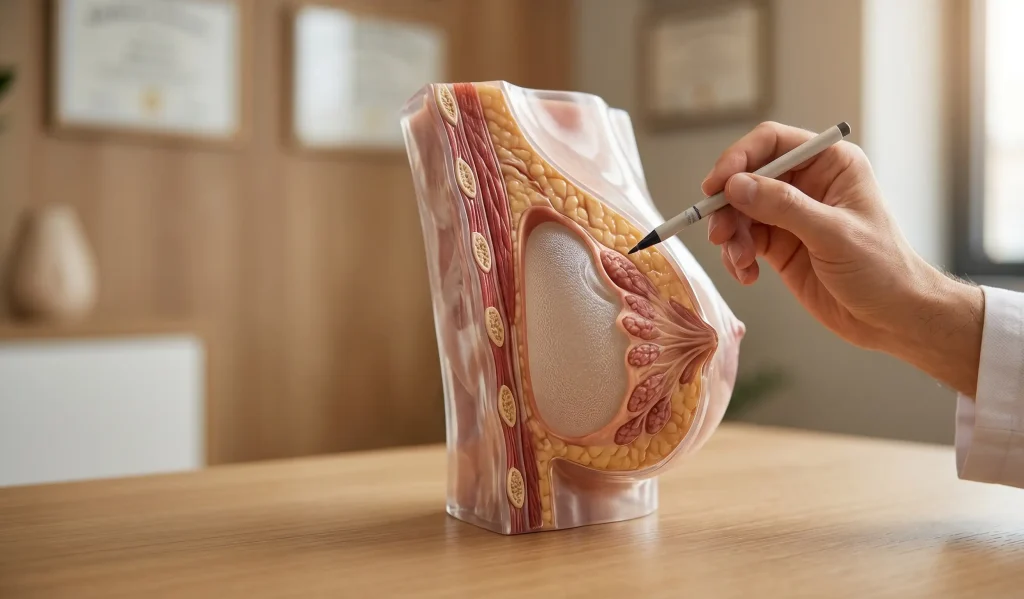
The implant needs to be precisely placed within the pocket in order to achieve an excellent silhouette. Due to gravity and the loosening of the tissues over time, this pocket may become elongated, resulting in implant malposition. The so-called “bottoming out” is the consequence of the lower breast fold (inframammary fold) failing and the implant being situated very low. If the area of the skin between the breasts thins, the implants will move towards each other, which leads to symmastia, a condition in which the cleavage line disappears completely.
Changing such complicated structural changes would need a high level of clinical skills. Specialized techniques of internal suturing, acellular dermal matrices (biological mesh), or fat grafting improvements are some of the tools a surgeon can use during the revision surgery to reconstruct the internal boundary of the breast pocket. Structural strengthening of the tissue matrix is a physical way to lock the new implant in its proper, anatomical position by the surgeon, thus both sides of the body remain young, symmetric, and naturally formed indefinitely.
Comparison Matrix: Primary Augmentation vs. Revision Surgery
| Clinical Metric | Primary Augmentation | Revision Surgery | Biometric Objective |
| Tissue Matrix State | Virgin, undissected tissue. | Pre-stretched, scarred, or altered tissue. | Adapting surgical technique to existing anatomy. |
| Surgical Complexity | Standard pocket creation. | High; requires scar removal or pocket repair. | Restoring pristine internal structural harmony. |
| Aesthetic Goal | Adding initial volume and shape. | Upgrading size, fixing asymmetry, or softening look. | Creating a flawlessly natural, candid profile. |
| Primary Trigger | Personal desire for enhancement. | Capsular contracture, rupture, or aging aesthetics. | Preserving long-term systemic vitality and safety. |
Breast Implants in Turkey
Choosing LIN Europe Clinic is opening the door to a global medical oasis where even the most complicated reconstructive surgeries are performed with top-level clinical skills. We know that deciding on a revision surgery can be a source of stress and anxiety that requires a surgeon who combines detailed knowledge of anatomy with transparent, caring, and understanding communication.
LIN Europe Clinic in Turkey is one of the world leaders in secondary and revisionary breast surgeries, eliminating past problems without jeopardizing your safety. When you put your trust in LIN Europe Clinic, you also become one of the team members in our excellent medical setting, where professional care is considered the most important. Through careful planning, high-definition imaging, and the use of premium, world-class implants, we are able to safely rebuild your tissue matrix after revision. Come to LIN Europe Clinic for comprehensive care and see your beautiful and structurally healthy profile, which is an absolute mirror of aesthetic and biological accomplishment at its best, safely delivered right in the center of Turkey.
FAQ:
Today’s cohesive silicone implants do not really have a set expiration, however the common interval for their natural wear and subsequent revamp is about 10 – 15 years. Regular MRI exploration would be an excellent means of monitoring the implants’ condition ensuring your tissue always remains in a perfect healthy state throughout the years.
Capsular contracture is a situation when body usually fights implant and as a result, a shell of scar tissue that is too tight is formed by the body. This makes the breast very hard to touch and also gives the distorted look. This can be completely fixed by breaking the capsule making it tight surgically.
Indeed a lot of clients choose revision surgery to entirely change their look either by going bigger or smaller sizing up or sizing down to match their current lifestyle. A surgeon thoroughly shapes the tissue pocket so that the new volume appears totally natural and your native frame is in harmony with it.
Nowadays silicone implants in most cases are characterized by “silent ruptures”, which means you will not notice any physical changes or deflation even if the implant shell tears inside your body. The only certain way to find a rupture that is silent and to check the structural health of your device is to go for a high-definition MRI or ultrasound scan.
Recovery time varies with the extent of the revision but for many patients it turns out to be less painful as the muscle pocket has been previously stretched. Nevertheless if a lot of scar tissue removal takes place, you will have to follow your rest protocol very strictly after the operation for preserving your systemic vitality.
Maxwell, G. P., & Gabriel, A. (2014). The evolution of breast implants. Plastic and Reconstructive Surgery, 134(1 Suppl), 12S-17S.
McGuire, P., Reisman, N. R., & Murphy, D. K. (2019). Risk Factor Analysis for Capsular Contracture, Malposition, and Late Seroma in Subjects Receiving Natrelle 410 Form-Stable Silicone Breast Implants. Plastic and Reconstructive Surgery, 143(1), 9-19.
Spear, S. L., Murphy, D. K., & Allergan Silicone Breast Implant US Core Clinical Study Group. (2014). Natrelle round silicone breast implants: Core Study results at 10 years. Plastic and Reconstructive Surgery, 133(6), 1354-1361.
Pochat, V. D., et al. (2017). Breast implant revision surgery: incidence, indications, and surgical strategies. Aesthetic Plastic Surgery, 41(4), 817-824.