
Liposuction is effective long-term if weight stays stable.
Liposuction continually ranks among the top requested cosmetic surgeries around the world. It is often promoted as a means of permanently getting rid of fat. The allure is undeniable: have a procedure, get rid of your “problem areas,” and never worry again about that stubborn belly or those saddlebags. Nevertheless, people who are going to make this investment often have a worrying question deeply planted in their minds: “Will the effect be permanent? Or is it just going to be like before – in five years’ time!”
It isn’t a black-and-white answer. In simple terms, biologically, the procedure is permanent; but from an appearance perspective, the outcome is up to you. Liposuction physically removes the fat cells that will never be regenerated by your body. On the other hand, it does not alter your body’s metabolism, your genetic makeup, or even the laws of physics. At Lin Europe Clinic, one of our main goals is to be sincere with our patients and to give them thorough and accurate information. We want you to realize that liposuction works like a reset button, not a protective shield that prevents your subsequent choices. Knowing how fat is distributed after you lose or gain weight is what will allow you to keep your new body shape indefinitely.
The Biological Mechanism Behind Our Answer: A Constant Cell Number
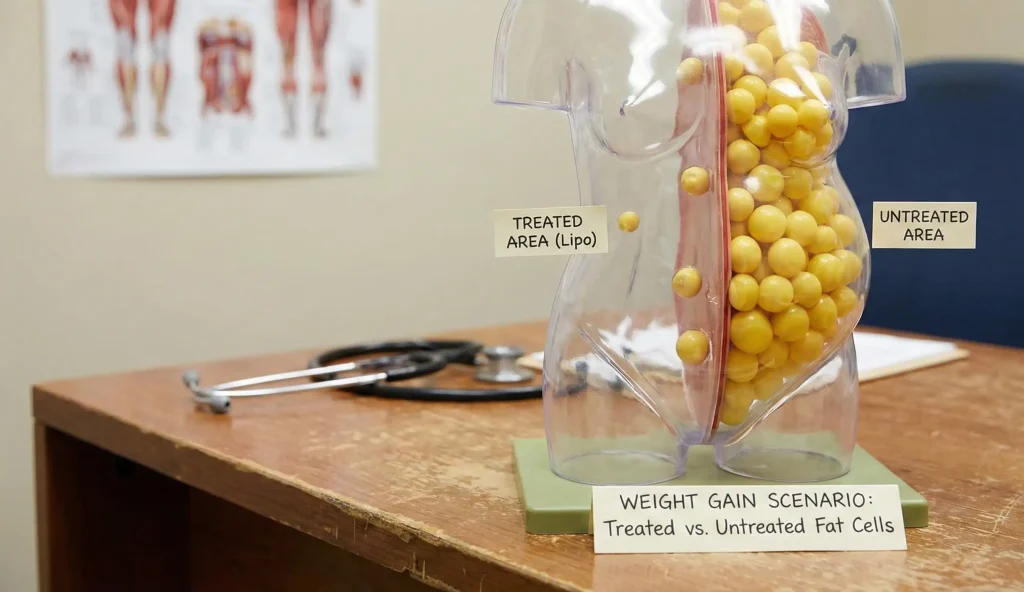
To grasp what a long-term result means, you need to understand what fat cells (adipocytes) really are. When you are a child and then a teenager, your fat cells can multiply. Once you are an adult, their number is fixed. Instead of generating new fat cells when you gain weight, your existing cells (just like balloons) become bigger (hypertrophy). The opposite happens when you lose weight: they become smaller, but they never vanish.
Liposuction changes the situation completely and forever. The operating doctor removes fat cells by means of suction and hence the total number of fat stores is reduced only locally. If for example, 70% of the fat cells from your abdomen are taken out, they are gone forever. New ones will not grow there to replace them. Thus, the part of your body that has previously been the subject of “trouble” will remain in a way a kind of “safe haven” even if you unfortunately gained weight later on. Your “problem area” is simply eliminated.
The Weight Gain Dilemma: Where Does the Extra Fat Deposit Then?
The main long-term risk of the resulting major changes is not that the fatty tissue returns in the same way in a treated area or that the fat cells swell up. Actually, fat redistribution is the problem. After a diet or surgery, if the caloric intake still surpasses the expenditure, the body will inevitably store that extra energy one way or the other. Since the “bank accounts” (fat cells) in the stomach have been closed by the surgeon, the body will thus take advantage of the ones that have remained in the untreated areas.
Long-term investigations demonstrate that patients who gain a considerable amount of weight after liposuction notice the accumulation in different areas than the initial parts such as the upper arms, back, or thighs. In the more alarming cases, the extra energy may be stored by the body as visceral fat. This is the fat which lies hidden in deep inside the belly and it is also the one that can pose the greatest risk to your health. It can lead to a protruding or hard abdomen (the “beer belly” look) even when the subcutaneous fat layer is very thin. It goes without saying that the rule of the game is very simple: liposuction changes the appearance of the body, but only a stable diet will keep that body as such.
The Aging Factor: Skin Elasticity
Fat removal is forever, but the skin covering it is definitely not time-resistant. One of the most underrated effects beyond the short-term ones that liposuction can bring is the ptosis of the skin in the operated area. Generally, youngsters with highly elastic skin can expect an excellent opportunity for their skin to come in contact with their new muscle contours.
On the contrary, when a person hits their fifties and sixties, the production of collagen naturally declines (along with many other things). This means that if there had been a huge fat removal long ago, the issue of loose or crepey skin in the same area could be noticed much sooner as compared with other parts of the body because that skin lacks the support of fat. This is the reason why we hesitate to do an aggressive “High-Definition” liposuction to an older patient; it is essential to leave a small layer of subcutaneous fat for a skin that is young and tender to last for more years.
Metabolic Changes: A False Sense of Security?
Some people mistakenly believe that liposuction is a cure for their slow metabolism. The explanation is that, even if you get rid of a large volume of fat through liposuction, it won’t particularly improve your metabolism. This is because subcutaneous fat (the fat that liposuction removes) is biologically different from visceral fat.
In view of the above, if you are suffering from insulin resistance or other metabolic problems, it is pointless to think that surgery can solve them for you. You are at risk of developing metabolic syndromes if you keep eating the wrong way and use the illogical argument “lipo fixed my fat” just because you look thinner. The health of the body has to be looked after from the inside, whereas the surgery only deals with the external part.
Long-Term Planning in Turkey
At Lin Europe Clinic in Turkey, we regard liposuction as a joint venture. We carry out the surgery skillfully to create the physical outline you desire, but the upkeep depends solely on you. During the consultation we assess your potential risk factors. If, for example, you have a history of “yo-yo dieting,” a nutritional plan might be suggested as your companion to the operation.
Another thing we do is thinking about “future you”. We refrain from over-resection which can cause an aged or unnatural appearance when one ages. We aim at achieving a natural look today that befits the person ten years from now without any signs of “lipo-irregularities” that are typical of overly aggressive surgeons.
Frequently Asked Questions About Long-Term Results
No. Actually, if done recklessly, taking out the deep fat layer can remove the support and hence worsen surface cellulite or even make the skin appear more dimpled with time.
Usually mature adults do not generate new fat cells. On the other hand, the remaining fat cells are capable of expanding without any limit. So although the cell count doesn’t vary, the quantity of fat can still go up if you overeat.
Indeed. Suppose after lipo you put on weight and your body decides to store it as visceral fat (around the organs). In this case, your risk of diabetes and heart diseases gets elevated even if you appear quite slim on the outside.
Not really. Yes, pregnancy does stretch the skin but the fat cells that were taken out of the abdomen will never come back. Several women observe that their post-pregnancy figure comes back to the contoured shape quicker if they had lipo before, as long as they don’t put on too much weight.
Eventually, the skin retraction takes about 6 to 12 months. In the long run, the best ways to keep the skin from getting loose or wrinkly over the treated spots are to maintain a stable weight and stay hydrated.
Hernandez, T. L., et al. (2011). Fat redistribution following suction lipectomy: defense of body fat and patterns of restoration. Obesity.
Swanson, E. (2012). Prospective clinical study of 551 cases of liposuction and abdominoplasty alone and in combination. Plastic and Reconstructive Surgery.