
Fat removal is permanent, but weight gain affects results.
It’s really the top concern that keeps people up at night before getting liposuction: I am investing a lot of money, time, and energy into recovering and looking great, only to ruin it all by slipping up once, right? A widely spread misconception suggests that the body “remembers” its previous form and if a burger is eaten post-surgery, the fat will somehow find its way back to the stomach and erase the surgeon’s work in a moment.
The truth is somewhat yes and no. Theoretically, the surgery remains permanent as the specific fat cells which are extracted are totally removed and can’t regenerate. Nevertheless, from a biological point of view, your body is still a living organism and a highly sophisticated energy-collecting-storage system that will save more food if you overfeed it.
So, if you decide to bulk up after liposuction, you certainly will gain weight, but the area of fat accumulation will be different than before. At Lin Europe Clinic, we think it’s highly beneficial to be able to understand your “new fat distribution pattern” as a means of keeping the results and not regretting liposuction.
The Science: You Cannot Grow New Fat Cells
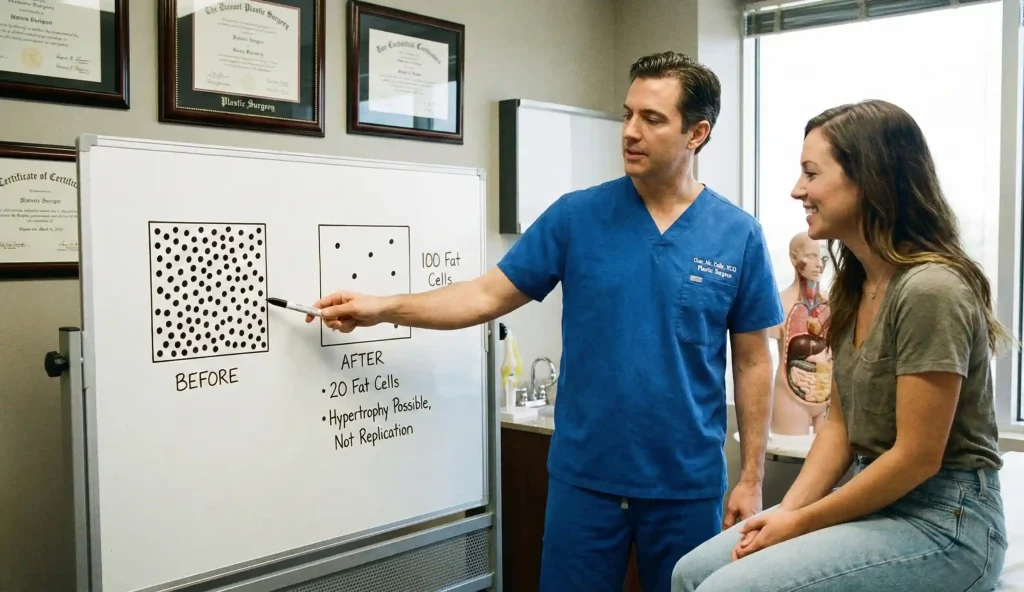
Firstly, liposuction is a permanent way of getting rid of fat, just think about it: The cells don’t just disappear and come back; a fat cell (adipocyte) typically lasts quite a long time.
- First stage: During childhood and teenage years, the number of fat cells grows to suit the size of the body (hyperplasia).
- Later stage: After 20 years, it’s difficult to add more fat cells to your body as your fat cell number is basically frozen. When an adult gains weight, it is not through new fat cells, the existing ones are just filled up and enlarged (hypertrophy).
Liposuction changes the equation permanently. Roughly 3 liters of fat (which equals around 20 pounds) removed by the surgeon mean that the surgeon has extracted physically extracted billions of those “balloons.” Your body does not possess the tools to make new ones to compensate for the loss. So even if you put on 12 pounds (5 kg), you will have a lot less “balloon” in your stomach area to fill up. That area will forever stay flatter and more sculpted relative to the rest of your body than it would have been without the intervention.
The “Redistribution” Effect: Where Does the Fat Go?
Now, this is the rub! The fat can no longer be put on your belly just as a matter of fact, it doesn’t just vanish. When you consume more calories than needed, that energy needs to be stored. Because the surgeon basically closed down the “main street” of waistline fat storage, your body has no choice but to open up new “branches” in other regions.
This is what the medical community calls “fat redistribution”. If you decide to put on a lot of weight (over 10% of your current weight) by the time the fat around your abs might not change much, the rest of your thighs, upper arms, back, or even breasts may become much larger than usual.
The fat takes the easiest route. This may eventually result in an uneven figure—some people even say things like “lollipop arms” or “heavy legs”—where the trunk has a fit look, while the limbs are heavy-looking.
The “Texture” Risk: Why Weight Gain Looks Worse
Even if you don’t really care about getting bigger in other parts of the house, shedding some that treated area weight poses a particular risk: Texture Irregularity.
Under the skin, a layer of fibrous scar tissue develops after liposuction. Such tissue is not elastic, and thus, it does not stretch easily. Therefore, if fat cells in this spot expand a lot after eating too much, they will press against the network of scars which is stiff. This pressure caused by the push of fat cells onto the non-stretchable fibrous tissue could be responsible for the superficial skin breakdown appearance of “cobblestone” or “wavy.” If you absolutely want to keep your smooth lipo result, don’t let the remaining fat cells get quite that big, or the resulting weight gain will visually and structurally look worse compared to a non-surgical situation.
The “Hunger Trap”: Metabolic Defense
This is something you might want to also take into account: your body is releasing hormones upon a drastic fat loss which will indicate to the brain a low energy status. Fat cells secrete leptin which is a hormone that signals satiety to brain. After extracting 3-4 liters of fat, leptin level will be temporarily decreased.
Hence, the brain then reacts to it as if it were “starved,” which is why for several months it might increase production of hunger hormones (Ghrelin) and therefore, the urge would be there to compensate by overeating. This constitutes the “Hunger Trap.” Several patients might notice that during their recovery, an increased desire to snack appears. Knowing that it is simply a hormonal thing can help you overcome that inclination and maintain your diet till normal levels are restored.
The Danger of Visceral Fat

Visceral fat accumulation presents a much greater health threat than just an aesthetically unbalanced body. Subcutaneous Fat (the pinchable soft fat we eliminate with lipo) is metabolically different from Visceral Fat (a dangerous, firm fat surrounding the organs inside the body).
According to research, if after the large volume liposuction, one continues to be inactive and eat excessively, the body will preferentially convert any extra energy into internal storage as visceral fat. This creates a scenario when the patient would look thin from an outside perspective (thin layer of skin and fat) but develops a hard, distended belly (bloated look) due to the internal pressure. Such fat can neither be evacuated with a cannula nor is it even visible; diet and cardio exercise are the only known ways of reducing it.
The “10% Rule” for Maintenance
The “10% Rule” is a guideline we frequently talk to our patients about regarding the management of their expectations.
- Living Area: Weight changes within a 2 to 4 kilograms (or about 5% of your total body weight) range are generally considered normal human behavior. They won’t jeopardize your results. Any existing fat cells will only be slightly larger, plus the newly attained shape will still be noticeable.
- Risk Area: As far as the aesthetic success is concerned only, exceeding 10% body weight gain brings about the destruction of the result. At this stage, the capacity of the remaining fat cells is fully exploited and the body chooses to deform the treated parts or to store fat in other body parts thus creating the so-called “lumps and bumps” or even a boxy shape.
Realistic Expectations in Turkey
At Lin Europe Clinic in Turkey, the concept that liposuction is primarily a body shaping procedure rather than a weight loss method is strongly stressed. It is not a magic tool to fight against calories but a “reset switch” of your problem areas. Patients with a history of “Yo-Yo Dieting” are intensively tested by us before undergoing surgery.
If becoming and staying at a certain weight has always been a struggle for you, then maybe a consultation with a nutritionist or an endocrinologist before surgery would be advisable. It is preferable to treat your new body as a luxury sports car that has been gifted with a high-performance upgrade, but even then, you will still need to put the right fuel in it for it to run smoothly and sleekly.
Frequently Asked Questions About Weight Gain
Not to a similar extent, because most of the cells in that area have been removed, so that area will always be smaller than before. However, since the remaining cells can still grow, if you gain a lot of weight, you will be able to increase your thickness in that area only slightly.
Of course, but the re-operation hardly accomplishes anything in areas with scar tissue (fibrosis) from the previous lipo that is painful, full of discomfort, and carries a higher risk of irregularities. If you want to get rid of the fat, it is always better to do it naturally than try to “lipo it off” for the second time.
Not true at all, because muscle and fat are biologically two totally different tissues. When you stop working out, your muscles shrink (atrophy), and when you overeat, your fat cells increase in size, but neither turns into the other physically.
After gaining weight, the fat cells left in your body can grow in a somewhat uneven manner. A doctor maybe only left one tiny area of fat which might be a little more than another (which is not noticed when you are slim), and then, by the enlarging cells, such difference becomes very obvious.
There is no “lipo diet” that can give you instant results, but high-protein and anti-inflammatory diets can be very effective for tissue healing. In the long run, you simply need to maintain a caloric balance (Calories In vs. Calories Out) that does not allow the storage of extra energy.
Hernandez, T. L., et al. (2011). Fat redistribution following suction lipectomy: defense of body fat and patterns of restoration. Obesity.
Fodor, P. B. (2009). The biology of fat cells and the impact of liposuction. Aesthetic Surgery Journal.
Benatti, F. B., et al. (2012). Liposuction induces a compensatory increase of visceral fat which is effectively counteracted by physical activity: a randomized trial. Journal of Clinical Endocrinology & Metabolism.