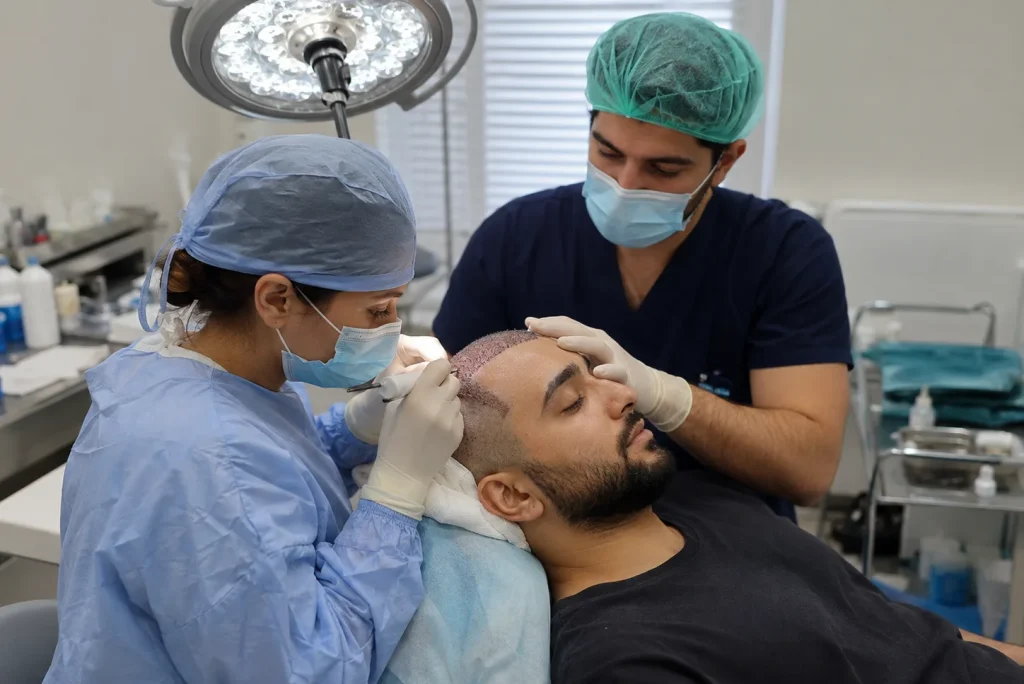
Crown hair usually grows within 9–12 months.
The Biology of Vertex Hair Regrowth
At a very advanced level of trichology and surgical restoration of hair, one has to deal with a lot of different scalp issues if one wants to keep the hair on one’s head at the right length. It also makes sense that, after getting a hair transplant in the crown, this part gets restored last compared to the hairline. Clinically speaking, it can last from 1 up to even 1.5 years before the hair grafts on the crown show their full potential. While the top of the head and middle-scalp areas are able to show good growth from months 9 to 12, the crown has to wait longer for this result.
The Reasons for the Delayed Growth
These are anatomical and biological factors mainly for the fact that it takes longer to achieve good growth in this area:
- Reduced Micro-Blood Vessel Density: The scalp in the vertex area is less thickly supplied by blood vessels at the top of the head than in other areas. As a consequence, the process of neovascularization (formation of new blood vessels by the hair follicles), through which newly transplanted hair follicles have to get their survival nutrients, will take more time and, as a result, the transition of the root hairs from resting phase to the active growth phase will be delayed.
- Thick Scalp Layer: The crown skin is thicker and tighter compared to forehead skin. Such an increased dermal level will naturally demand more time for internal healing, microvascular integration, and hair shaft emergence.
- Turning Pattern (Spatial Geometry): It can be said that hair in the crown runs naturally in circles or whirls. In order to reconstruct the multilinear hair pattern in the vertex area, precise angle placement is necessary. Since hair in the crown radiates outward instead of being laid in the same direction as in the case of a hairline, more hair and much longer hair shafts are required so that hair covers the skin area well visually without the scalp being seen.
Donor Area & Healing Care Post-Operation
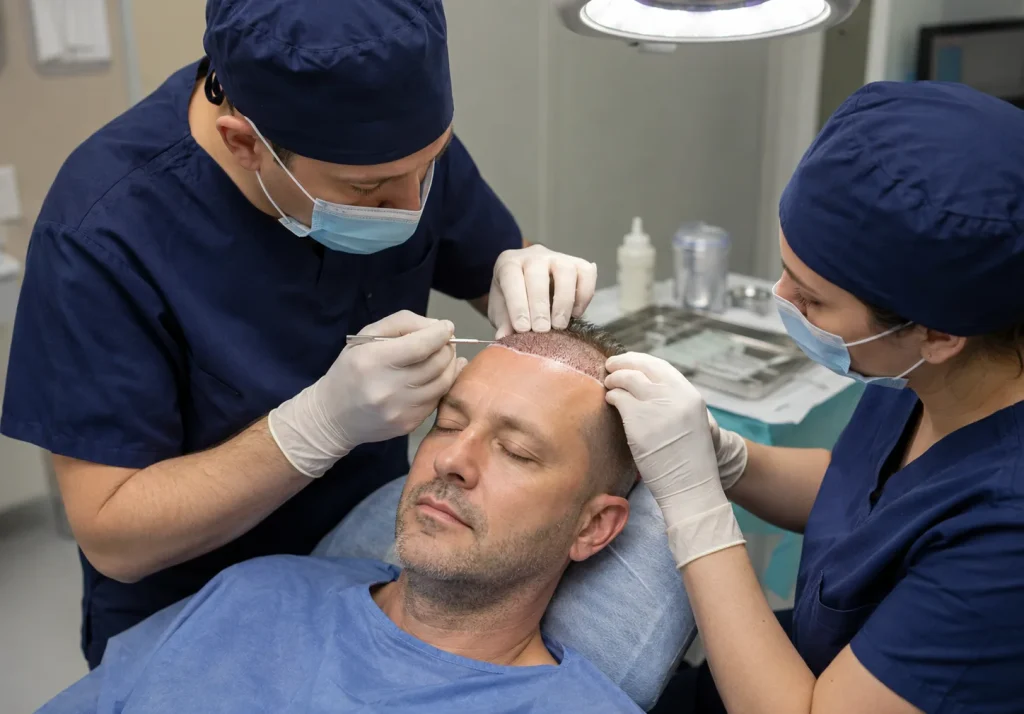
It is the key aspect for the post-operative period to be very cautious about activities that may negatively affect the healing process and the donor area and the grafts in particular, if the person is after a near-perfect hair restoration of the vertex at an uncompromised level. During the early healing phase, the area of the head that receives the grafts is more vulnerable as it is exposed to friction from sleeping or resting.
Forcing premature engagement with heavy physical movements or neglecting targeted care procedures, in fact, brings a harsh biological cost. This is so because the newly placed grafts might be knocked out, microvascular supply networks might be damaged, and donor area closure might be delayed. So that the grafts fix in place at the structural level with high precision, you must sleep with the head raised on a supportive travel pillow throughout the first 10-14 days to avoid direct touch between the crown area and your mattress. Moreover, you should never scratch, pick at tiny crusts, or wear tight hats or helmets.
Timeline for the Maturation of Crown Hair Transplants
Mindful recognition of hair development in crown hair allows you to monitor with absolute ease your restoration progress as initial dormancy gradually gets converted into dense hairy coverage:
- Months 1–3 (Shock Loss and Sleepiness): After the initial scabs are gone, roughly by day 10, the transplanted hair shafts will start to thin gradually. Shock loss can be seen as an entirely typical reaction to surgical intervention. The hair root beneath the scalp continues to stay securely attached, but it has become dormant, so to speak.
- Months 4–6 (First Hair Shows Up): Fine, hairless, and white hair begins to emerge on the scalp in the crown area. It probably looks patchy or sparse. It should be considered to be merely about 20%- to 30% of the total number of grafts.
- Months 7–12 (Hair Strengthening & Growth): The speed of hair growth will be the fastest from this point on. The hair strands will become thicker, darker, and reach out to the hairs. About 70% to 80% of all that could be visually perceived is visible by month twelve of the whole project, and the crown part still grows.
- Months 12–18 (Hair Full Thickness & Spiral Finish of the Crown): The hairs will have the full structural and mature qualities and texture on the scalp. The natural spiral pattern of the hairs will settle into place at this moment and provide complete, dense coverage of the entire area of the crown.
Hair Transplant in Turkey
Going to LIN Europe Clinic will give you access to an unparalleled international destination in terms of top-notch healthcare that is also very warm and supportive, where your needs, concerns, and aesthetic preferences regarding the hair will be taken into consideration, and your follicular reconstruction with hair density will be carried out with the highest level of technical accuracy while showing deep empathy towards your needs. We know that it is very difficult, time-consuming, and painstaking to master the harvesting angles precisely, the crown hair pattern rebuilding, and the post-operative phase protection for achieving the ideal hair restoration results.
Therefore, we offer you the chance to work within an environment that is technically the most advanced, completely transparent, and yet very nurturing so that evidence-based medicine is at the very heart of our work. By putting your complete trust in our exceptional specialist team at LIN Europe Clinic in Istanbul, it means not only that we will track and control your hair follicular conditions at the very diagnostic level, which is beyond a doubt, but also that we will support you step-by-step through the entire process, including your recovery, lifestyle adjustment, and growth of the hair.
FAQ:
The natural supply of the crown area is less abundant blood and the skin is much thicker. This will slow down the establishment of new micro-vascular networks of the hair follicles at the point and delay the entrance of the follicles to their growth phase.
Usually, the hair first comes out in the form of small, soft filaments, beginning around the 4th or 5th month. A big increase in density is noticed during months 8 to 12, and the finishing results usually happen between 12 and 18 months.
Yes, you will have the same feeling. As 6 months is not even halfway through the whole process, 30% to 40% of the new hair on your head is all that will be visible. Since the scalp on the top of your head (crown) usually heals slower than the front part, you need patience during the first few months.
During the first 10 to 14 days, you are not to lay directly head-first to a surface, which can displace and break the tiny grafts. So, keeping your head off the ground during sleep would be advised in this period of time. A neck or a travel pillow is very useful.
In experienced hands of the professionals who perform hair transplants, there is almost no difference in graft survival between two areas of hair. In fact, the survival rates for both are about 90-95%. However, because the hair growth of the crown is usually a circular spiral rather than linear in direction, much more grafts and a great hair length are needed to give the visual coverage that one sees at the hairline if it is hair that is being transplanted on a crown.
Rassman, W. R., et al. (2002). Follicular Unit Extraction: Minimally invasive surgery for hair transplantation and vertex restoration kinetics. Dermatologic Surgery, 28(8), 720-728.
Umar, S. (2011). Hair transplantation to the crown: Spatial orientation, whorl dynamics, and long-term maturation timelines. Facial Plastic Surgery Clinics of North America, 19(2), 339-354.
Rohrich, R. J., et al. (2014). Advanced postoperative care, micro-vascular scalp perfusion, and tissue integration in hair restoration surgery. Aesthetic Surgery Journal, 34(5), 587-595.