Yes, for many patients with moderate hair loss.
The Surgical Calculation of Grafts
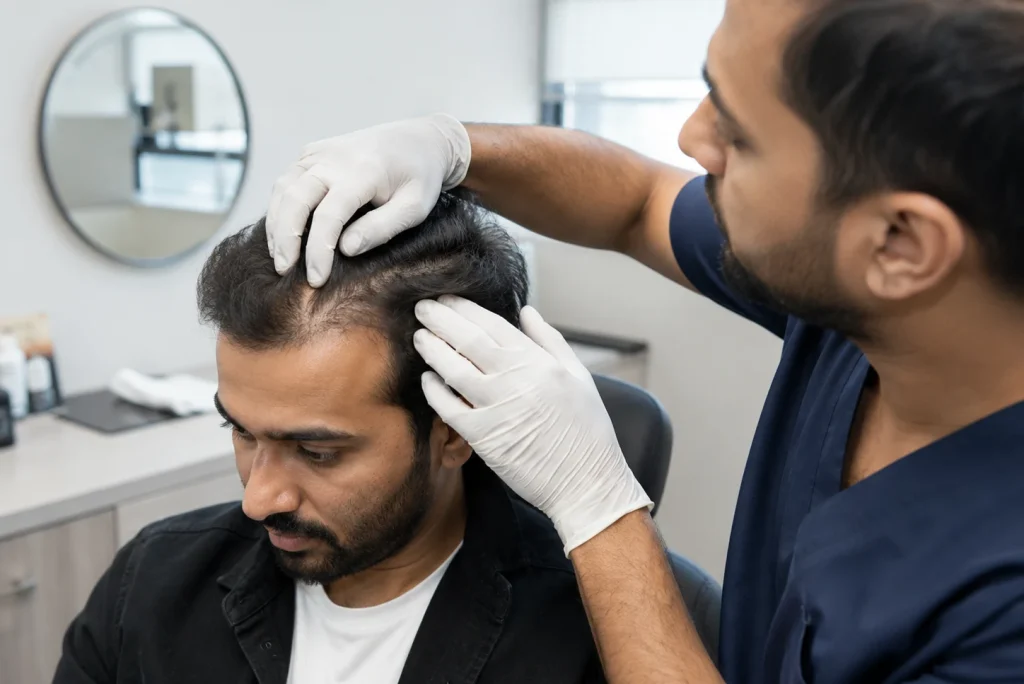
An accurate diagnosis and good surgical planning are essential for hair restoration and will help to decide the optimal number of grafts to be transplanted during a single session. From an academic perspective, the answer is yes: under moderate hair loss, with plenty of grafts in the donor area, you may expect that 3,500 grafts would be enough to cover both the hairline and the vertex in such cases. Still, your team of hair surgeons has to be very cautious in their distribution of the grafts because of the limiting number of 3,500. A natural, youthful appearance can be created by first making a dense, frame-like rim of hair along with a gradual blend towards the crown area.
Front vs. Vertex: Where More Grafts Will Be Allocated
When the limited number of grafts (i.e., 3,500 grafts) is going to be allocated to the different parts of the scalp for optimal results, surgical specialists make a visual and mathematical assessment of the priority:
- The Hairline and Above (2,000 to 2,500 Grafts): As hairline is the most important aesthetic aspect because it frames your face and is seen the closest during the conversation or pictures, naturalistic hairline is achieved only when there is quite a high density, e.g., around 45-50 grafts per square centimeter, of the hairs along the edges (mainly singles) and also in the back (mostly doubles or trios) creating the structural density.
- The Crown/vertex (1,000–l,500 grafts): The spiral pattern of the hair on the crown necessitates a large number of grafts to fully cover a bald vertex spot, and hence shading will be the primary method by which scalp visibility is minimized in a crown region through the use of hair transplants. It is important to note that the baldness at the vertex will disappear due to the use of shading, but it may not be as dense as the hair that you had in your teenage years.
3,500 Grafts Can Be Sufficient or Not
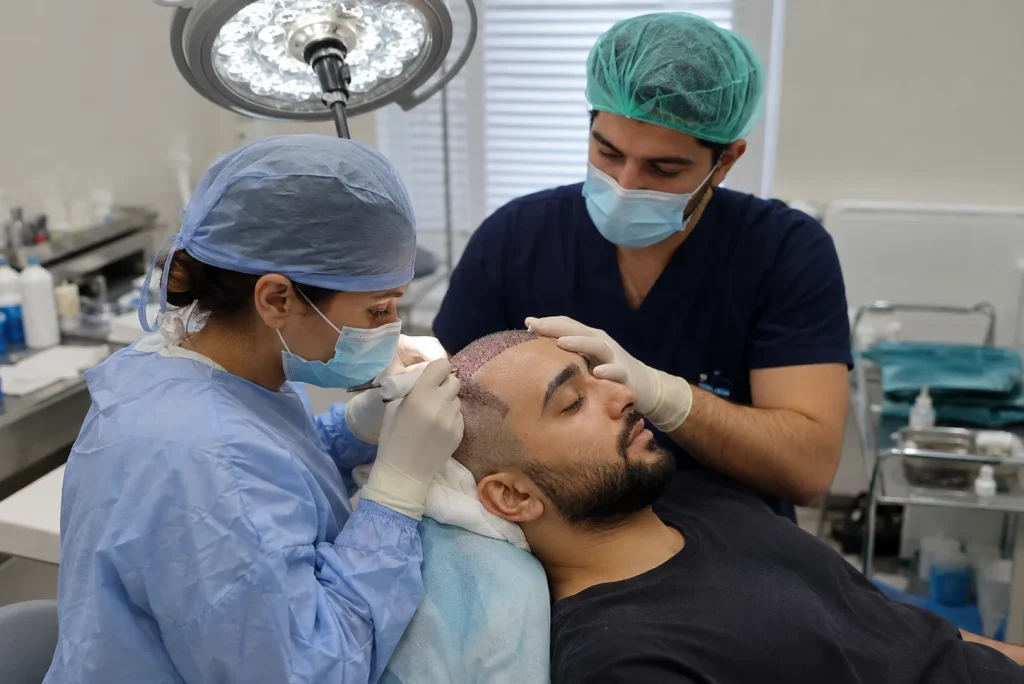
Several key variables besides the sheer number of grafts determine the outcome as to whether 3,500 grafts are enough or not. These are:
- Thick or Coarse Hair Shafts: Compared to fine and thin hair of a patient, a person with thick or coarse hair needs fewer hairs to cover the scalp surface due to the fact that the light reflected from the hair is blocked much more effectively by thick hair shafts.
- Hair Texture and Color Contrast: The coverage from wavy or curly hair is better since the natural bend of hair shafts gives them more surface area to cover. A person whose hair color is more similar to the skin tone of the scalp will find that the hair transplant result looks much fuller visually when the graft count is limited to 3500; that is, there is not much color contrast.
- Donor Reserve Health: Extracting a large number of grafts, say 3500 in one FUE/DHI surgery, demands a healthy donor area that is mainly located at the back and sides of the head. Preventing over-harvesting ensures the back of the head remains natural-looking, besides keeping the donor zone healthy.
Maintaining the Viability of the Follicles and Observing Rules of Behavior
Strict observance of both preventive and behavioral measures after the surgery is a basic requirement for those who are very particular about getting top-quality results out of their hair reconstruction. Spreading out almost 3,500 follicular units over a vast area means hundreds of very tiny wounds on both the front and the back of your head. To the extent you ignore the post-operative protocols or push your physical condition to its limit, such as engaging in activities that result in skin abrasion, or failing to care for micro-crusts, which are a part of the healing process, you are actually penalizing your body’s physiology in the following ways: dislodging the hair grafts, damaging the small blood vessels that supply the newly transplanted hair follicles, or delaying healing of the donor area. Thus, to ensure that your follicles are well implanted structurally, you need to sleep with your head above your body by means of an inflatable travel pillow for 10-14 postoperative days so that the grafts do not come into contact with your bed.
Hair Transplant in Turkey
If you are selecting LIN Europe Clinic, you are choosing to work with a world-famous group of hair experts who will help you achieve the aesthetic and functional goals of hair restoration through a combination of medical skills, empathy, clinical excellence, and patient care. We strongly believe that the whole process of hair harvesting at accurate angles, graft redistribution according to the patient’s anatomy, and protective post-operative care are demanding aspects that require from the hair surgeon and patient a high level of understanding, openness, and teamwork.
We can give you our absolute guarantee at LIN Europe Clinic, Istanbul, that your hair restoration process will be followed carefully in terms of the level, density, and condition of your hair with the utmost medical precision and attention to detail. We offer a series of diagnostic scalp preparations on a large display for patients, and we provide the patients with healing plans for each phase of their lifestyle. We are not only a hospital that has the most competent medical professionals, but we also make sure that all the cosmetic and health investments of our patients are protected and their lives are as normal as possible.
FAQ:
3,500 grafts is a good estimate for hair restoration of moderate hair loss (Norwood Stage 4 to 5). The hairline will be the focal point for the graft use with about 2000-2500 grafts and the rest, about 1000-1500 will be used on the crown.
3,500 hair grafts can supply as many as 7,000 to 9,000 hair hairs. This quantity can be spread over up to 70 to 90 square centimeters of the thin or bald scalp area resulting in natural dense hair.
In cases of total baldness covering the entire crown, you might need a higher number of grafts. 3,500 may not give 100% coverage at both regions. Your surgeon might first focus on the front hairline and then consider the crown for a second session.
If harvesting 3500 grafts from a healthy donor area of sufficient thickness, the back of your head should still appear dense and natural regardless of the methods used.
It requires a lot of care, concentration and detail to do 3500 hair graft session. Usually, it takes around 8 hours with the patient being under local anaesthesia for this operation.
Rassman, W. R., et al. (2002). Follicular Unit Extraction: Minimally invasive surgery for hair transplantation and high-density graft distribution parameters. Dermatologic Surgery, 28(8), 720-728.
Umar, S. (2011). Strategic distribution of limited donor reserves in extensive hair loss: Balancing hairline framing and vertex coverage. Facial Plastic Surgery Clinics of North America, 19(2), 339-354.
Rohrich, R. J., et al. (2014). Advanced postoperative care, micro-vascular scalp perfusion, and tissue integration in hair restoration surgery. Aesthetic Surgery Journal, 34(5), 587-595.