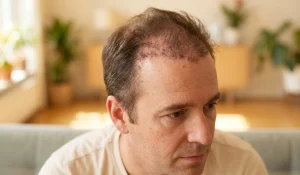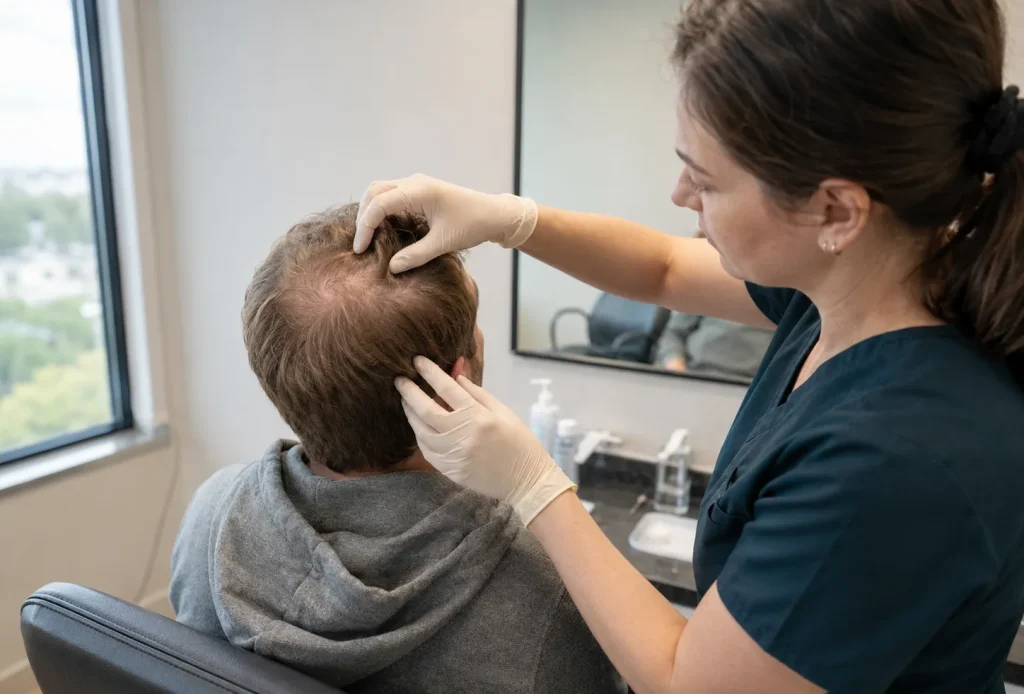
FUE hair transplant leaves minimal visible scarring.
Hair Restoration with “Zero-Scar” a Myth
A natural, thick hairline without any scar is indeed among the foremost considerations for patients around the world. Therefore, when searching for a surgical intervention, they very often inquire about the hair transplant methods that do not leave the slightest marks. From the point of view of medicine and surgery, it is not possible for any procedure that causes breaking of the skin to be completely scar-free, but through Follicular Unit Extraction (FUE) or even a more recent method, which leaves virtually undetectable hair restoration with micro scarring.
Outmoded hair transplants – mainly Follicular Unit Transplantation – left a permanent scar in a continuous horizontal line by incising the scalp through a wide strip of the rear head. Revolutionary micro extraction techniques have given a new dimension to the surgical world through replacing those lengthy straight incisions with microscopic, almost invisible, dot-like extraction channels. Even when the patient cuts the hair very short, these minute wounds have blended so well that they are totally out of sight.
Micro-Harvesting Technologies for Hair Transplantation: FUE vs. DHI
It is impossible to overestimate the extent of damage that even the smallest scar on the hairline can cause, so it is essential to be well-educated about this issue before deciding on the surgical procedure to opt for.
Let us look at the two latest and popular micro-hair transplant techniques:
- Follicular Unit Extraction (FUE): A surgeon takes each donor hair (a follicular unit) separately with the aid of a special mini punch drill (approximately 0.7mm – 0.9mm in diameter) used in this procedure. As these very tiny holes on both sides and the back of the head (the donor zone) are randomly distributed throughout the scalp rather than being along one line, they become microscopic white points that heal and integrate seamlessly with the surrounding scalp skin.
- Direct Hair Implantation (DHI): This is a development in the FUE technique. Micro-FUE is used for graft harvesting, while implantation is performed by an instrument called the Choi implant pen. This tool enables both steps (recipient site preparation and graft implantation) to be made at the same time, thus avoiding the need to first cut small recipient slits. By doing this, scalp microdamage is drastically reduced.
Donor Site and Recipient Area Management Post-Transplantation
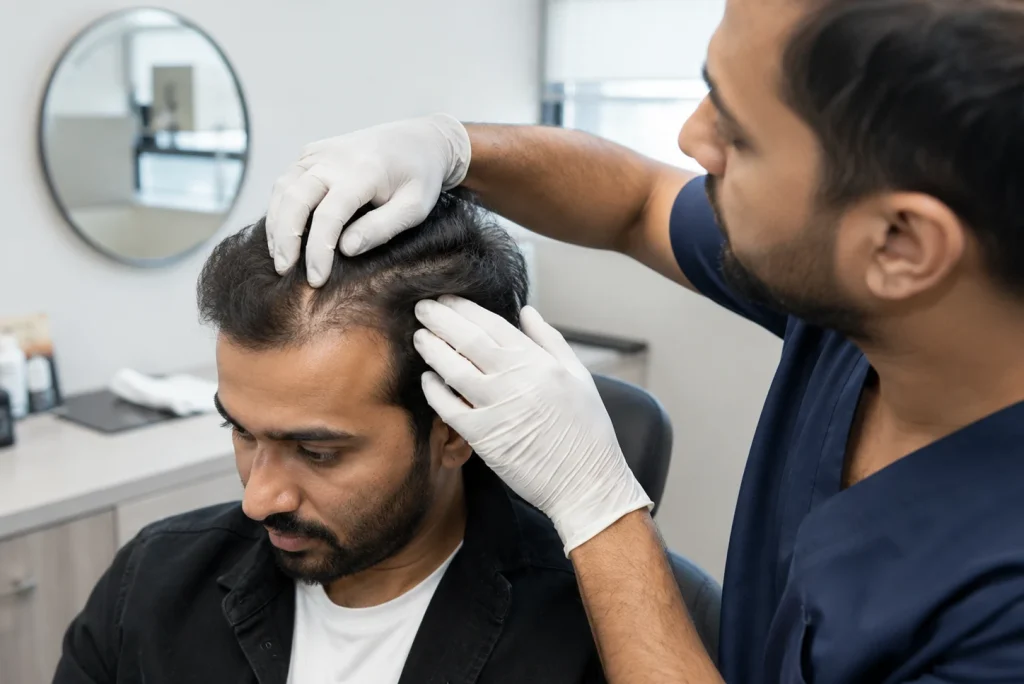
If the tiny puncture sites made by FUE or DHI are not allowed to heal properly through strict adherence to postoperative guidelines, a very dedicated person who wants perfect hairline restoration will not achieve satisfaction. Donor holes and hairline area closures are not a question of cosmetics alone. It is about the survival of hair transplants. Micro-trauma introduced by early physical activities, friction to the skin, and disregard for prescribed care plans is very detrimental from a biological point of view – it can lead to loss of hair, delayed healing, or even scarring.
To be certain that your repositioned hairline is structurally accurate and remains so over time, you have to keep your head lifted when sleeping using a travel pillow for the first 7-10 days of the recovery period. You must totally avoid behaviors like picking at micro scabs, scratching, or even putting on caps which can be tight or heavy. Moreover, smoking must be totally banned. Tobacco has a strong systemic vasoconstrictor that is very fast in reducing the microvessels in the scalp. This effect deprives the newly transplanted hair grafts of the very essential oxygenated blood and nutrients they need for survival as well as clean skin closure.
Donor Maturation and Dermal Healing Timeline Hair Transplant in Turkey
Familiarizing yourself with the body’s healing process of the scalp will enable you to clearly see the progress of your hair restoration as micro-crusts gradually shed and your donor site stabilizes:
- Days 1-5(Acute Dermal Healing): Around each point of extraction on the donor site, small blood clots are forming. Local redness and some edema of the forehead and eyes reach their peak first, then start to get better.
- Days 7-14 (Scab Shedding and Micro-Scar Formation): Washing the head gently with a special shampoo or a product recommended allows scabs and micro-cracks to come off naturally. Extraction sites underneath are becoming very small, pink, and quickly fading.
- Months 1-3 (Shock Loss and Silent Dormancy): At about 4 weeks, a large part of the transplanted hairs fall out (temporarily, of course) – it is the so-called ‘shock loss’. While the hairs above the skin have shed, the follicles beneath the skin remain untouched, and they are resting for a while.
- Months 4-12 (Final Invisibility and Growth Phase): The growth of the newly grown hair begins at a speed of roughly one centimeter a month, and in 12 months, they have reached full volume, and you won’t see a trace of donor site surgery, not even if you get a fade or very short haircut.
hair transplant in turkey
Choosing LIN Europe Clinic means that through a state-of-the-art global medical facility dedicated to you, your hair aesthetic goals, high-density follicular restoration, and your surgical pathways will be executed with unbreakable clinical excellence and deeply human care. We acknowledge very clearly that in order to perform a truly flawless, natural-looking hair restoration that is hardly noticeable, the precision of harvesting angles, implantations with the Choi pen, and care to prevent scars post-operation are all aspects that require a highly sophisticated, transparent, and supportive environment. Our medical facility in Turkey is one of the best in the world for hair restoration.
Entrusting us completely to care for your hair transplant with the help of the specialists we have at LIN Europe Clinic in Istanbul will lead to you being able to have every follicular feature of yours monitored without exception in the most accurate medical terms possible and to have a perfect cosmetic result in a medically secure way. You get high-quality hair restoration and medical aftercare with us, and at the same time, your general condition is well supported by us and your safety is our foremost concern. With LIN Europe Clinic, you can feel the difference only when the results are good. In Turkey, we safely and masterfully hand down the most refined hair restoration techniques.
FAQ:
There isn’t a 100% scar-free hair transplant surgery. However, with FUE (Follicular Unit Extraction) and DHI (Direct Hair Implantation), only very small, dot-like scars are left that are difficult to notice even when hair is very short.
It is very different from the old FUT “strip” technique where the donor hair was harvested in a strip of skin and then left a linear scar. Instead, FUE takes out individual hair follicle units a bit at a time using a miniaturized rotary punch (0.7mm–0.9mm). The points of this tiny extraction are not healed as a single, long scar, but as small scattered micro-points.
There shouldn’t be a visible difference, as both types of hair transplants leave just micro-dots that are virtually invisible. The difference is that, while with FUE, a doctor creates small openings (so-called slits) for hair transplant, DHI doctor uses a special tool, i.e. a Choi Implanter Pen, that doesn’t make the recipient site visible to the eye, and this leads to even less surface injury, specifically in the hairline area.
Yes, it is completely possible that the micro-scars from either an FUE or a DHI operation will show up only as scattered dots over the scalp’s back side, so most patients are capable of wearing very short styles such as grade 2 or 3 buzz cut without any hint of the surgical mark.
Generally, scars at the donor site heal quite fast. The pinpoint scabs fall off within 7 to 10 days, while the slightest redness following surgery in donor area is gone completely in 2 to 3 weeks. The scalp’s back skin looks natural again.
Rassman, W. R., et al. (2002). Follicular Unit Extraction: Minimally invasive surgery for hair transplantation. Dermatologic Surgery, 28(8), 720-728.
Unterschutz, A., et al. (2019). Comparative analysis of FUE and DHI harvesting tools: Evaluating donor trauma, micro-scar dimensions, and transection rates. Journal of Cutaneous and Aesthetic Surgery, 12(3), 145-152.
Rohrich, R. J., et al. (2014). Advanced postoperative care, micro-vascular scalp perfusion, and tissue integration in hair restoration surgery. Aesthetic Surgery Journal, 34(5), 587-595.