Usually after 1–2 weeks.
For a lot of patients, the surgery itself is certainly the easiest part; the most challenging aspect of recovery is often the sleeping arrangement. If you are a natural side-sleeper or a dedicated stomach-sleeper, being forced to sleep on your back, propped up like a statue, might be a real torture for you. It completely disrupts your natural sleep cycle, can cause lower back stiffness, and you might suffer from a restless night. Obviously, one of the most common questions we get at the one-week check-up is, “When can I just lie down normally?”
Briefly, the answer is you need to sleep elevated (at a 45-degree angle) for the first 2 to 3 weeks. Usually, you won’t be allowed to sleep completely flat on your back until the 3rd or 4th week, and side sleeping is absolutely not allowed until week 6. These guidelines are not only comfort-related rules but are also based on fluid mechanics and the biology of pocket formation. At Lin Europe Clinic, we stress that gravity is really like your surgeon’s assistant during recovery. If you use it right, it can hasten your results; if you struggle against it, you may prolong your swelling and even have your implants shifted.
Phase 1: The “Throne” Position (Weeks 0–2)

You must be lying on your back, propped up on pillows or a special wedge, at a 30 to 45-degree angle, for the first 14 days. This elevation is essential because gravity is the most effective way to drain fluid from the surgical site. After the surgery, your chest is most probably loaded with inflammatory fluid as well as the tumescent liquid used during the operation. When you lie flat, the fluid pools in the breast pockets which results in an increase in the internal pressure and pain. When you stay in an upright position, you facilitate the drainage of that fluid into the lymphatic system of the torso, which leads to a considerable reduction in the “morning swelling” that many patients find quite depressing.
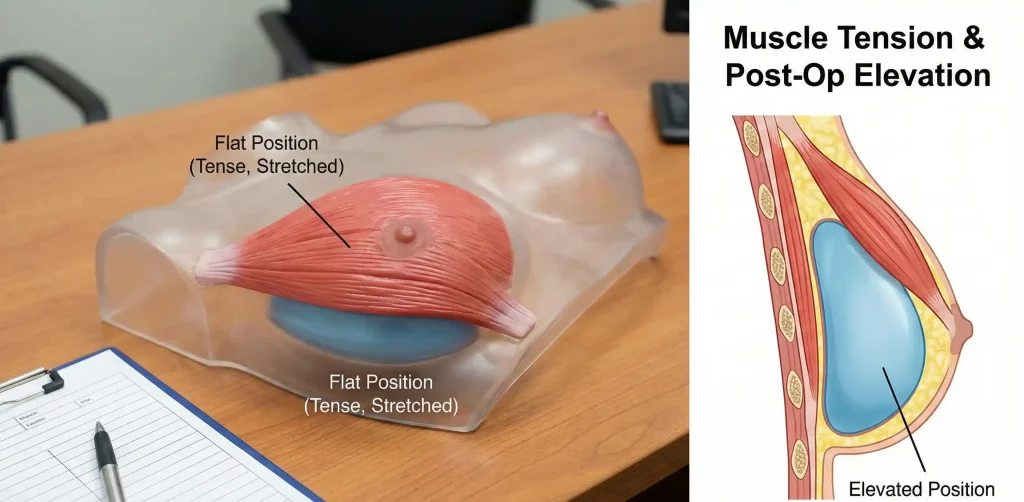
Additionally, it is very important that you are at a certain angle while sleeping because this is the most efficient pain relief, especially when you have Sub-Muscular implants. Putting implants under the muscle makes the pectoralis major muscle to stretch and this muscle is the one that goes into spasm sometimes. Completely flat position puts this muscle under the greatest tension, which can give the feeling of a tight rubber band being snapped across your chest. Slightly raising your head keeps the muscle in a relaxed state; hence, you will significantly lower your need for taking muscle relaxants. Also, getting out of bed when you are lying down in an elevated position is more comfortable. Coming to a sitting position from lying flat on your back involves firstly pushing your arms and engaging your core and this is the way your chest muscles are flexed and the fresh incisions are hurt. When you are sitting already, you do not feel such a strain.
Phase 2: Flat on Your Back (Weeks 3–4)
You are generally able to say goodbye to the wedge pillow and lie flat on your back completely by around the third week when the major swelling has gone down and the bleeding risk has disappeared. However, it may be warned that you could possibly experience a very strong “tightness” or heaviness in your chest during the first nights you will lie flat. This is a typical feeling caused by your muscles being stretched again after they have been in a shortened state for quite a long time due to the elevated position. You are not being damaged in any way and it really is re-adaptation that this sensation means.
It would not be wise to deviate from the rule for sleeping perfectly still on the back in this stage. That’s the very moment when patients have the most accidents of rolling over in their sleep. In order to stop this movement of which you yourself are not even aware, we advise the “Fortress Method.” This means you put a heavy pillow under each arm or on the sides of the body to serve as physical barriers. The barriers stop you from turning onto your side at night and thus your implants are free from lateral pressure.
Phase 3: Side Sleeping (Week 6+)
Most patients’ golden milestone is the 6-week mark. This might be the time when the internal scar capsule has formed enough strength to hold the implant in place against gravity without the need for pads. The main risk of lateral displacement is associated with side sleeping too early. If you sleep during the 2nd or 3rd week on your side, the weight of the implant and the force of gravity can push the implant to the armpit. The reason why this can happen is that the surgical pocket is still fresh and the scar tissue is soft so the implant can slide sideways and as a consequence, the pocket can be permanently stretched. This undoubtedly is a condition where the patient will have to undergo revision surgery.
It would be better if you use a pillow between your breasts or hug a body pillow when the time to side sleeping comes. Either of the two regulates the position of your chest and keeps the top shoulder from falling inward that, in turn, can pinch your skin and create an area of uneven pressure on the cleavage.
Phase 4: Stomach Sleeping (Months 3–6)
The last thing you recover from is stomach sleeping. Some doctors let their patients do this as early as three months, but the majority of them actually recommend that patients should wait 6 months or even longer. When you lie on your stomach, you apply the full weight of your body directly on your implants and this is why. Even though medical-grade silicone is super tough and is not going to burst, the continuous pressure might cause the surrounding tissue to become thinner or the capsule to get irritated.
In reality, quite a few ladies who had breast implants found that they never got back to stomach sleeping just because it was not physically pleasant. The feeling is somewhat comparable to lying on two tennis balls and as a consequence, there is an involuntary backward curve of the spine resulting in a strained neck. So unless you find it really difficult to give up this habit, it looks like you are either going to have to modify your sleeping routine indefinitely or get a pillow with a hole so that you can still lie comfortably and actually accommodate your new curves.
Why You Can’t “Just Be Careful”
The frequent question we get is, “Can’t I just sleep on my side if I am careful? The point is that while you sleep you are unconscious. Dreaming, your corporeal state of rest and protection of the chest cannot go hand in hand. Stretching the wound with a sudden jerk or rolling over may even undo the stitches (wound dehiscence) and cause the implant to be displaced or shifted before it has fully settled. Good sleep habits are essentially a kind of protection you are getting from yourself when you are going to sleep and thus, temporarily deprived of the capability of making conscious decisions.”
Frequently Asked Questions About Sleeping Positions
Don’t worry. Your results won’t be ruined after a single night of sleeping on your side by accident. Just change your position right away. If you experience pain or asymmetry in the morning, consult your doctor.
Absolutely! Pregnancy pillows or U-shaped body pillows are fantastic for breast augmentation recovery. They keep you from turning over and giving you a comfortable arm rest, thus, you won’t be using your chest muscles.
In a lying position, the fluid in the breast disperses, and the gravity that was affecting the implant downwards is eliminated. Besides, the muscle stretching, which together with the change in pressure distribution, creates the feeling of heaviness.
While it partially depends on your doctor’s instructions, generally, we advise sleeping in a soft, supportive sports bra for at least 3 months so that the skin can tighten around the implants as the weight of the implants is supported.
By elevating your body, you let gravity do its work and pull the blood as well as the fluid away from the chest wall, thereby preventing the line of bruises from becoming darker and more stubborn.
Maxwell, G. P., & Gabriel, A. (2014). Biofilms and breast implant contracture: Was the era of texture a mistake? Aesthetic Surgery Journal.
Headon, H., et al. (2015). Capsular contracture after breast augmentation: An update for clinical practice. Archives of Plastic Surgery.