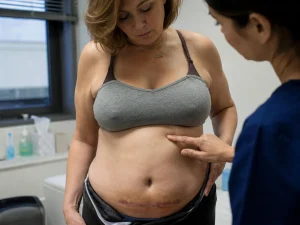
Bottoming out is relatively uncommon.
Understanding the Inframammary Fold and Its Role in Bottoming Out
In the body of mammary architecture, the breast’s shape and form are controlled by a very specific system of ligaments. The main border of the lower breast is called the inframammary fold (IMF). It consists of a compact band of connective tissue fibers that tightly bind the skin envelope to the deep fascia of the pectoralis major and chest wall. Bottoming out is a condition where this anatomical constraint is either broken or intentionally altered during surgery, resulting in the breast implant moving downwards and beyond its natural position. In terms of biometrics, this side of the implant falling below the natural fold changes the length between the nipple-areola complex and the new, dropped crease in a highly unnatural way.
Implants going beyond the natural inframammary fold bring about a big imbalance in the breast’s volume distribution. The upper pole, which normally provides the projection of the breast, loses depth and collapses, whereas the lower pole becomes the over-extended bottom-heavy bulge. This kind of mechanical breakdown changes the direction of the nipple, which then points further and further up to a situation at times referred to as “star-gazing nipple”. At LIN Europe Clinic, we do not see the IMF merely as a line. Instead, we consider it a very important, almost sacred anatomical boundary. It is this matrix of ligaments that forms the structures supporting the breast and only by preserving it can we operate with structural harmony, keeping the implant in its intended pocket and not distorting the natural contours of the torso.
Statistical Incidence and Risk Profile

Accurately, from both a clinical and a statistical perspective, bottoming out is a rare complication nowadays occurring in only 1% to 5% of all breast augmentations worldwide. Despite this small percentage, the rate of occurrence varies significantly depending on individual tissue properties and choices of implant size. The top factors influencing it are neither the implant itself nor the medical device, but the mismatch between the weight of the implant and the ability of the dermal envelope to hold it.
| Structural Phase | Clinical Presentation | Impact on Symmetery |
| Normal Settling | Gradual relaxation into the lower pole over 3 months. | Ideal position; achieves absolute structural harmony. |
| Early Laxity | Minor descent; scar begins to ride slightly upward. | Subtle asymmetry; requires close monitoring. |
| True Bottoming Out | Complete failure of the IMF; star-gazing nipple profile. | Severe distortion; requires advanced surgical brilliance. |
Besides wearing over time, tissues also become weaker due to extrinsic factors such as a major loss or gain of weight, multiple pregnancies, and, not to mention, the aging process that results in a decline in collagen content. So, patients suffering from tissue laxity will have a substantially reduced threshold for mechanical strain. On the other hand, certain individuals with thin and fragile skin, if they decide on a large and heavy implant, their tissues will soon be overwhelmed without question by the continued downward force of gravity.
Mastery of Surgery: The Creation of a Safe Pocket
If we want to prevent the migration of an implant in a downward direction, the main point at which we may intervene is surgery technique. The chief culprit leading to early structural failure at a clinical level is the excessive dissection of the lower pocket. After a while, if a surgeon goes too far with the cannula or scalpel, the deep fibers of the inframammary fold will be severed, leading to the implant having no structural shelf to rest on. The way to avoid malpractice here is a very deep embodiment of surgical brilliance and the execution of anatomical precision.
It is the dual-plane or submuscular pocket placement that we are referring to when we talk about our benchmark of long-term stability. The main place in the upper part of the implant is under the muscle, so it is acting as a sling – a biological one that is natural and heals extremely strongly on its surface. What this configuration does is take the physical weight of the implant away from the delicate lower skin, and it is secured against the muscular framework of the chest wall.
Physical Lifestyle and the Great Shape Over Time

The operating room is where one lays the initial architectural plan of the pocket, but maintaining the beautiful look of breasts over the years is a joint responsibility of both medical science and the patient’s commitment. The time length of 6-12 weeks post-surgery is when the body is busy manufacturing a capsule of scar tissue around the implant. This period in healing is the very time of systemic vitality, where extra mechanical pressures or even internal pressure spikes should be avoided at all costs to the newly repaired IMF.
Skipping post-operative garment protocols is the main cause of late-stage structural descent. High-impact cardiovascular exercise, heavy lifting, or running without adequate external support forces the heavy implant to bounce violently against the healing lower pole fibers. To mitigate this risk, we enforce a strict, high-definition recovery roadmap that mandates the use of specialized, non-wired compression brassieres around the clock during early maturation.
Breast Implants in Turkey
The case of an implant that has bottomed out completely, either from a previous surgery done elsewhere or from a natural degradation of tissues over time, will require surgical correction and cannot be solved by conservative measures. This type of revision surgery is a great example of the fusion of medical innovation and reconstructive skills.
The most effective way to fix a bottomed-out figure is a two-step operation:
- Capsulorrhaphy: The surgeon carefully removes the stretched, lower part of the internal scar pocket and, with high-strength, permanent sutures, the capsule is pleated and tightened, thus lifting the inframammary crease to its natural biometric location.
- Internal Bra Material: To further support the newly-built tissue shelf, a piece of acellular dermal matrix (ADM) or highly advanced synthetic mesh is placed under the implant. The mesh acts as an internal brassiere offering a permanent structural scaffold that not only provides immediate stability but also encourages the patient’s own collagen to grow within the matrix, thereby strengthening the lower pole for the future and resulting in a beautifully balanced and symmetric profile.
FAQ:
Absolutely! Dramatic weight loss or the natural process of aging can cause your skin to lose its elasticity gradually. In fact, such a long-term loss of tissue support may even lead to the implant moving downwards slowly.
Typically, a natural settling will cause the breasts to take a soft, natural teardrop shape with the nipple directly pointing forward. If, however, the implant bottoms out, then it slides underneath the crease line and the nipple is pushed upward.
Almost never is bottoming out characterized by sharp pain. When pain is associated with it, it is usually described as an uncomfortable feeling of being out of place. Along with this, there is also a sensation of heaviness that persists with a feeling as if one needs to hold the breasts up manually.
Not at all! A bra or any other external garment cannot help in a situation where the inframammary fold is torn or stretched. When the tissue that provides the breast support breaks down, the only way to fix the problem is through surgery.
An internal bra mesh is a sheet of strong material that looks like a medical mesh which is used during breast implant revision surgery. Besides supporting the breast pocket, the medical mesh also helps to keep the implant from moving downwards permanently.
Tebbetts, J. B. (2002). Systemic Vitality and Surgical Precision in Mammary Procedures. Saunders Elsevier.
Adams, W. P. (2011). Breast Augmentation: Clinical Mastery and Biometric Pocket Stability. Saunders Elsevier.
Janis, J. E., et al. (2005). Thoracic Anatomy and Biometrics: Inframammary Fold Integrity. Plastic and Reconstructive Surgery.
Nahai, F. (2011). The Art of Aesthetic Surgery: Principles and Professional Rigor in Revision Procedures. Quality Medical Publishing.
Maxwell, G. P., & Van Natta, B. W. (2009). Medical Innovation and Internal Support Matrices in Breast Reconstruction. Aesthetic Surgery Journal.