Swelling decreases and discomfort improves.
Recovering from plastic surgery is a personal psychological experience because it usually seems and feels worse before it becomes better. Healing from a flu is very different where you steadily gain strength each day, however, recovering from breast augmentation is non-linear and filled with unusual, sometimes scary sensations. One day you can notice that one breast is higher than the other; the next week, you feel electric shocks in your nipples; the week after, your incisions feel hard and lumpy. For inexperienced patients, these variations can cause worry and later-night Googling the question: “Is my recovery normal?”
Actually, recovery is a biological construction project. It is quite messy, loud, and busy. The “pain” or “complication” you sense are often just your body’s vigorous efforts to stitch up the tissues. Knowing how the body heals on a cellular level can help you relax instead of worrying. At Lin Europe Clinic, we consider a well-informed patient to be a composed patient. By identifying the slight signs of cell repair—such as the “healing ridge” or the “nerve zaps”—you can stop being concerned about your symptoms and start seeing them as an evidence that your body is doing what it was made to do.
The Seeing Part: The “Drop and Fluff” Progression
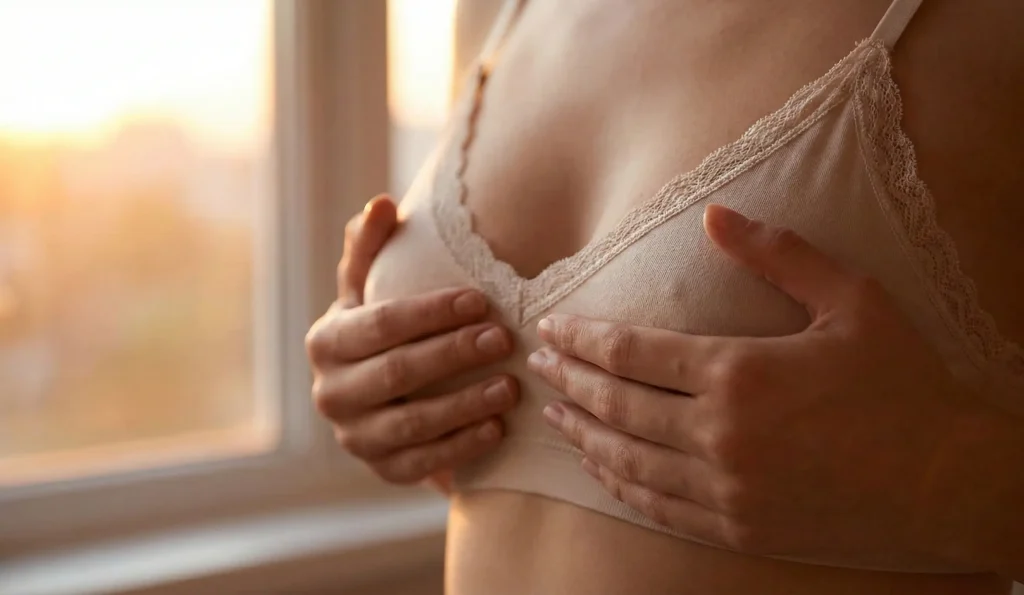
One sure sign that your breast implants are healing properly is that they gradually lose their square shape and move further down the chest wall. Right after the surgery, it is typical for the implants to be placed very high on the chest, which often gives a “square” or “torpedo” look and makes the upper pole look very full. It is not the final outcome; it is just the beginning.
Healing is demonstrated by the “Drop and Fluff” effect. The first of the two phases is when the pectoral muscle that was stretched during surgery stops contracting and spasm due to surgery-driven irritations. After the muscle has relaxed, it is no longer pushing the implant upwards, thus the gravity can lead the implant to the lower breast pocket without resistance. The second part of the process is the skin of the lower pole of the breast getting stretched and accommodating to the new volume, thus the breast rounds out. You are going to be healing when week after week you look at yourself in the mirror and realize that the “slope” of your upper breast is getting smoother and your nipple is changing from pointing downwards to being at the center and projecting forward. This slow-motion descent is basically the visual proof that your tissues are getting used to the implant.
The Feeling Part: “Zingers” and Electric Jolts
Sudden sharp pains are the most terrifying symptom of healing to many patients. Typically, they compare these pain to electric shocks, “zingers,” or burning needles that come here and there in the nipple or on the side of the breast. Most of us tend to think that sharp pain means that there is a tear or that something is quite wrong. Nonetheless, in the case of surgery, this is a sign of nerve healing.
The introduction of the breast pocket involved the presence of numerous tiny nerves for sensation which were most likely not only stretched but also temporarily stunned (neurapraxia). When the swelling phase is almost over, that is around weeks 3 to 6, the nerves “get up” and try to reconnect with each other. The nerve operations are controlled by your brain which is sending different kinds of signals; some are just testing scenarios. The electrical “zaps” you sense are basically the nerves sending test signals as they get back to normal. Also, the nerves overreact, so even something as soft and harmless as the fabric of a t-shirt feels like it is made of sandpaper rubbing the nipples. This uncomfortable moment actually does confirm that your sensory system is fixing itself and that the risk of permanent numbness is very low.
The Feeling Part: The “Healing Ridge”
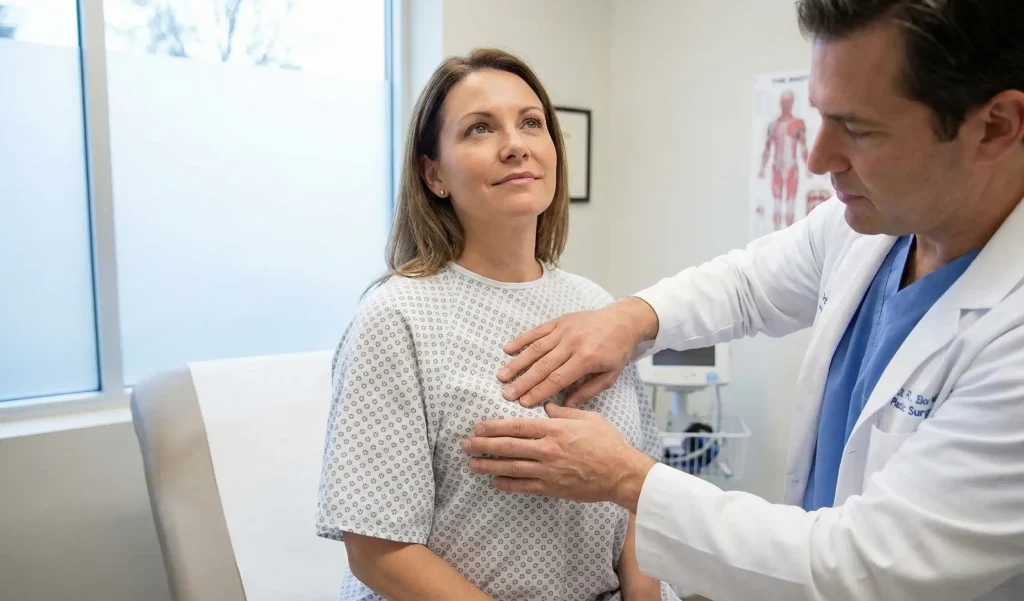
When you gently move your finger over your incision site (either in the fold or around the areola), you may detect a hard, raised line that feels like a wire or a hard cord beneath the skin. Some patients even think that it is a keloid scar or a cyst. In fact, the Healing Ridge is the correct name for this.
A healing ridge is a building of collagen together with internal dissolvable stitches and fibrous tissue which acts as a splint for the wounded area. Just like a broken bone forms a hard callus as it heals, your incision forms a hard ridge to keep the vulnerable skin edges from separating. The appearance of this ridge shows that your immune system is very active and reacting strongly. In the period of 3 to 6 months as the wound gets stronger, your body will gradually get rid of this extra collagen, and the ridge will become flat. Touching this firmness is some evidence that your body, at the initial stage, is more interested in the structural solidity than in the softness.
The Softening Phase: From Rock to Flesh
One of the options you might think of dealing with the “hard-as-rock” stage of the first few weeks is to picture someone taping stones to their chest.
Stuffiness and swelling of the muscles and skin are main reasons the implants feel so hard during this time. The pressure created by the fluid makes the tissue feel tight and resistant to the touch.
The “Softening Phase” is a key healing accomplishment that generally starts at week 6 and lasts up to 6 months. If you observe that the breasts are gradually losing firmness and the wiggle is very obvious, you could be right in your guess. This is a very strong sign that the inflammatory swelling has been drained through the lymphatic system, and the tissues around the area have been able to stretch to take the implant. In case your bras go from feeling like a flexed muscle to being dense breast tissue, then your recovery is very nice.
Systemic Indicators: Energy and Bloat
Healing indicates not merely a local but a systemic change. Your whole body pays a “tax” to cover the costs of tissue rebuilding after surgery. This “tax” first expresses itself in excessive tiredness, “brain fog,” and the well-known “post-op bloat” caused by water retention and constipation resulting from the use of painkillers.
One way of telling that recovery no longer requires great efforts is when you get your energy back to the level you had before the surgery and the “opiate belly” disappears. The moment you realize that your rings fit on your fingers again, your stomach is flat, and you can make it through the afternoon without taking a nap, it means your body has already finished the process of redistributing its energy and thus wound repair is not the only thing to consume it anymore. As systemic inflammation is decreased, metabolism and the water balance return to their normal state. Systemic normalization is often the first step before the breasts settle in their final beautiful shape.
Frequently Asked Questions About Healing Signs
Generally, for most patients, the main dropping phase takes place during the first three months. Besides, the last fluffing and softening might take up to six months to be totally done.
These sudden, sharp pains are known as nerve zingers and they show that the sensory nerves in your chest are repairing and reconnecting. It is a very encouraging sign that the area is becoming less numb and normally the sensation returns within a few weeks.
It is very common for one breast to drop and soften quicker than the other. The reason is that your dominant hand usually keeps the pectoral muscle on that side somewhat tighter. This asymmetry will disappear when the two muscles relax eventually. So, it is a temporary thing.
Post-op bloating is a whole-body reaction caused by anesthesia, antibiotics, and water retention as your body deals with inflammation. It is not a weight gain caused by fat and will naturally be eliminated from your system as you regain your mobility.
You will notice the breast softness starting at about six weeks when the swelling has gone down and the breasts will continue to get softer up to one year. Smooth or textured implants could feel a little bit different as texturized implants can remain firmer due to their structure.
Drosou, A., et al. (2005). Wound healing. Southern Medical Journal.
Campbell, A. (2006). The pathophysiology of postsurgical pain. Pain Management Nursing.
Perkins, S. W., & Sklarew, E. C. (1996). Prevention of facial scars: Protocols for wound healing. Facial Plastic Surgery Clinics of North America.