
They may feel cooler but adapt quickly to body temperature.
This may merely sound like a rumor or some joke thread on a forum, but ladies with breast implants and living in colder areas know that this is a very real physical feeling. It is just when you are walking out to the cold winter street or entering a cold water pool that your chest suddenly seems to have been filled with ice. You may ask yourself, is it normal? or can implants really freeze?
In fact, breast implants can get cold but they cannot freeze inside a human body. At Lin Europe Clinic we always want you to be well prepared for life with implants. That includes all sorts of little stuff like the change in sensation. This is actually a result of basic laws of thermodynamics and silicone being a type of material. It is safe but still quite surprising to most people if they don’t expect it.
The Science: Thermal Inertia

Silicone is a material that provides a very good thermal insulation. This is one of the reasons why glass and rubber are used as thermal insulators as well. A breast implant, unlike a natural tissue of the body, which is always perfused with warm blood at a temperature of 37°C (98.6°F), has no internal blood supply. It does not generate any heat.
Therefore, implants are affected by thermal inertia and in other words, they adopt the temperature of their environment.
- Cooling Down: Being in a cold environment for a long time, the cold air will get through the skin and cool the implant. The implant temperature will drop much quicker than the natural tissue temperature because the implant is not provided with blood flow internally to “reheat” it.
- Staying Cold: After the silicone has become cold, it will remain cold for quite a while. Just imagine a cold pack putting pressure on your chest wall. Your body heat will not only have to work very hard to warm the implant but it will take a lot longer as compared to the time it requires to warm up your skin.
The Sensation: The “Cold Heart”
Most patients talk about the condition as a chilled feeling deep inside rather than a pain. Maybe, you have two cooled water balloons nestled in your coat.
Usually, when the cold implant is pressing on the warm musculature of the chest or the skin underneath, the most powerful feeling appears. This sharp difference in temperature can be very startling. However, you can be fully clothed and feel the warmth outside, but upon touching your breasts, you get a noticeable cold feeling, or you may have a “cool radiance” in your chest that lasts for 15-20 minutes after you go inside.
Is It Dangerous? Can They Freeze?
Don’t worry, your implants simply cannot freeze. Medical-grade silicone is extremely tough and durable. It is able to withstand such extreme temperatures as no human can survive. So, the only way to make silicone freeze or crack is at -100°C (-148°F). If you happen to be in such an environment, you will have bigger problems than implants such as hypothermia.
The cold feeling is absolutely harmless not only for the device but also for you. The shell of implants does not become less strong or the gel more cohesive. It is just an irritating feeling.
Submuscular vs. Subglandular
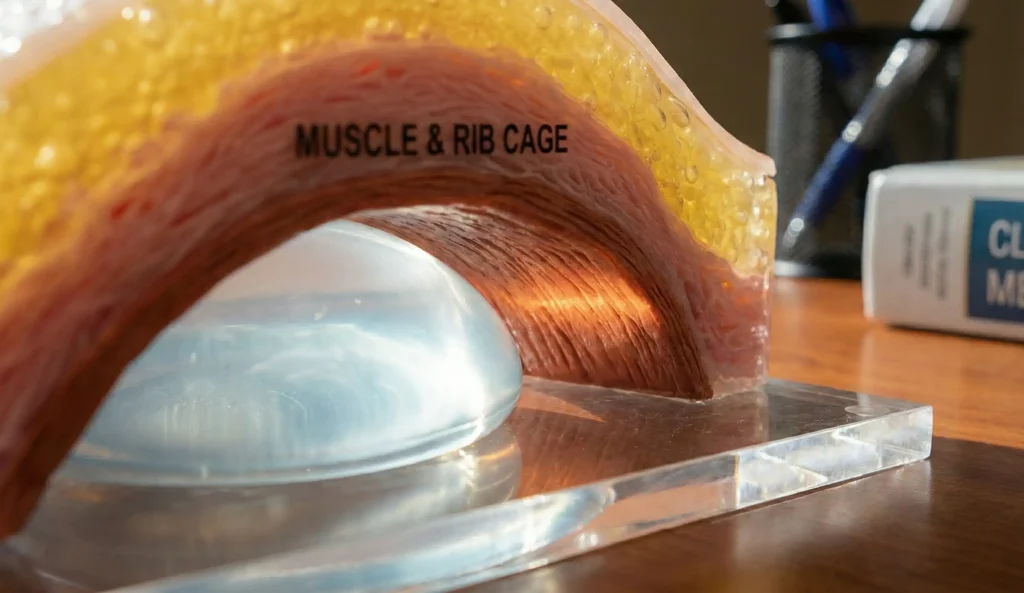
Your implant’s position makes a difference to how much you are going to feel cold.
- Subglandular (Over the Muscle): This kind of implants is very close to the skin surface and has very little tissue covering them. Therefore, they get cooled faster and the sensation of cold is more intense.
- Submuscular (Under the Muscle): Implants under the pectoralis muscle receive another layer of warm, vascular tissue as a covering. This layer functions as a buffer, insulating the implant from the exposure to the cold air. The implant still can get cold but the change is slower and the feeling less.
Tips for Managing the Chill
If you are a winter swimming enthusiast, skier, or live in a region where there is a lot of snow, you do not have to worry about implants at all. You just need to be smart about how you layer your clothes.
- Layering your clothes properly is important here. The body core needs to be kept warm if you want to save energy. Wearing a down vest or only a thick thermic medium layer over the chest will provide the external insulation that is absent in an implant.
- If you are coming inside from outdoors and still feel cold, a warm(not very hot) shower is the most effective way of warming up the silicone again. Since water warms the skin, which in turn heats up theImplant more rapidly than body heat.
- Once you have fully recovered, avoid the use of ice packs on your breasts for a long duration as it can cause discomfort because of the difficulty in warming them back up.
Breast Augmentation in Turkey
When you choose Lin Europe Clinic for your breast augmentation in Turkey it means that we are using only the best quality, FDA-approved breast implants from the likes of Mentor and Motiva. These producers go through vigorous testing of their gels for thermal stability, thus they will not harden or become brittle whether you choose to sunbathe in Antalya or go skiing in Uludağ.
Your stay in Istanbul is also associated with truthful discussions around lifestyle. If, for example, you are a passionate winter sports athlete, we might suggest submuscular placement not just for the aesthetic benefit but also for that extra thermal protection layer. Lin Europe Clinic is where you get comfortable in your new body and every season too.
Frequently Asked Questions About Cold Implants
Yes, quite often. Basically, saline is just salt water which changes how temperature is conducted as compared to thick silicone gel. Water is a very efficient medium for heat/cold transfer, thus the saline implants can get the feeling of being cold quicker and the “slosh” of the cold temperature is more obvious.
No, they cannot. Neither the pressure of a plane nor the cold of winter will make implants rupture. They have been made capable of withstanding extreme environmental stress.
It’s just the natural response of the nipples to cold (erectile reflex). If your nerves are hypersensitive post-surgery (which is quite normal during the healing process), exposure to cold air may cause the nipples to be painfully stinging. This normally goes away after the first year.
No, heat is not a problem generally. But, just like they store cold, implants will also store heat. In a sauna, your breasts can be hotter than the rest of your body for quite some time after you leave. If you have any numb spots, make sure that you use hot water bottles carefully so as not to get burned.
Implants just mimic the temperature of the outside air as they do not have any blood flow. This is an innocent feeling caused by the silicone holding the cold like an ice pack.
Bondurant, S., et al. (2000). Physical and mechanical properties of breast implants. (Discusses thermal properties of silicone).
Brown, S. L., et al. (2000). Silicone gel breast implants: Safety and efficacy. (FDA safety data regarding environmental stressors).