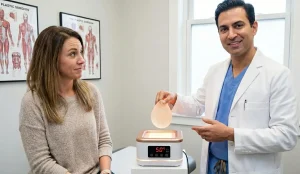

Silicone degradation and rupture may cause issues.
The Biometrics of Elastomer Degradation and Device Aging
If you work in reconstructive and aesthetic breast surgery, it will be helpful for you to know how long a medical device lasts, that is, its lifespan. This is very important because one of the most common worries among women who got breast implants a long time ago is the possibility that old implants may become “toxic” inside the body. If we look at medical-grade silicone from a purely biometric point of view, this material does not turn into a poison if it is just left lying around. However, the fact is that the physical structure of implants is going to get worn out naturally, and that is one of the reasons why older generation implants are not good anymore.
At LIN Europe Clinic, we mention that your implant’s outer shell (elastomer) undergoes the mechanical friction of your chest muscles and the biological pressure of your scar tissue encapsulation, besides other micro-motions during the day. These interactions keep happening, and it is even when you just relax that you keep moving slightly in your sleep. Over a period of 10 to 15 years, this chronic friction causes the shell to weaken, thin out, and eventually experience micro-tears or complete ruptures. When the protective barrier of an older device fails, the internal contents interact directly with your native tissue matrix, disrupting your biological balance and triggering a complex systemic response.
Liquid Silicone and the Phenomenon of Gel Bleed

First, you need to know the risks of the implants with their beginning technology during the 1980s and 1990s to get it physiologically. Back then, implants were filled with a very fluid, free-flowing liquid silicone gel covered by a highly permeable shell. Gel bleeds are one of the most common phenomena occurring in breast implants without leakages or ruptures and during normal continuous use. So, even when completely intact and unruptured, these implants had a major drawback, which was gel bleed. The free liquid silicone gel molecules were so small that the silicone basically “bled” out in tiny amounts through the whole intact shell. This went on for several years until the liquid silicone collected in the breast capsule and locally overwhelmed the immune system, besides damaging the structural harmony of the breast cavity.
The Immunological Reaction: Inflammation vs. Chemical Toxicity
It is quite common for the word “toxicity” to be tossed around without fully understanding what the medical term implies. The fact is that old silicone breast implants simply do not release heavy metals or toxic chemicals into your system. In fact, all the “toxic” symptoms we hear about, such as persistent weariness, joint ache, and swollen lymph nodes, are actually the outcome of a serious, local immunological fight.
Gel rupture or gel bleed happens when gel is expelled from a damaged implant and recognized by your immune cells (macrophages) as an alien invader in your system. Macrophages are the body’s first line of defense. To get rid of the unfavorable silicone, macrophages will do their best to swallow it and, if possible, digest it. Dying cells then release the cytokines that create inflammatory signaling to attract more immune cells to the site, resulting in a chronic inflammation cycle that ultimately manifests as silicone granulomas—hard, tender nodules in the breast and underarm areas. To maintain your systemic vitality, it is necessary to remove this free liquid before it permanently debilitates your immune system.
Clinical Comparison: Old Liquid Silicone vs. Modern Cohesive Gels

Actually, your current aesthetic investments are safe only if you know the difference between breaking down the mechanisms of failure of old devices and medical innovations used for modern contouring:
- Internal Viscosity: The implants of the old generation were filled with liquid silicone which could easily migrate throughout the body after implant rupture. Nowadays, we have implants made of highly cross-linked, form-stable cohesive gels (gummy bear implants) that behave like a single solid unit.
- Response to Rupture: Liquid silicone leaked into the breast and lymph nodes, causing severe inflammation if an old implant was ruptured. As long as cohesive gel implants are concerned, the gel is similar to a solid and after the implant is ruptured, no gel spreads but remains in place, preventing the migration of gel.
- Shell Permeability: Shells of vintage implants were thin and had notable gel bleed. Today’s top-level devices with multiple barrier layers and low bleed shells efficiently prevent the escape of silicone molecules from within the device.
- Biological Risk: On top of liquid implants that leaked perpetually into the body and caused chronic immune responses, the new cohesive gels are physically separated from the human body, which results in no immunological reactions or risks.
Breast Implants in Turkey
Walk into LIN Europe Clinic, and you’ll find yourself in a medical haven where clear, evidence-based science controls your every step of care. We see the female body as a complex and ever-changing system, and that’s why dealing with the complications of old surgeries demands a very skilled and kind approach. LIN Europe Clinic in Turkey is one of the leading centers in the world for performing more difficult revision surgeries, especially those frequent among en bloc capsulectomy patients – a major operation to take out the old implants and the surrounding scar tissue that is often very inflamed.
By entrusting us with your care, you are joining the ranks of a first-rate medical system that holds professional care as its highest priority. We carefully lay out every detail of your reconstruction, employing top-notch high-definition imaging not only to evaluate the state of your existing implants but also to usher you into a new era with the safest, CE-approved, cohesive gel implants available to the global market. Unlock the exquisite nurturing touch of LIN Europe Clinic and rediscover a stunningly harmonious, flawlessly restored silhouette that embodies the absolute essence of biological excellence, all within the secure and hospitable confines of Turkey.
FAQ:
Since older silicone implants can result in “silent ruptures” without you noticing immediate changes at the appearance level of your breast, the the first signs of leaking can be a feeling of burning, the appearance of lumps in the breast or armpit, and unexpected hardness. However, the only way to definitively check the physical health of an old implant is with a high-resolution MRI or ultrasound.
In case a ruptured leak is the cause of an old liquid silicone implant, the gel is most likely to remain within the scar tissue capsule that surrounds the breast. Nevertheless, if this capsule is also damaged, microscopic silicone particles can reach the local lymph nodes in your armpit, although it is extremely rare for them to travel to major internal organs.
Today implants primarily consist of highly cross-linked cohesive gel which is the silicone that looks and behaves more like a solid gummy bear (with structural memory) than a liquid. Even if the strong, multi-layered outer shell gets broken, the solid gel cannot run, bleed, or leak into your body.
Removing the old implants and the surrounding scar tissue capsules (en bloc removal) surgically could possibly be a good option for you, if your symptoms are derived from a chronic immune response to leaking silicone, removal of the implants stops the localized inflammatory trigger. Many women that undergo the surgery report a marked alleviation of their systemic symptoms thereafter.
Although cohesive implants in use today do not have a shelf life after which they must be changed, surgeons on the whole still suggest having your implants examined with an MRI every 10 to 15 years. Doing so allows you to replace your implants before the shells degrade due to aging and also ensures that your body continues to be exposed only to perfect medical devices that are intact and pristine.
Brandon, H. J., Young, V. L., Jerina, K. L., & Wolf, C. J. (2003). Long-term aging characteristics of silicone gel breast implants. Plastic and Reconstructive Surgery, 111(7), 2205-2211.
Brown, S. L., Todd, J. F., Kraft, P. R., & Luu, H. M. (2000). Silicone gel breast implant rupture, extracapsular silicone, and health status in a population of women. Journal of Rheumatology, 27(4), 996-1003.
Katzin, W. E., Centeno, J. A., Feng, L. J., Kiley, M., & Mullick, F. G. (2005). Pathology of lymph nodes from patients with breast implants: a histologic and immunohistologic study. The American Journal of Surgical Pathology, 29(4), 506-511.
Hölmich, L. R., Friis, S., Fryzek, J. P., et al. (2001). Incidence of silicone breast implant rupture. Archives of Surgery, 138(7), 801-806.