

The nose, forehead, and tear troughs are riskiest.
Dermal fillers have become as ordinary as facials in today’s beauty regimes, providing immediate results for a vast array of issues from thin lips to lackluster eyes. With millions of syringes used each year, it sometimes gets overlooked that this is a medical procedure where a gel implant is introduced into a vascular face. The majority of the filler treatments are extremely safe, but there are certain “Danger Zones,” where the margin for a mistake is minimal. Injecting blindly in these regions doesn’t only result in a bad aesthetic result; it risks severe complications, such as skin necrosis (tissue death) and even permanent blindness.
The most powerful weapon a patient can have is to recognize the location of those risk zones and what makes them dangerous. The hazard normally escalates from Vascular Occlusion, a situation where the filler is mistakenly injected inside an artery or is completely closing it from the outside by pressure, thus, the supply of oxygen to the skin or eye is cut off. At Lin Health Europe Clinic, we consider transparency as the highest form of safety. We want you to be fully aware of the areas where your treatment has to be done by a highly skilled person, the reasons why we might refuse your requests, and the anatomical protocols at the highest level that we use to safely navigate these biological minefields.
The Glabella: The Most Forbidden Part of the Face
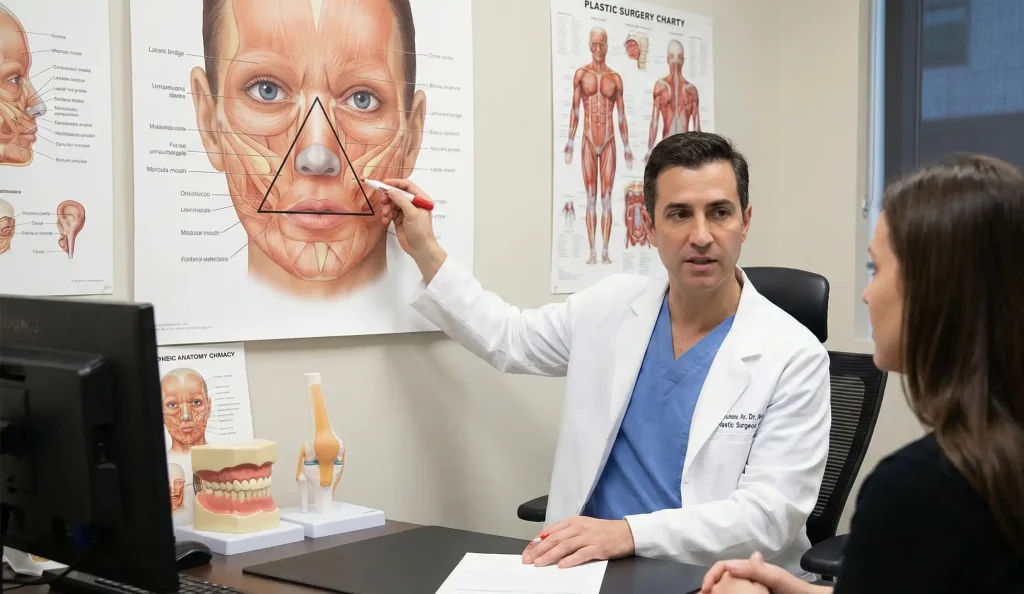
The top among the places extremely risky for fillers, in fact, statistically and anatomically, is the Glabella—the spot between your eyebrows where the lines “11” frown form. For a long time, patients have been asking for fillers here to get rid of the deeply etched lines that Botox did not completely remove. Still, many practitioners now considering this a firm “no-fly zone” with the responsible ones. The reason is the Supratrochlear and Supraorbital Arteries. These tiny yet vital vessels lie very close to the surface in this area, and their connection to the ophthalmic artery, which supplies the eye, is direct and under high pressure.
Since the skin is firm here and the arteries are narrow, there is practically no room for error. In case a needle hits one of these arteries and filler is squeezed into the blood, the air pressure can push the gel backward (retrograde flow) and within seconds, it will reach the eye’s blood supply thus the central retinal artery gets blocked and instant, irreversible blindness occurs. Contrary to other parts of the body, where you might survive because of the collateral blood flow, the glabella lack “backup” circulation very much. That is why we mostly just use Botox or threads for frown lines, completely avoiding deep filler injections in the glabella area thus we eliminate the risk of the worst-case scenario.
The Nose: The Reason Liquid Rhinoplasty Needs to Be Taken Seriously
Liquid Rhinoplasty has become very popular as a “15-minute nose job,” yet it is a second procedure in the queue for the most dangerous in terms of vascular compromise. The nose is a very harsh structure by nature because it is just skin wrapped tightly around bone and cartilage. There is almost no subcutaneous fat or space for the filler to spread. When an injector places volume in the bridge or tip, the internal pressure skyrockets.
Just the increased pressure alone can suffice to crush the tiniest blood vessels that supply the nasal skin, thus resulting in necrosis (skin dying and turning black). Besides, the dorsal nasal artery is the one that goes along the bridge and it is connected to the eye’s blood supply. An injection by mistake here brings the same risk of blindness as the glabella. That is the reason why we handle the nose with great caution, we normally resort to microdroplet techniques, and safety is always our first priority even if it means the nose won’t be radically transformed. Better to have a little bump on your nose than to ruin the blood flow to your vision.
The Nasolabial Folds: The Most Common Site for Necrosis
While the glabella and nose are the main where the risk of blindness is given the terrifying one, the Nasolabial Folds (smile lines) are the most common place for skin necrosis. This is caused by the course of the Facial Artery, which is a big, winding vessel coming up from the jaw, and at the deep crease of the smile line right beside the nostril wing (alar), the facial artery passes underneath. This artery’s depth varies quite a lot between different humans; for some, it is pressed against the bone while for others, it is just below the skin.
In case this artery is blocked by the filler, the initial sign is often a lancinating, burning pain together with blanching (whitening) of the skin around the nose and upper lip. If it is neglected, the skin around the nostril will die and the place will be left with a permanent scar. As preventive measures, skillful injectors frequently put filler into this area superficially (i.e., above the artery) or very deeply (i.e., onto the bone) thereby they avoid the dangerous middle layer where the artery mostly lies. We also perform aspiration (pull back on the syringe) or blunt cannula use so that we can be sure we are not going inside a blood vessel at the time of injection.
The Forehead and Temples: Careful with the Shallow Areas
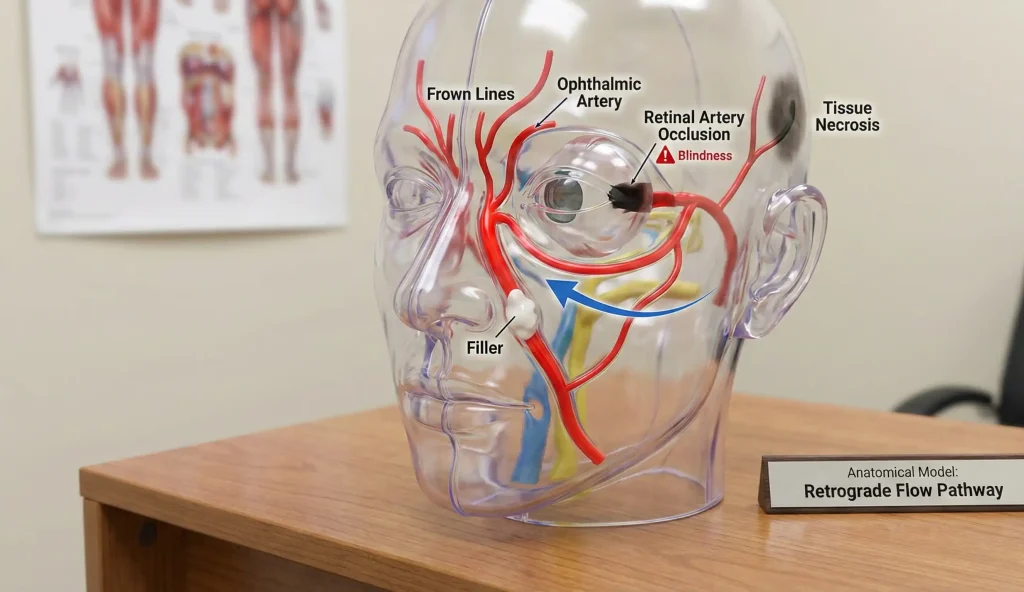
The upper facial part is also accompanied by the challenges of its kind. The forehead constitutes a broad, flat danger zone because the arteries here are extremely superficial. Arteries in most parts of the face are deep under the muscle, while in the forehead they often lie right under the skin. Here, to smooth horizontal lines with injectable filler, you need to know the depth intimately so that you do not hit the supraorbital vessels. Likewise, Temples are a less safe place/potential place for an extreme makeover. First, a hollow temple can make your age perceptible; second, the area is hosting the superficial temporal artery which is connected to the brain’s venous system and in a dangerous way.
When it comes to the temples, the key to safety is depth. Usually, we apply a technique that medically is called a direct, perpendicular injection (injection given at a 90 degree angle to the skin’s surface) to put the filler right on the bone, underneath the thick temporalis muscle. Once there, at the deep side of the bone, we are very far away from the dangerous superficial arteries. The other option is being very light and using an ultra-diluted filler in the topmost skin layer. What is risky is the middle layer—the interfascial planes—where the vessels are. The difference between a safe injector and a risky one is the exact knowledge of the layer to be targeted.
Lin Health Europe Clinic: Ultrasound Mapping
At Lin Health Europe Clinic, we don’t believe in guessing the possible route of your arteries. Everyone’s face is different, and what’s written in the anatomy books doesn’t always correspond to the anatomical reality of an individual. Hence, to our high-risk filler protocols, we have added Ultrasound Mapping. Just before injecting a hazardous spot like the nose or glabella, a small ultrasound probe can be placed on your skin to show the arteries’ exact location and depth.
With this tool, we get to “see” underneath your skin even before the needle has touched you. Hence, if we spot that in your smile lines the facial artery is unusually superficial, we will change our injection depth accordingly. Moreover, we always have high doses of Hyaluronidase (the dissolving enzyme) and vascular emergency kits in every treatment room. We don’t consider fillers a beauty procedure but rather a vascular one, and we are committed to taking good care of you not only to make you look better but also to ensure your health and safety are fully intact.
Frequently Asked Questions About Riskiest Place for Fillers
The Glabella (the vertical area between the eyebrows) is known as the riskiest place for fillers because of the high risk of losing sight. Most safety-conscious practitioners would not even consider treating that area with filler.
From a surgical standpoint, a nose job has the risk of recovery, but in terms of blood vessels, nose filler is one of the riskiest places for fillers. The blood supply to the nose skin is very sensitive, and hence liquid rhinoplasty has a higher risk of skin necrosis than surgery.
Yes, although it is very unlikely. The Nasolabial Folds are the riskiest place for fillers in terms of skin death (necrosis) next to the nostril, yet the risk of blindness here is less than in the glabella or nose.
It may be that you have a vascular occlusion and your face is at one of the riskiest place for fillers if you have severe pain, skin blanching (whitening), or a net-like red pattern (livedo) right after injection. Get medical help immediately.
Yep. In case we see a possible blockage in a riskiest place for fillers, we immediately put a large amount of Hyaluronidase in the area. This enzyme breaks down the filler, and blood circulation is restored, thus not allowing permanent damage to occur.
Beleznay, K., et al. (2015). Vascular compromise from soft tissue augmentation: experience with 12 cases and review of the literature. Plastic and Reconstructive Surgery.
Carruthers, J. D., et al. (2014). The glabella: the “no-fly zone” for soft tissue fillers. Dermatologic Surgery.
DeLorenzi, C. (2017). New High Dose Pulsed Hyaluronidase Protocol for Hyaluronic Acid Filler Vascular Adverse Events. Aesthetic Surgery Journal.