Yes, liposuction can reduce a mommy pooch.
One of the most frequent complaints we receive from new mothers is this: “I have shed all the baby weight, I have even returned to the gym, but this lower belly bulge just won’t disappear.” A lower protruding abdomen that has been affectionately named the “Mommy Pooch” is an incredibly discouraging thing for women who are on the right track with diet and exercise. As expected, quite a few consider liposuction as a solution that will allow them to relatively quickly get rid of the problem without the long recovery and heavy scars that go with a tummy tuck.
The question “Can lipo remove the mommy pooch?” is a bit of a puzzle: It can but only when the odious pooch is composed entirely of fat. The truth is that most mothers have the bulge as a complex mixture of stubborn fat, loose skin, and separated abdominal muscles. If the main problem is skin sagging or muscle damage, then liposuction will not be able to fix it—and sometimes, it may even worsen the appearance of the belly by deflating the volume that was supporting the loose skin. Here at Lin Europe Clinic, we assist you with the diagnosis so that you do not waste your money on a surgery that will not give you the flat stomach you desire.
The Triad: What Actually Causes the Pooch?
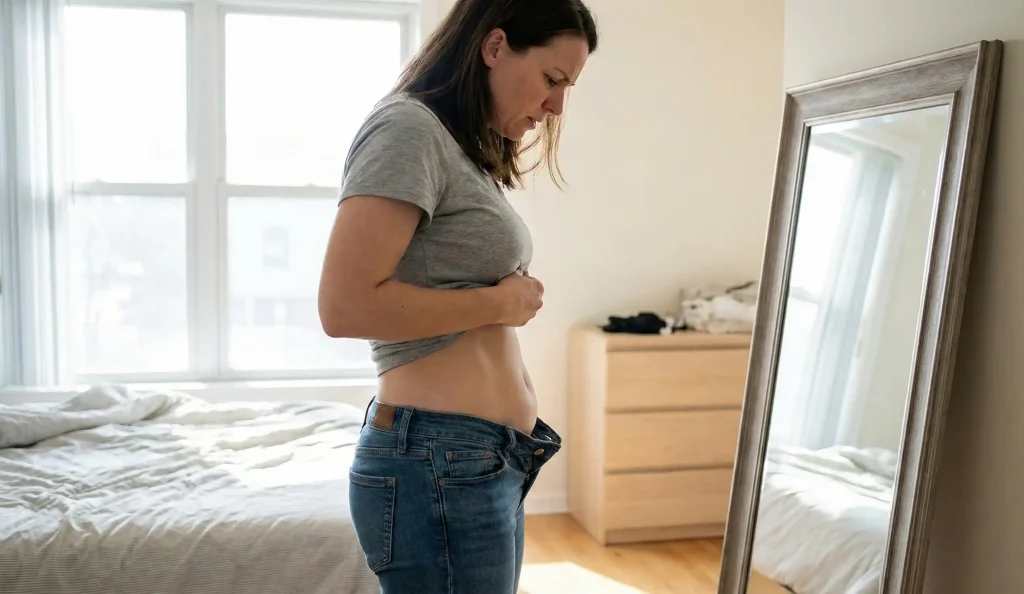
Before deciding on whether a liposuction procedure will be helpful for you, you first need to figure out what exactly your “pooch” consists of. Three main changes are developing the bulge in the pregnant woman’s abdomen. First of all, the body stores extra fat in the lower belly area, which is later used to cushion the fetus and provide energy during breastfeeding. This type of fat is very difficult to get rid of through diet and exercise because it is hormonally protected.
However, the other two factors have to do with the body’s framework. While the baby is growing, the skin is stretching at a rapid pace which, in many cases, results in the collagen network being damaged and the skin thereby losing its elasticity. At the same time, two vertical bands of your abdominal muscles may separate to make room for the uterus, a condition called Diastasis Recti. Liposuction is simply a fat-removal method; it is not a skin-tightening method and it certainly cannot bring the separated muscles together surgically. Thus, for the majority of moms, it only solves a third of the problem.
The Diastasis Recti Trap
One common mistake among new moms walking in for liposuction is the misdiagnosis of Diastasis Recti. Abdominal muscle separation allows the internal organs to push forward against the weakened abdominal wall, resulting in a round, protruding belly that is similar to the pregnancy bump, even if the patient has very little body fat. Crushing exercises or going to the gym will not help close this gap completely once the connective tissue has stretched to the point where it cannot spring back.
A liposuction surgeon essentially cuts all fat on the surface of the abdominal muscles in case there is Diastasis Recti. The reason for such a move is that fat removal specimens make muscle separation more obvious. You may notice an uneven stomach, or the protrusion may be strange in the center, and the skin may even appear wrinkly. The only treatment for this condition is a Tummy Tuck, which is designed to fit the muscles together and thereby flatten the abdomen.
The “Empty Bag” Effect: Loose Skin
Just picture a balloon that has been stretched for nine months, and then it was suddenly deflated; often the rubber is wrinkled, sagging, and is not able to return to its original form. If most of your “pooch” is made up of the loose, dangling skin—as it is called, an “apron” or pannus—then lipo is not a suitable method for you.
Liposuction essentially removes tissue volume from under the skin. For instance, if you take away the volume that underpins a pocket of loose skin, the skin will fold and hang even more than before and it may have a crepe-paper texture. Those with significant skin laxity can only be helped by the surgical excision of the excess skin. In this context, using liposuction will most likely only lead to dissatisfaction and the patient asking for revision surgery later.
Lipo Will Do What for Whom
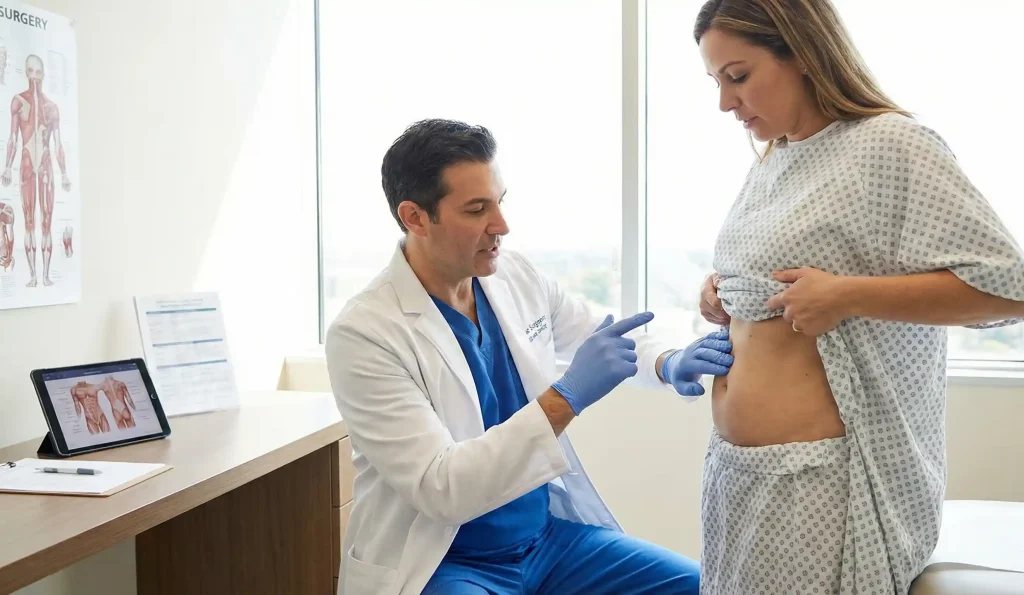
Liposuction is a perfect solution for a particular category of postpartum patients who have been fortunate with their genetics. The right candidate is a woman who has retained good skin elasticity—the surface of the skin is free from deep stretch marks and it quickly regains its shape after pinching—and whose core is strong and without muscle separation.
For such a woman, the mom’s belly is simply a very stubborn area of fat that refuses to respond to exercise. For cases such as these, we at Lin Europe Clinic go for vaser Liposuction. This is up-to-date ultrasound technology that laments the fat cells only, leaving the connective strands intact, thus it becomes easier to flatten the baby’s silhouette from only minute poke marks and a quite short recovery period.
The “C-Section Shelf”
Postpartum mothers can take advantage of the special condition of liposuction if they are suffering from the “C-Section Shelf”. This term is used to describe the intractable fold of fat that is over a tight C-section scar. The scar tissue sticking is tightly to the muscle allowing the usual fat above it to bulge out, and this creates an irregular ledge.
Liposuction is a great tool to help this transition go more smoothly. By melting the fat pit right above the scar with care, the area is flattened and some of the tension is released thus allowing the creation of a lovely, smooth abdominal outline. This is usually a really good “mini” answer for those mothers who don’t require a tummy tuck but want to correct a specific change in their shape after giving birth.
Why Choose Us for Postpartum Surgery in Turkey
Lin Europe Clinic is your trusted partner if you are planning to have postpartum surgery in Turkey because we are proficient in the comprehensive approach of “Mommy Makeover”. We don’t break down your body to individual parts in our assessment; we get the entire picture. Our surgeons utilize High-Definition Ultrasound Diagnostics to detect Diastasis Recti before they consent to perform liposuction, thus ensuring that the procedure being done is the most suitable one for the patient.
Here at Lin Europe Clinic, we will utilize Vaser technology alongside good technique to make sure your healing goes well and your skin is well protected. When a Tummy Tuck is required, it can be combined with 360 Lipo to both give you a new waistline and repair your muscles. We want to make sure that you get the operation that suits your anatomy rather than the one that just offers you quicker healing so that you can savor your results for a lifetime.
Frequently Asked Questions About Postpartum Lipo
You have to wait at least 6 months after giving birth or 6 months after you have stopped breastfeeding for your hormones to get back to normal and your uterus to return to its original size.
Control your weight gain during pregnancy so as not to stretch your skin excessively. Unfortunately, whether your skin bounces back or stays loose depends largely on your genes.
Yes, but you should wait at least 6 months after delivery or after you finish breastfeeding. It gives your uterus time to shrink and your hormone levels to stabilize.
If the bulge is mostly fat, diet and exercise work well. If you have muscle separation (diastasis recti), the only way to flatten the wall is to have surgical repair.
Deep core exercises such as Pilates can help to strengthen and pull in the abdominal muscles. However, very loose skin cannot be tightened by exercising and is only removable through surgery.
Matarasso, A. (2000). Abdominoplasty: A system of classification and treatment for combined abdominoplasty and liposuction. Aesthetic Plastic Surgery.
Brauman, D. (2008). Diastasis recti: clinical anatomy. Plastic and Reconstructive Surgery.
Nahabedian, M. Y. (2005). Pregnancy, lactation, and breast implants: clinical and legal implications. Plastic and Reconstructive Surgery.