
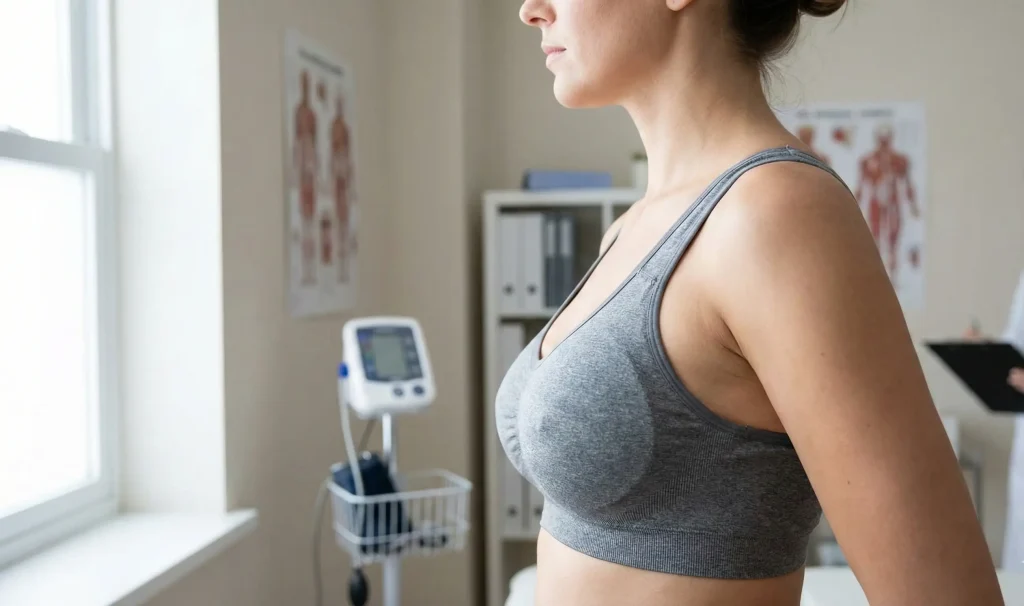
It may feel heavy at first but usually feel normal over time.
Before making a decision to undergo breast augmentation, most women initially think about what outcome they will see from the procedure. Some of the considerations about size, cleavage, and silhouette are normal. Nevertheless, the physical reality that comes with the aesthetic change is the addition of weight. A recurrent question that comes up during the consultations of prospective patients is, “Will I be able to feel that? Is it that the breast implants weighing on my chest?“
We believe at Lin Europe Clinic in Istanbul that if we provide our patients with good support, the patients would be able to imagine the sensory experience of the surgery better and not just visually. First of all, the human body is extremely flexible. This is why even though at the beginning, you will definitely feel the weight, after some time, the heaviness will only be a slight feeling to most women. Only a handful of the women whom we have treated have ever described the implants as feeling heavy after several months have passed following their breast augmentation. This guide discusses the weight of breast implants, the body’s adjustment, and when it can be a problem.
The Very First Days After the Surgery – The “Fake” Heaviness
Separating one from another the real weight of the implants and the feeling of tightness inside the first few days after the operation is very crucial. Your chest is over-weighted more than enough when you come out of anesthesia. It is the most common way patients explain this heaviness “like cement blocks” or “sandbags” being tied to their ribcage.
Why: Actually, it is mostly because there are swelling (edema) and autogenic spasm of the muscles but not only because of the silicone. Your tissues are very irritated to the point that they even produce more fluid for the inflammation resulting in the overwhelm of the weight.
The Timeline: When the swelling is gone and the muscle that was spasmed due to the operation is now relaxed (normally weeks 2-6), the feeling irritated of heaviness gone. What is left is the real weight of the implants.
The “New Normal”: Sensory Adaptation
Would a person who has a heavy watch on one of their wrists feel the weight all the time? Usually, the answer is no. This is because the brain is good at ignoring the constant sensory signals. This is a process called sensory adaptation.
When the first couple of months are gone, you might find it funny to discover that your body has already adapted to the extra weight without your even realizing it. For example, you might have a slight feeling of being pulled when you bend down to tie your shoes, the feeling of your body rolling and changing positions in bed, or the feeling of momentum when you run down the stairs. These feelings or slight directions of energy may be new to you. The fact is that as your skin stretches and your muscles become stronger to support the new weight of your breast, the receptors in your brain sending neural signals for awareness of the implant stop doing so. Most of our patients told us that breast implants became a natural part of their body and were no longer seen as an external attachment after 6 months of their surgery.
The Physics: How Much Do They Actually Weigh?

If you want to be shocked by the number, don’t go any further, but the reality is that it might be really helpful to know the real mass of the implants when you are in the planning stage of the procedure. Typically, the weighting properties of the standard silicone implants adhere to the 1:1 ratio, which means the volume of 1cc corresponds to a weight of 1 gram approximately.
300cc Implant: ~300 grams (0.6 lbs) for each breast. Total: ~1.3 lbs.
500cc Implant: ~500 grams (1.1 lbs) for each breast. Total: ~2.2 lbs.
Nevertheless, the difference and advantage of carrying a plus one kilogram (2.2 lbs) can also be seen in how it supports the body. In case the implant is given a place submuscularly, the pectoral muscle will become a sort of a sling and support the implant, thus the weight gets well distributed along with the robust chest wall, rather than it solely and directly hanging on the skin. The feeling of “drag” or heaviness is therefore significantly diminished.
Weight Issues
Certainly, most women can easily get used to it. However, the load might give rise to symptoms or problems in some circumstances.
Macro-Augmentation: Larger implants likely over 600cc can definitely be considered “heavy” by nature. The laws of physics are unstoppable; implants that weigh increasingly more put the spine and the shoulder area under the additional force.
Fragile Tissue: If it so happens that your skin is very thin and the connective tissue is weak, the sagging occurring as the implant weight stretches skin (ptosis), will happen faster. Thus, you will “feel” the breasts “pulling” down being more and more.
Physical Exercise: Runners or athletes doing high-impact exercises might find that the extra weight causes the momentum to be a bit “out of control”. That is the reason why a very supportive sports bra is a necessity rather than a fashion statement.
A Remedy: Lightweight Implants (B-Lite)
For patients who are bothered by the feeling of heaviness and especially active women or those who want a bigger size, technology has enabled a compromise. B-Lite implants are an innovative option that can be found in advanced clinics. By making use of microsphere technology, these implants manage to reduce the weight of the silicone by as much as 30% without the loss of volume.
The Math: Whereas a standard 500cc implant weighs 500g, a 500cc B-Lite implant weighs only about 370g.
The Benefit: Lesser weight would imply lesser tension and wear on the neck and back, lesser breast skin dilation, and a “lighter” feeling during everyday activities, over a lifetime.
Breast Implants in Turkey
Consulting an expert is the best way to reconcile your personal preference for size and the comfort of your body. At Lin Europe Clinic in Istanbul, Turkey, our board-certified plastic surgeons do not only inquire for the size of the bra you want. After taking your frame, the quality of the tissue, and your lifestyle into account, they suggest a volume that you could carry comfortably for many years.
Moreover, we take pride in giving an opportunity for those who want to have a full volume without the burden to be implanted with light-weight implants. Our service package all under one roof at Istanbul is built around you. You are able to physically weigh sample implants at the consultation, thus getting a fair idea of this weight not only in your hands but later in your body. We are waiting for you to go through a surgical experience where comfort is given the same level of importance as beauty.
Frequently Asked Questions About Implant Weight
It happens because you have a new implant weight and also your body is very swollen after the operation.
During the initial period, your breasts will be swollen with fluid (edema) which will make the weight of the breasts feel much heavier as compared to the actual weight of the implants.
Indeed, tightness is the symptom which is highly observed; especially when the implant is placed under the muscle.
No, that is a false statement. Breast implants are located on top of the rib cage (chest wall), whereas your heart is well protected deep inside the rib cage. The pressure that you feel is only muscular, not cardiac.
Indeed, especially if you had almost no natural breast tissue before the operation. It will take a few months for your brain and your posture to adapt to the new center of gravity and for your brain to stop seeing the weight as a foreign object.
Dover, H., et al. (2020). The effect of breast implant weight on spinal curvature and posture. Aesthetic Surgery Journal.
Govrin-Yehudain, J. (2018). Lightweight breast implants: A novel solution for breast augmentation and reconstruction. Aesthetic Plastic Surgery.
Maxwell, G. P., & Gabriel, A. (2016). Bio-dimensional planning in breast augmentation. Clinics in Plastic Surgery.