Time, proper support, and gentle movement.
It’s like this: you get the surgery, get over the anesthesia fog, and eventually get back home to rest. So naturally, the very first thing you’d probably want to do is to run to the mirror to see what the new you looks like. But for a lot of women, instead of being happy about this moment, suddenly anxiety sets in. You’re not seeing the soft, natural, tear-drop curve but instead, you’re looking at two very high, firm, and kind of “square” mounds that are way too close to your collarbone. You might be questioning, “Are they stuck? Wasn’t it the surgeon who put them too high? Can I look like this forever?“
Daily, at Lin Europe Clinic, we assure our patients that this “high and tight” look is not some permanent problem; it’s only the beginning of the physiological process that, in the plastic surgery community, is lovingly called “Drop and Fluff.” When it comes to this change, the main thing needed is patience; however, since it’s human nature, we tend to wonder if there is some kind of fast-forward button. Sure, you can’t beat biology at its own game, but knowing how muscle relaxation works will let you make a few small lifestyle changes that will help nature, dropping your implants more smoothly and efficiently.
The “High and Tight” Phase Is Basically Your Body’s Reaction
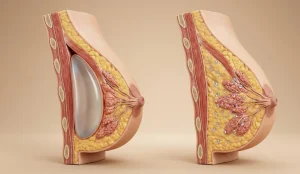
It is important first to realize that implants will sit high after surgery due to the very nature of the operation and the body’s reaction. The most natural long-term result for a submuscular breast augmentation (implant placement under the muscle) is the pectoralis major muscle was previously resting flat on the rib cage. Now with an implant, this muscle has to accommodate the new volume. To help heal this surgical trauma, the muscle spasms and contracts. Just like a clenched fist, this muscle spasm tightly holds the implant pressed high against the chest wall.
So, the “Drop” is the time the muscle is no longer able to hold this protective contraction; it relaxes and lengthens. This moment is when the implant actually comes down into the bottom of the new space. The “Fluff” is the process of the breast tissue becoming softer and the skin stretching. The skin is initially tight and tries to squeeze the implant. The implant feels hard because of this. With time, especially a few months, the skin will stretch more, and the implant will regain its natural softness and projection.
The Stabilizer Band: A Secret Weapon

If the surgeon decides to use a thick elastic strap on the upper chest, you will need to wear it consistently. This item known as the breast stabilizer band is the ultimate tool that can help the drop happen quicker. The band is not just some fancy thing; it exerts gentle, continuous, downward mechanical pressure on the upper slope of the breast. This pressure is a kind of counter-action to the pectoral muscle, which is tight, and it physically pushes the implant down through the resistance of the muscle fibers.
On the other hand, caution should be exercised in not doing too much. It is very common for patients to think tighter is better but it is very dangerous to over-tighten the band as possible consequences include forcing the implant too low (bottoming out) and causing circulation problems. The aim is a comfortable feeling with moderate, continuous pressure that persuades the muscle to give in – generally, it is worn for 24 hours a day during the first couple of weeks. So, don’t think of it as a punishment but a gentle guide.
Gravity: A Silent Helper
It may seem trivial, but the fact is that gravity is the most significant passive force among the recovery aids. Initially, you may feel inspired to stay in bed to avoid pain. But lying down removes the effect of gravity on the implants. You must be in the vertical position to allow the implants really drop. Going for a walk and keeping your torso upright helps the force of gravity to pull the implants down continuously, thus, making the implants settle their new pocket’s lower portion.
Besides that, your body positioning is very important. Pain is an unpleasant feeling, and naturally, we tend to use the “hunch the shoulders forward” and “chest inward” shields. But sadly, these “protective postures” really shorten the pectoral muscles and make them tight. If you keep your shoulders back and chest open, you will give the implant the necessary space to drop.
Don’t Wear an Underwire
Apart from a few other surprising things during the drop-and-fluff phase, clothes restriction is right at the top. Whereas patients generally believe that wearing a push-up bra to shape their breasts is the best, in fact, putting on a bra with underwire or any other kind of rigid support at this stage will hinder the drop of your implants. An underwire bra essentially is a shelf that makes it impossible for the implant to go down. You are working against the stabilizer band without even knowing it; the band pushes down, but the wire pushes up.
To aid the drop, stick to surgical bras made of soft fabrics or sports bras without underwire. Both of these types of clothing pieces will keep the swelling tightly controlled yet without creating a barrier at the bottom of the breast. What you really want is for the lower part of the breast to be able to expand and relax.
How to Deal with the One Side That Looks Different
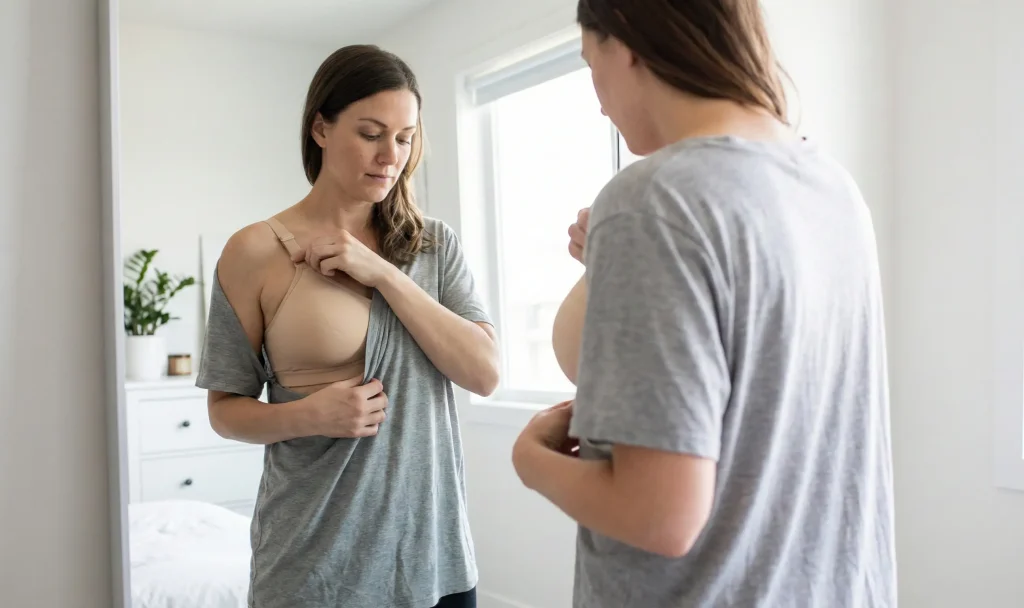
Asymmetry during the breast implant recovery process is a primary source of stress. Occasionally, one breast comes down fine, whereas the other just remains high and stubborn. You might freak out and think the surgeon made a mistake, but almost all the time, that is not the case. It is very much a sign of your anatomy because we are mostly one-sided, resonant with the fact that one of our hands is more dominant. As a result, one pectoral muscle is going to be stronger, tighter, and more used to working than the other.
The dominant muscle is generally the more stubborn one when it comes to stretching. Therefore, if you are right-handed, it will not surprise us if the right implant takes a bit longer to drop than the left. The stronger muscle simply can give more resistance before it actually relaxes. Knowing this biological fact can spare you a lot of trouble and stress.
Turkey for Breast Implants
It requires the surgeon’s accuracy and the patient’s discipline that the implants go from being “high and tight” to “drop and fluff.” At Lin Europe Clinic in Istanbul, Turkey, we do more than just operate and send you off; we guide you every step of the way through this recovery timeline. Our surgeons are very particular about the pocket dissection so that the implant will be in the perfect spot after the drop.
We, at Lin Europe Clinic in Istanbul, provide you with proper post-operative bandaging and stabilizer bands based on your measurements. We know very well that that waiting is painful, but with professional help from a cutting-edge medical environment, you can be sure that your final aesthetic is worth it.
Frequently Asked Questions About Dropping and Fluffing
Gravity, wearing a breast stabilizer band consistently, muscle relaxation (through heat or medication), and not wearing restrictive bras with underwire are the main contributors to implant dropping and fluffing.
Most changes are to muscle that is between weeks 4-6 stages 4-6 as the muscle relaxes. However, the last stage of “fluff” and softening of the tissue can take 3-6 months.
The reason is probably muscle dominance. As a person is right-handed, the right pectoral muscle is stronger and tighter. Therefore, it takes longer to relax and release the implant on the right side than on the left.
Yes, especially “downward displacement” type of massage which can help stretch the lower pocket. But only go ahead with this if your surgeon has given you a green light because not all implant types are suitable.
If after 6 months an implant is still positioned high, it could be that the implant is “malpositioned” or that the capsule around it is so tight that it cannot move. This is very rare, but it may be necessary to undergo a minor revision surgery to open the pocket.
Adams, W. P. (2008). The process of breast augmentation: Four phases of care. Plastic and Reconstructive Surgery.
Bengtson, B. P. (2011). Complications, adverse events, and reoperations in breast augmentation. Clinics in Plastic Surgery.
Spear, S. L. (2010). Surgery of the Breast: Principles and Art. Lippincott Williams & Wilkins.