Usually after four to six weeks.
The Day 1 to Day 30 Back-Sleeping Mandate
Postoperative sleep position adjustments following a breast augmentation procedure are crucial and require utmost caution, especially in the field of aesthetic breast restoration and high-definition body sculpting. Your healing breast tissues, along with the anatomically precise pockets containing your cohesive silicone or saline implants, will be highly susceptible to any external forces for a considerable time after the surgery. From a clinical point of view, it is not possible to sleep on your stomach or sides at all, even for a minimum of 4 to 6 weeks after a breast surgery.
Within the first 30 days after the surgery, your body will undergo remodeling and formation of internal protective tissue (scar) around the implant. If you sleep on your stomach, your whole upper body weight will be directly exerted on your newly augmented breasts. This incredible mechanical pressure can cause biological risks such as deep internal suture tearing, implants shifting from the desired position, incision enlargement, and asymmetrical fluid retention.
The Physiological Risks of Premature Sleeping
A premature transition to other sleeping positions lessendthe stability of the implant and introduces several different biological consequences.
- Displacement of the implant and overstretching of the lateral pocket: Side or stomach lying the implant will heavily shift under the force of gravity. The pressure will be able to overstretch the margins if the pocket isn’t fully closed and stabilized along the borders. This might cause a problem such as bottoming out or lateral displacement (implants shifting into the armpits) to occur.
- Stress on incision lines: Regardless of the access path, under the breast fold or around the nipple, early wound closure requires no tension so that it heals as a fine, faint line. Placing your body on the front will result in shear stress directly applied across these closures, risking wound separation or scar thickening.
- Increased rebound edema: Lying flat or prone is not the best position for lymphatic drainage. As a result, at the two-week mark, adopting a stomach-sleeping position will cause an immediate onset of localized swelling and tightness, which will prolong the inflammatory phase.
Methods for Preserving Structural Lines and Transitioning Sleep Positions

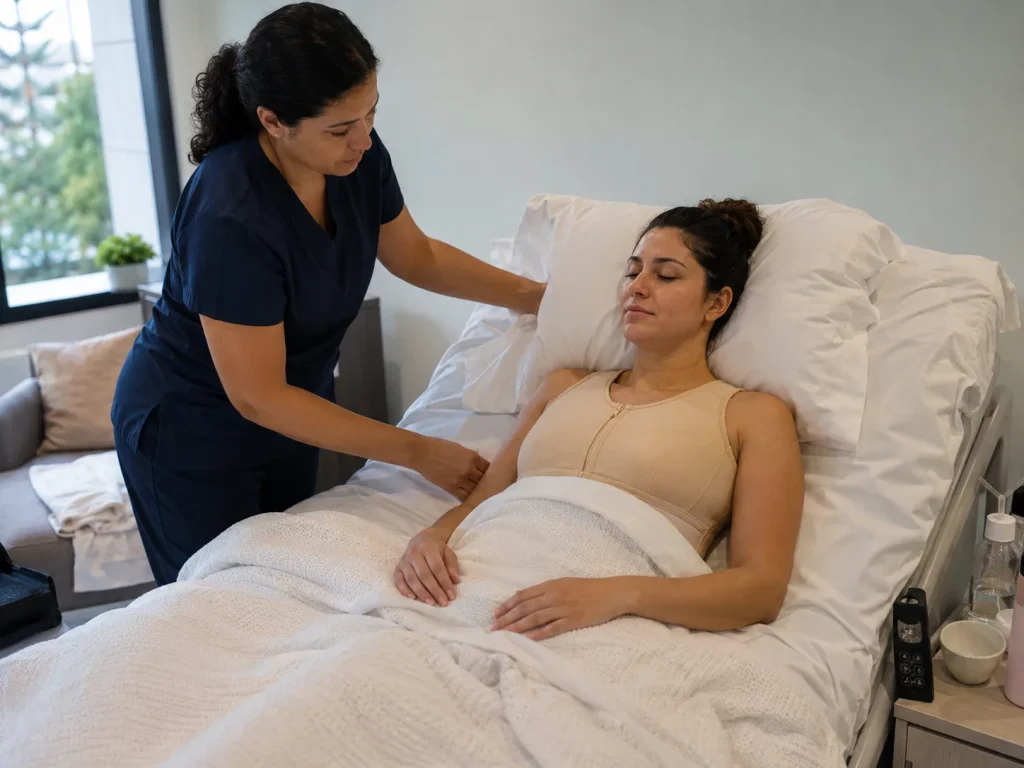
For individuals with a disciplined lifestyle who demand absolutely perfect profiles, strict protective boundaries while sleeping are of paramount importance. Your breast framework beneath the device needs to be absolutely stable during the night in order for the implants to settle evenly in the lower poles, following the delineated anatomical contours. A 30-to-45-degree head and torso elevation is necessary using a wedge pillow made for the purpose or a series of firm bed pillows for the first fortnight in order to limit support to the device for advanced bustline stability with structural precision. The use of this elevated, supine position will maintain your blood pressure at a constant level, work with gravity to quickly clear post-surgical fluids, and prevent you from rolling over.
Moreover, to build a physical barrier that will prevent you from switching positions in your sleep unconsciously during deep sleep cycles, body pillows should be placed side by side very tightly against both sides of your waist and torso. Furthermore, total abstinence from nicotine and tobacco products is to be strictly adhered to without any exception for the entire duration of your sleep-rehabilitation period. Nicotine is a very powerful vasoconstrictor systemically; it narrows the micro-vessels, cutting off the supply of oxygenated blood to the skin envelope, expanding the walls of the internal capsule that are healing, thereby preventing them from undergoing their nighttime cellular repair in a clean manner.
Recovering and Reverting to Habitual Sleeping Positions
By recognizing that the biological process of stabilizing the pocket and tissue settlement unfolds gradually over time, patients are able to arrange their transition back to their favorite sleeping positions with full assurance and without any anxiety or concern arising from their lack of knowledge on the subject.
| Recovery Phase | Approved Sleeping Position | Underlying Biological Activity & Rationale |
| Weeks 1–2 | Strictly on your back; head elevated 30°–45° | Accelerates fluid drainage; eliminates acute muscle tension and friction. |
| Weeks 3–4 | On your back; completely flat | The acute inflammatory phase subsides; internal incisions close completely. |
| Weeks 5–6 | Cautious side-sleeping (with surgical bra) | Early capsule matrix stabilizes; minor lateral gravity shifts will not deform the pocket borders. |
| Week 8+ | Stomach-sleeping approved by surgeon | Full pocket encapsulation is complete; tissues achieve mature tensile strength. |
Breast Implants in Turkey
LIN Europe Clinic is synonymous with a premier global medical oasis where uncompromising clinical mastery, profound empathy, and the highest solidarity in breast aesthetics, body contouring, and surgical paths are managed. The journey of physical recovery, tissue adaptations, and lifestyle changes necessary for an outstanding breast augmentation is a multifaceted task that we acknowledge requires a transparent, supportive environment, sophistication, and a priority of evidence-based medicine in the first place. LIN Europe Clinic in Turkey is not only an international leader in breast remodeling and plastic aftercare but also a place of serenity where your health is guided by the highest global patient safety standards.
Trust and confide in the team of specialists at LIN Europe Clinic in Istanbul so that your recovery and tissue parameters are monitored with diagnostic precision. We provide a comprehensive and personalised post-operative calendar, high-definition tissue-kinetics evaluations, and healing guidance through checklists to take you step-by-step in each phase of tissue maturation and lifestyle integration. Our first-rate medical personnel take every measure to ensure the protection of your body contouring investment and systemic health, so that you will be able to relax and enjoy your dream silhouette without any worries. Discover the exclusive and complete care of LIN Europe Clinic and produce a perfectly balanced canvas through a secure and skillful manner, in the heart of Turkey.
FAQ:
Generally, you can start sleeping on your stomach or side without worry about your implants after 6 to 8 weeks from the surgery. This, of course, depends on your surgeon’s final confirmation that your implant pockets inside are fully healed and stable.
If you wake up on your side and feel no sharp pain or sudden bleeding, you likely haven’t disrupted the implants. However, you should immediately return to your back and tighten your pillow barriers to prevent it from happening again.
Sleeping elevated at a 30-to-45-degree angle for the first 14 days is essential to keep post-surgical swelling to a minimum, relieve tight pressure on your chest muscles, and prevent you from rolling onto your stomach.
Absolutely not. You must wear your seamless, wire-free post-surgical support bra 24/7 for at least 6 weeks. This compression garment holds the implants securely in place and prevents them from shifting while you sleep.
Yes. Sleeping on your side before the 4-to-6-week mark places uneven gravity pressure on the healing tissues, which can over-stretch one side of the surgical pocket and cause the implants to heal symmetrically off-center or crooked.
Tebbetts, J. B. (2002). Dual plane breast augmentation: Optimizing tissue coverage, managing sleep elevation vectors, and long-term pocket stability. Plastic and Reconstructive Surgery, 109(3), 1017-1024. Spear, S. L., et al. (2007). Breast implant life expectancy and cosmetic longevity: Analyzing structural shell failure, pocket geometry, and positioning parameters. Plastic and Reconstructive Surgery, 120(7), 89S-99S. Rohrich, R. J., et al. (2014). Advanced postoperative care, pocket geometry engineering, and long-term architectural stability in secondary breast augmentation. Aesthetic Surgery Journal, 34(5), 587-595.