
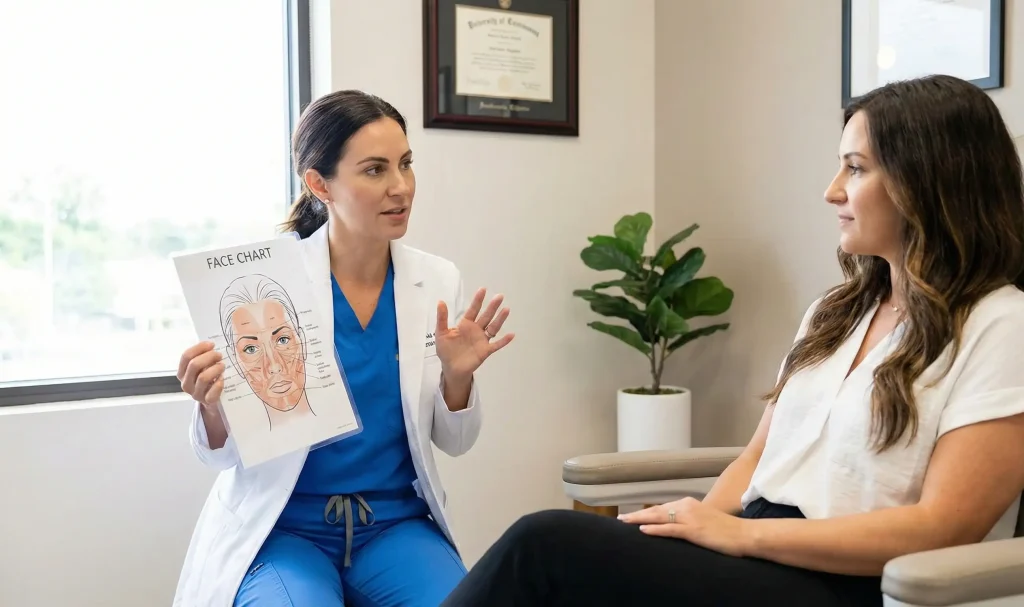
Skin tightening with injectables or devices.
The wish to reverse signs of aging is quite common among patients. On the other hand, the hesitation to take a scalpel and get a surgical facelift is also very common. You can spot on your face the signs of age – drooping eyelids, sagging cheeks, or your jawline looking less defined. But at the same time, you are not willing to bear the pain, scars, and permanence which is part and parcel of the traditional surgical facelift. A non-surgical facelift has thus become very popular as a result.
We at Lin Europe Clinic believe the phrase “Non-Surgical Facelift” is rather misleading and usually leaves patients helpless since they assume that with a syringe, one can get surgical results. We advocate transparency; therefore, we think that even though these treatments are potent, they are still quite different from surgery.
Simply put, a non-surgical facelift is a customized combination of minimally invasive treatments that are intended to refresh your face. It usually consists of three main components: restoring volume ( with a filler), relaxing muscles (using neurotoxins), and tightening skin (with energy devices or threads). A surgical facelift involves the physical removal of excess skin and muscle tightening; on the other hand, non-surgical methods use concealment and collagen production to get the desired effects. The condition of the skin of the patient possessing some firmness and elasticity with only very few lines is the best for non-surgical methods.
The “Liquid Facelift”: Structural Volumizing
A lot of non-surgical facelift procedures today rely on dermal fillers and sometimes people refer to them as a “Liquid Facelift”. After years and years of living, our face’s bone density and fat pads have become thinner, which is the reason for the skin sagging and looking like a dress that is now too big for the body. Without surgery, we can´t make the dress (skin) smaller, but we can fill out the body.
We inject Hyaluronic Acid (HA) fillers with a high density right at the bone level to recreate the skeletal structure. Both cheekbones and a well-chiseled jawline will be the main areas where the filler will be placed so that the face is lifted and the cheeks look fuller. The filler provides an instant “lift” as it is a re-inflation of the support system underneath. Botox is used to smooth dynamic wrinkles on the forehead and eyes. The combination of both the treatments results in a rejuvenated, well-rested appearance that takes a few years off the face without even the need for a lunch break.
Energy-Based Tightening (HIFU and RF)

Your skin can be nicely volumized with fillers but it can never be the same as with native skin with good quality and tightness. For these purposes, we use energy-based devices. HIFU and RF Microneedling work by delivering heat to the skin at a very precise temperature (usually 60-70°C).
The controlled thermal damage stimulates the production of collagen and elastin to be renewed and tightened. It takes a period of 3 to 6 months for this “shrink-wrap” effect to be fully developed. One should not expect a drastic change when it comes to the removal of excess skin; however, it is quite possible to significantly firm up the jawline and neck. It is a slow-burn approach; you won’t see the full result immediately, but the improvement is entirely natural and comes from your own biological resources.
The Thread Lift: Mechanical Suspension
For those who want to have a facial lift, but at the same time, dare not to go under a surgery, Thread Lift makes a perfect choice. Besides, it may also be a good choice for those who only want to have fillers, but their skin is so loose that fillers won’t be sufficient. In this procedure, less invasive, dissolvable sutures (PDO or PLLA) are inserted under the skin using a cannula. These threads have tiny barbs or cones that grab onto the tissue. The doctor pulls the thread taut, physically lifting the sagging skin upwards, and anchors it.
On the one hand, the lifted skin is by the pulling of the thread up; on the other hand, the thread that gradually dissolves produces new collagen and elastin to rejuvenate the skin. The scar tissue left by the resolving of the threads helps to maintain the lift. It is, therefore, no wonder that it is called the weekend facelift as the recovery time is quite short when compared with the results that are comparable with the surgery. Despite that, the effect is not permanent and lasts for 1-2 years.
Who Is the Right Candidate?
To a certain extent, it is necessary for you to set your expectations reasonably so that you can be satisfied with a non-surgical facelift. The perfect candidate for such a treatment is a person with what is considered to be mild to moderate laxity of the skin. So if you are someone who has deep enough jowls, or a “turkey neck” or a face that is prone to shedding, non-surgical methods will let you down. If a face is heavy and sagging, fillers cannot be used to raise it; in fact, the situation may get worse as it would appear puffy rather than lifted if excessive volume is added to a sagging face.
This is a preventive approach in a way – the early signs of aging are treated before they get deeper. It is also great for people who cannot undergo general anesthesia due to their medical condition or those who simply do not want to bear the two-week recovery time required for surgery. If your desire is for a subtle, “you look rested” kind of result as opposed to a dramatic transformation, then this is your way.
Maintenance and Longevity

An important aspect that a person must weigh in with non-surgical options is the length of time that the result will stay. After having a surgical facelift, one can say that he/she has made a purchase that would go on to last 10 or 15 years. When it comes to a non-surgical facelift, it is rather a renting. Fillers get metabolized, Botox effect wears off and finally, the newly formed collagen breaks down. In case you want to keep your face looking younger, you have to make a commitment to keep yourself always updated.
The effect of Botox usually lasts for 3-4 months before another treatment is needed. Fillers can last about 12-18 months, whereas energy treatments are done approximately once a year. Even though the first cost is lower than that of surgery, a person may be spending more if he or she considers the cumulative cost of the treatments over several years. During the consultation, we discuss these in details and assist the patients in making a choice that would financially make sense to them.
Non-Surgical Rejuvenation in Turkey
The reason why you should consider Lin Europe Clinic for your non-surgical facelift in Turkey is that we bring surgical anatomy knowledge at the level of using non-surgical tools. Our injectors and dermatologists in Istanbul are not just people that treat wrinkles with fillers, but professionals that truly understand the structure of a face. We only use premium, FDA-approved products (such as Juvederm, Restylane, and Botox) as well as genuine energy devices (such as Ultherapy), thus your safety and results are definitely not compromised by counterfeit materials.
One of the benefits of coming to Istanbul for your treatment is that you can turn it into a whole “beauty holiday” experience by staying a few days longer. You can have your treatment and then go around the city since the recovery time is very short. While your treatment is effective in giving you a new look, we also make it a relaxing day for you with our VIP transfers and luxury accommodation. At Lin Europe Clinic, we create a treatment “stack” that fits your unique pattern of aging, and give you a radiance that comes effortlessly.
Frequently Asked Questions About Non-Surgical Facelifts
Typically, the results last somewhere between 12 to 18 months, depending on what sort of fillers and threads are used. Botox elements tend to go away quicker, usually in 3 to 4 months.
The discomfort level is very low. We apply a numbing cream and for threads, local anesthetic injection is also given. Most fillers also have lidocaine in them so the injected area gets numb from the inside as well.
Not at all. It is able to provide an improvement to mild sagging and volume loss but it is not capable of getting rid of excess skin or tightening the deep muscle layer (SMAS). If your skin is significantly loose, the only effective method is surgery.
This procedure only appears to be fake if it is overdone. When it is done correctly by a professional who thoroughly understands anatomy, the result looks very natural. The “puffy” appearance is a result of using an excessive amount of filler in the wrong areas.
Certainly, yes. Actually, taking good care of your skin by means of energy devices and maintaining volume with fillers can make you a better surgery candidate in the future, provided that you stay away from the permanent fillers.
Fabi, S. G. (2015). Noninvasive skin tightening: focus on new ultrasound techniques. Clinical, Cosmetic and Investigational Dermatology.
Savoia, A., et al. (2014). PDO threads: a new concept in aesthetic medicine. Dermatology and Therapy.
De Maio, M. (2015). Myomodulation with injectable fillers: an innovative approach to addressing facial muscle movement. Aesthetic Plastic Surgery.