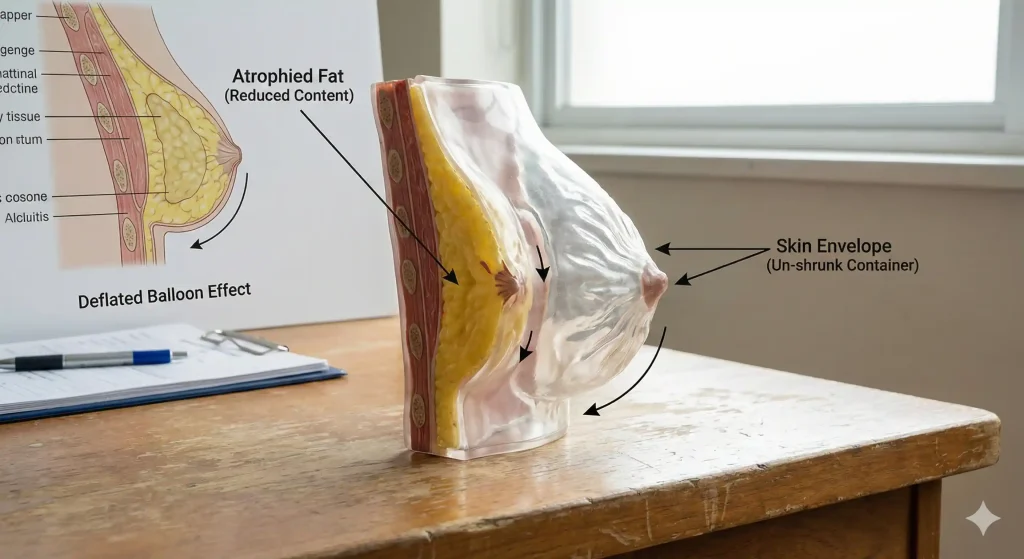
Rapid weight loss reduces breast fat and skin support.
The rise of semaglutide-based drugs like Ozempic, Wegovy, and Mounjaro has transformed the whole field of slimming by enabling millions to lose an extraordinary amount of weight in a surprisingly short time. However, this wonder drug has come with an aesthetic challenge that plastic surgeons have been encountering on a daily basis: “Ozempic Breast”. A patient may be so excited about their weight loss on the scale that they forget to be shocked by their breasts appearing without their former volume, drooping and making the patient’s look older and more “deflated”.
Actually, the phenomenon is not a direct chemical effect of the drug upon the breast tissues. Rather, it is a mechanical and biological aftermath of breaking down the fat you had stored very quickly and in great amount. The composition of breasts mainly consists of two elements: glandular tissue (milk ducts) and adipose tissue (fat). For the majority of women, fat accounts for most of the breast size. If Ozempic instructs your body to use the fat stored in the body for energy, it doesn’t give preference to any area. It will be as if the fat in your breasts is just as attacked as the fat around your waist, thus causing a situation of the upper chest being hollowed out and extreme sagging (ptosis) that is in such sharp contrast with your body.
The Speed Factor: The “Deflated Balloon” Effect
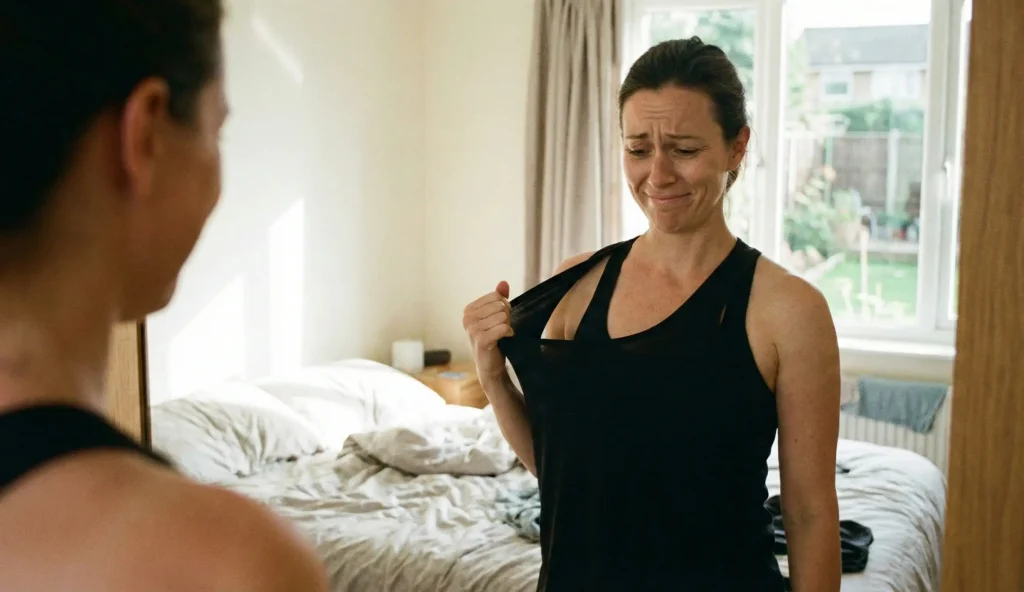
The main culprit of Ozempic causing breast sagging is the speed of the weight loss. When you lose weight slowly (say, 1-2 kg monthly) via normal diet and exercise, your skin naturally has time to adjust to the new, smaller body. The dermis elastin fibers can thus gradually get used to the new volume.
With GLP-1 agonists, the situation is different. A patient can lose 10-15 kg in just a couple of months. It is this sudden shrinking that severely affects the skin’s elasticity. Think about a balloon that has been inflated fully over a long time: once you rapidly deflate it, the rubber does not return to its original tight shape but becomes wrinkly and loose. In a similar manner, your breast skin has been “programmed” for a “Large” size and is thus still stretched out, whereas the volume has abruptly dropped to a “Small”. This leftover skin folds under the force of gravity resulting in a long, flat, or “pancake” form that no cream can restore.
The “Nutritional Deficit” Impact on Collagen
Besides this, another less visible factor leading to Ozempic Breast lies in the nutrition side of eating less due to drug-induced appetite suppression. These medications achieve the effect of less eating by significantly reducing hunger which results in patients unknowingly eating a lot less. But if not appropriately controlled, this calorie restriction can leave you protein- and microelement-deficient.
Your skin’s main structural proteins, collagen and elastin, which help maintain your breasts’ firmness and perkiness, are able to produce new ones only with the aid of amino acids supply. When you’re on a very low regimen, the body chooses to keep alive the working of major organs at the expense of skin elasticity. Hence, the situation of “starvation mode” aggravates skin aging making it even more obvious than that from weight loss alone. This is the reason why we notice that the skin of the breasts of Ozempic patients is thinner and more crepey than that of patients experiencing natural weight loss.
Loss of Structural Support (Cooper’s Ligaments)
Within your breast, there is a bunch of connective tissue known as Cooper’s Ligaments. This internal bra does the job of binding the mammary gland to the chest wall. When the breast is full of fatty tissue, the ligaments are under tension and the volume internally pushes against them.
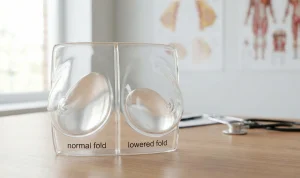
Once the fat rapidly disappears, the tension thus present internally is gone along. The ligaments become like a hammock without its supporting trees, i.e. slack. The heavy glandular component without the support of the fat being the “stuffing” descends the chest wall and it even overpasses the inframammary fold (the breast crease). This is the reason why no amount of exercises aimed at the chest (bench presses or pushups) can work to bring the skin up again after it has been loosened; you will be able to build your muscle behind the breast but you cannot make your skin or ligaments tight again through exercise.
The “Ozempic Face” Connection
Volume loss, as such, takes place all over the body, not just in one part. In fact, thinking about this can help us understand what is happening to our breasts’ volume when we talk about “Ozempic Face”, a term coined by patients who feel that their faces look emaciated and older because of the disappearance of buccal fat pads. Both breasts and faces got their youthful shape from layers of subcutaneous fat. When the fat is removed, the structures beneath (bones for the face, ribs for the chest) become more prominent. The “Upper Pole” of the breast (the cleavage) is the first part to be hollowed out resulting in a skeletal look that most people find rather disturbing. It is precisely the same aging process that prompts most patients to want to surgically address both their face and breasts after reaching their target weight.
Surgical Safety: The Anesthesia Risk
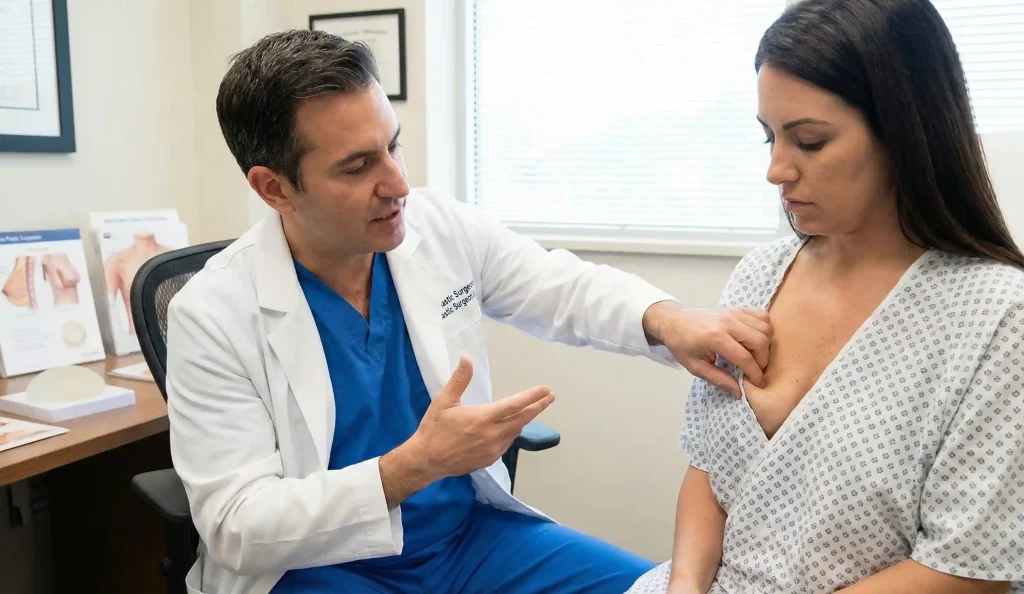
Lin Europe Clinic also insists on an important safety measure about Ozempic and surgery. Since these drugs act by slowing the stomach emptying (the food in your stomach stays longer), there is a great risk of aspiration if the stomach is not empty when anesthesia is administered.
Should you opt for a surgical breast correction, you have to discontinue Ozempic usage at least 1 to 2 weeks before your operation. If you fail to do so, you may be risking your life of a complication where the stomach contents get into the lungs at the time of the surgery. We value your life far above your looks; therefore, a complete disclosure of your medication is a must.
Frequently Asked Questions About Post-Lipo Diet
Breasts normally have a large amount of fat tissue and therefore when Ozempic induces a rapid overall fat loss, the breasts become smaller as well. This shrinking of volume is usually so fast that the skin doesn’t have time to adjust and hence the breasts look deflated.
Generally, when the skin has been stretched and the fat underneath has completely disappeared, it doesn’t just bounce back. The loss of the skin’s ability to stretch is in most cases permanent and only surgery can fix the tightening.
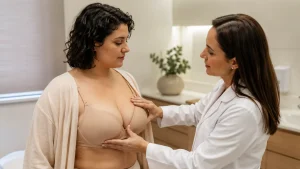
The sure-fire way is a mastopexy (breast lift) to physically take away the excess skin and do the reshaping of the mound. Some patients of the procedure also use implants or fat grafting to replace the upper pole volume that is lost.
It basically happens because Ozempic promotes weight loss so rapidly that your skin doesn’t get the chance to shrink-wrap naturally around your smaller size. Instead of tight skin, this “deflated balloon” effect makes the skin look loose, crinkled, and empty.
If you go off the drug and regain weight, the fat could come back to the breasts but the over-stretched skin would probably still be loose. Thus, you may end up with heavier, more droopy breasts rather than getting your original perky breasts back.
Rubin, J. P., et al. (2019). Body contouring in the massive weight loss patient. Plastic and Reconstructive Surgery.
Hurwitz, D. J. (2004). Single-stage total body lift after massive weight loss. Annals of Plastic Surgery.