
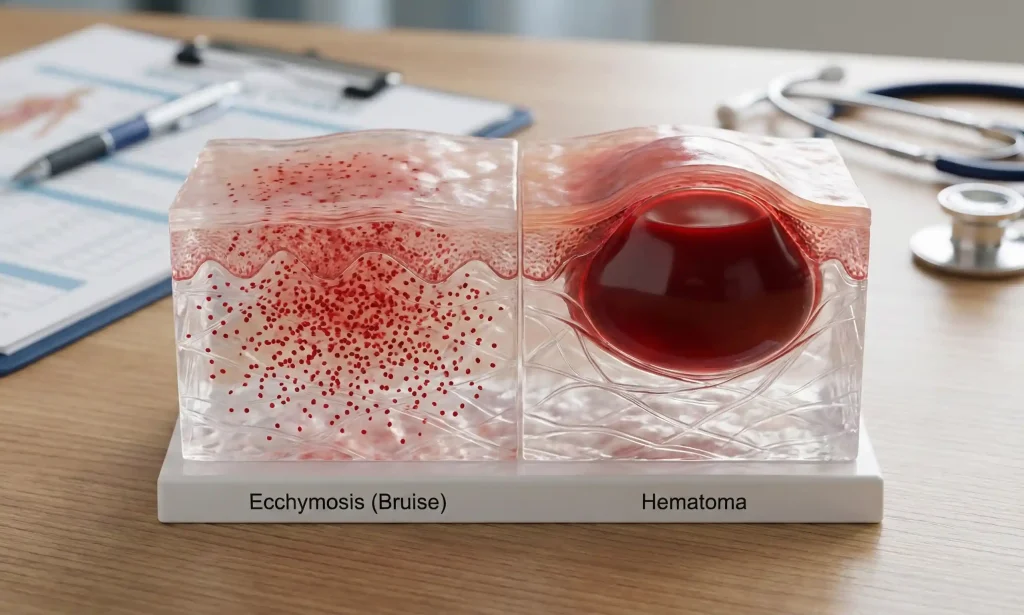
If bruising worsens or doesn’t fade after weeks.
Waking up after surgery is relieving and exciting, no doubt; however, many patients get quite a shock when they first see their post-surgery bodies in the mirror. The skin, especially around the incision sites, may appear bruised like a black eye in shocking blue, purple, or very red shades, being very inflamed. Naturally, pain and swelling are expected, but the mere visual appearance of post-surgical bruising, medically called ecchymosis, can be so frightening that it literally makes patients physically see red. They even send pictures to our emergency line, asking in the first 24 hours or so, “Is this normal? Did you make a mistake?”
Actually, bruising is a near-certain side effect of any invasive surgical procedure. It is the thing that happens when blood escapes through the walls of tiny blood vessels that were broken during surgery and pools under the skin. Although it looks dramatic, it is often not harmful and will disappear without any treatment. Nevertheless, there are a few situations when a bruise is more than just a simple discoloration and actually indicates continuous bleeding or an injury that requires medical care. Knowing how to tell the difference between the healing process which is not so pretty but normal and a real medical emergency is an essential skill every plastic surgery patient should master.
The Colorful Timeline: Understanding the Stages of Healing

Before you can decide if there is something that needs your attention or not, you have to have an idea of a normal bruising timeline. Bruising is a biological clock which marks the time of the injury by the color of the hemoglobin breaking down under your skin. The color of bruises right after surgery (Days 1-3) can be red, blue, or purple. These colors represent oxygen-depleted fresh blood. It is expected that the bruises will be very visible during this period and even grow slightly within the first 48 hours, since the residual bleeding stops and the blood spreads out within the tissues.
When the body starts to break down the blood cells (Days 5-10), the bruise will be green or yellow. This change means that your body is actively getting rid of the waste products which is wonderful. After this, the bruise will become light golden-brown and eventually disappear, typically by the end of the second week. Your body is doing exactly what it should if you follow the color changes of the bruise. Generally, you only need to worry if the bruising stays dark purple or black, continues to grow significantly after the first three days, or if bruises show up in new locations weeks post-surgery.
The Red Flags: Distinguishing a Bruise from a Hematoma
The most important decision that a patient will have to make is to determine whether it is simple ecchymosis or a hematoma. While ecchymosis is just a bleeding stain in the skin, a hematoma is a larger blood clot contained in a pocket that is usually the result of one bigger blood vessel that has been bleeding and its opening has not been properly closed. Hematoma is not a mere aesthetic concern as it is a condition which can cause necrosis of the skin or spoil the surgery result.
If a site that was previously a discolored spot is growing rapidly, swollen and is becoming hard and painful, then you should be worried. The difference between a normal bruise from hematoma is that the former one, when touched, feels soft, while the latter one is usually felt as a hard, tense ball or a water balloon under the skin. It might also come with “asymmetrical pain,” which means that one side of your body is way more painful than the other side. For example, after breast surgery, if one breast swells up to twice the size of the other and turns dark purple, then it is a hematoma example. In such scenarios, you should get in touch with your surgeon asap as the blood being trapped may require surgical drainage to relieve the pressure.
The Gravity Effect: Why Bruises Travel Downward
Bruise migration is one of the things that really frighten patients. Somebody who has had a tummy tuck might find their genital area or thighs black and blue and a facelift patient might have bruises on the chest five days later. This kind of situation results in patients rushing to their doctor and questioning themselves if they are bleeding internally in new places.
That is simply how gravity works. Blood is a liquid that behaves like any other liquid, i.e. it flows down following the least resistant path. After the blood in the surgical area breaks down and turns into liquid it makes its way down your body along the fascial planes. It is entirely normal for bruises on the face to collect in the neck or for those on the belly to collect in the area of the groin or on legs. The “traveling bruise” is not a bleed since it is actually the old blood that is moving and breaking down. You will only have to worry if the original surgical site starts to swell again, but otherwise, the appearance of a lower-body bruise is nothing more than a cosmetic bother.
Managing the discoloration: Supplements and Lifestyle
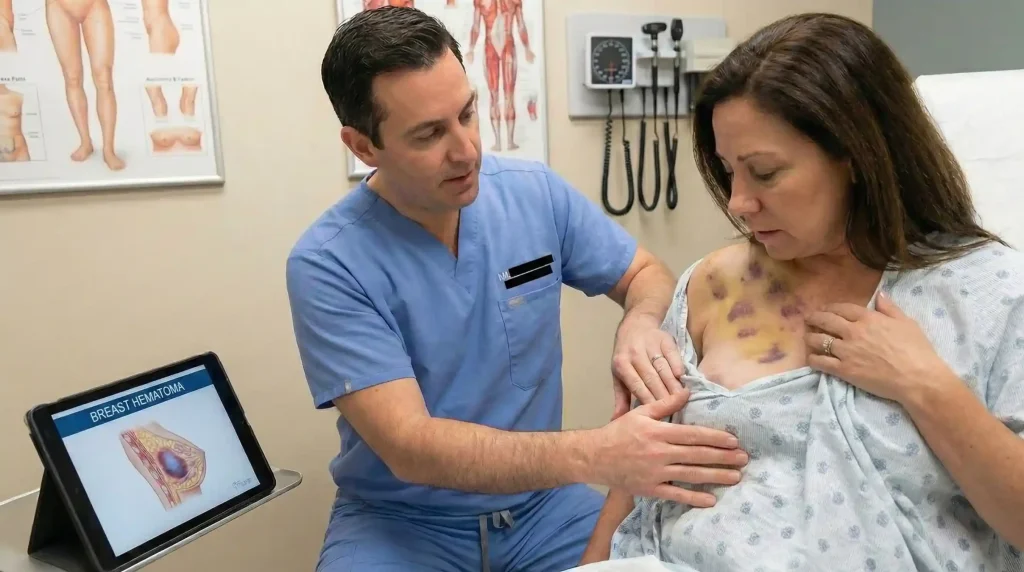
Though you won’t be able to stop bruises completely, you can make them disappear much faster. The idea is to facilitate the lymphatic system in clearing the cell debris. Aspirin ibuprofen and Vitamin E are examples of blood thinners which we strictly prohibit from being used within at least a week before and after surgery because they interfere with clotting thereby turning a tiny bruise into a huge purple patch. Another thing that is most likely to cause bruising is alcohol; when you drink wine during the postoperative period, your blood vessels dilate thus bleeding can be re-initiated in healing tissues.
However, supplements such as Arnica Montana and Bromelain (an enzyme present in pineapples) have been demonstrated to assist in not only lessening the severity but also the duration of ecchymosis. While Arnica lowers the swelling, Bromelain functions as a “cleanup crew,” dismantling the proteins in the trapped blood so the body can absorb them faster. Within the first 48 hours, applying cool compresses constricts the vessels and thus limits the spread whereas after day 3, switching to warm compresses dilates the vessels and hence, the stagnant blood gets flushed away. In any case, heat should be used with great care so as not to burn numb skin.
Lin Europe Clinic: Preventing Trauma Before It Starts
Lin Europe Clinic in Turkey thinks that the right approach to bruising is first and foremost preventing it in the operating room. “Atraumatic technique” has been the central idea of our surgical method. We use technologies like VASER Liposuction to carry out procedures in an even more controlled way. VASER liposuction uses ultrasonic energy to partly dissolve fat cells before their elimination thus allowing the preservation of the connective tissue and what is more important the blood vessel network that the traditional, aggressive liposuction might tear. By preserving the vascular network we are able to reduce bleeding significantly and hence bruising as well.
Besides that, our surgeons are extremely careful about hemostasis on a microscopic level. They even double-check every single small vessel… We also put in preventative drains for bigger operations such as tummy tucks. This is because the main goal here is to get the excess fluid out of the body as opposed to letting it accumulate under the skin. Our post-operative surveillance is so thorough that we catch the earliest signs of a hematoma just by checking your skin perfusion regularly. We understand less bruising equals less pain and faster social recovery thus, you can get out of the ‘witness protection’ phase and fully enjoy your new look.
Frequently Asked Questions About Bruising After Surgery
Bruising after surgery does tend to worsen before it gets better. Usually, bruising reaches its maximum extent on the third or fourth day. The blood underneath the skin moves around and the area looks bigger and darker before the color fades.
A hematoma may be felt as a hard, painful lump that rapidly increases in size, and the skin over the area may become tight and shiny. Typical bruising after surgery is flat and soft. If you find a hard mass, contact your surgeon.
Signs of color change are a positive indication. It shows that the hemoglobin in the blood is decomposing. Green and yellow colors signify that bruising after surgery is gradually going away, and the body is cleaning up the mess.
Yes, but don’t apply ice for more than 48 hours as it narrows the blood vessels and reduces bleeding. After 48 hours, use warm compresses to get rid of the old bruising after surgery.
You need to worry about the bruise if the bruising after surgery is very painful, there is rapid swelling, the skin feels hot, or if the skin becomes black and necrotic (skin dying). These conditions require immediate medical attention.
Baker, J. L. (1976). The effectiveness of Arnica Montana in reducing bruising and swelling in facelift surgery. Annals of Plastic Surgery.
Rohrich, R. J., et al. (2000). The pathophysiology of bruising and swelling in plastic surgery. Plastic and Reconstructive Surgery.
Hunstad, J. P. (1998). Tumescent liposuction and the management of ecchymosis. Clinics in Plastic Surgery.