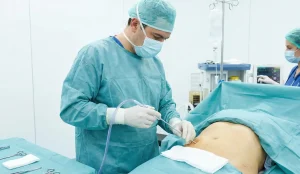
It shortens the space between the nose and upper lip.
Among facial plastic and reconstructive surgeons, the subnasal lip lift—also known as subnasal cheiloplasty or the bullhorn excision—has been widely accepted as the ultimate surgical procedure to reverse the signs of an aging perioral complex. Hyaluronic acid dermal fillers will always be the first-line treatment for volume loss, but anatomically, they can’t fix a lengthened philtrum. Aging naturally causes the upper lip to lengthen vertically due to the degradation of the collagen framework, the pull of gravity, and the loosening of the orbicularis oris muscle complex.
At the same time, the elongated soft tissue covers the upper teeth. We at Lin Health Europe Clinic flatter ourselves that our patients understand that we don’t see this as a mere beautification procedure but rather that a vertical shortening procedure is a measure to help lower-third facial proportions regain their normal ratios. By removing excess skin surgically from the base of the nose, not only do we shorten the philtral height measurably and the vermilion border everts, but also the youthfulness of the incisal display is brought back. People coming to Turkey for Subnasal Lip Lift surgery want to experience the signs of aging structurally reversed and see it as a permanent solution rather than a temporary one that masks them with injectables.
Surgical Technique and Deep Suspension

Nowadays, a subnasal lip lift is not just a matter of simple skin removal that takes place beneath the nose. The commonly used bullhorn method includes a finely executed, curved incision that is located entirely in the subnasale natural crease (junction of nose and lip) and continues into the nostril floor. Although the removal of skin solely addresses the surface, it is insufficient if one has a long-term perspective, since the skin will continue to stretch due to its viscoelastic properties. If you excise only the skin, then the tissues left will eventually be stretched to the original length by the force of gravity.
In order to avoid the lip relapsing and the scar widening, doctors employ a deep plane suspension technique. Once the outer layer of the skin has been removed, the surgeon performs a very meticulous dissection to expose the muscle underneath which is the orbicularis oris. Important stitches are made to attach the dermis and muscle fascia to the periosteum of the anterior nasal spine. Consequently, the face’s stable bony framework can now carry the weight of the lip instead of the skin tension. Minimizing scar visibility and securing the permanence of the lift are significantly aided by this tension-free closure which is also a major factor.
Philtral Anatomy and Facial Proportions
Strict anthropometric measurements form the basis of surgical indication for a lip lift. In an attractive, balanced face, the philtrum vertical height is ideally about 11-13mm in females (measured from the columella to the vermilion border). Naturally, aging causes this distance to increase considerably, often well over 18mm. The elongation results in the violation of the rule of thirds in the lower facial area and alters the composition of a long, straight upper lip which is the factor that makes the face look older.
The surgical approach to this issue means, among other things, shortening the philtrum height in the range of 5 to 8 mm. In consequence, the distance between two points is shortened while, at the same time, the philtral columns become redefined and the cupid’s bow more pointed. The geometric transformation brings back the nose-to-chin compact ratio which is characteristic of a youthful face. The preoperative phase at Lin Health Europe Clinic is characterized by the use of calipers to measure accurately so that the amount of excised tissue will perfectly harmonize the patient’s facial features without making lip incompetence a problem.
Restoring Dental Show and Volume
Dental hooding can be described as one of the most inconspicuous yet most telling signs of facial aging. Normally, only 2 to 4 mm of the upper central incisors are visible through slightly parted lips when the mouth is at rest. With the aging of the face, the lip shortening becomes a curve going downward, completely hiding the teeth even when one is smiling. Therefore, the face looks severe because it is lacking the teeth which are usually there to soften the expression.
Subnasal Lip Lift raises the lip margin to the necessary level, so the fixture incisal display is being restored in a natural way. Besides vermilion eversion, for that matter, is nothing else but an outward rolling of the red lip mucosa. It increases the visible, pink lip height (the vertically measured one) without the need for filler injections. Actually, the dental show is one of the markers of youth, energy, and freshness of the face. In other words, it is the volume that comes from within the lip itself since the procedure turns the lip outward and is a permanent way of its increase; this volume therefore looks totally natural as opposed to when a foreign gel substance is used.
Comparison with Dermal Fillers

It is crucial to understand the main anatomical difference that separates surgical lifting from injectable volumization. The role of hyaluronic acid fillers is to provide the face with volume and, therefore enhance its contour. For an already long lip, the increased weight of its filler will most probably lead it to follow the path of least resistance: going out anteriorly. Consequently, the lips can take the form of the so-called duck lip or monkey shelf, where the lip protrudes horizontally but is still unable to be lifted vertically. Besides, an overabundance of fillers in an overly long lip can worsen the aging effect by making the lip very heavy and hence less tooth show will be obtained.
Subnasal lip lift works against gravity, hence it requires a vertical vector movement from the tissues. So, patients whose philtrum is longer than 15mm should primarily consider surgery as their treatment of choice. When the goal is to add subtle hydration or define the vermilion body after a lip lift, then fillers are just the perfect adjunctive therapy. Patients treated in Turkey are thus often aware of this differentiation and so they realize that filler could not at all be a substitute for that geometric change created by a surgical lift.
Subnasal Lip Lift in Turkey
Deciding on facial surgery is undoubtedly a very significant step and at Lin Health Europe Clinic, we take a multidisciplinary approach to perioral rejuvenation first and foremost. Based in Turkey, our clinic is fitted with state-of-the-art surgical equipment which aims to facilitate wound healing and reduce scarring at the same time. We use microsurgical instruments and a high-powered microscope in our surgical procedure for the subnasal lip lift in order to be able to implant the incision with rigorous accuracy within the natural nasal fold.
We know that a patient would mainly be anxious about the scar, no matter how well the surgery is done. In this respect, Lin Health Europe Clinic can boast about a comprehensive post-care treatment plan, including laser therapy and silicone gel, in order to make sure that an incision heals so well that it becomes invisible. By applying the deep plane suspension method and the suture made with great care, we deliver to international patients both functional restoration and aesthetically pleasing results at once, thus turning back the time of aging features on the lower face.
Frequently Asked Questions About Subnasal Lip Lift
In order to achieve the desired shortening surgeons usually remove 5mm to 8mm of skin from the philtrum. This precise excision shortens the distance without impairing normal lip closure.
The upper lip is permanently raised to a level where the teeth are seen without the need to smile. The procedure ensures that even when your mouth is at rest, your upper central incisors are visible.
To make the scar less visible, the incision is made in the shadow of the natural crease of the nose base. Usually over the course of one year after the surgery it becomes a barely noticeable white line.
A subnasal lip lift cannot be done on people who have a gummy smile. In fact, raising the lip border will reveal more gum tissue and the aesthetic effect of the treatment will go against the patients’ intention.
Pain after surgery is usually minor and patients are able to manage it well with standard medication. On the other hand, for a couple of weeks the majority of patients feel a great deal of stiffness and tightness of their upper lips.
piegel, J. H. (2019). The subnasal lip lift: procedure, techniques, and patient selection. Facial Plastic Surgery Clinics of North America.
Benlier, E. (2020). Upper Lip Lift: A modified technique and review of literature. Aesthetic Plastic Surgery.
Ramirez, O. M., et al. (2018). The central lip lift: safety and efficacy. Plastic and Reconstructive Surgery.