
Yes, temporary sounds can occur.
Biometric Factors Behind Postoperative Implant Noise
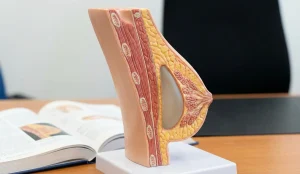
In a very specific area of breast surgery, implant patients often experience a new and weird sensation of hearing “noises” like sloshing, gurgling, or clicking coming from their breasts in a very early stage after surgery. Biometrically, such noises are most often caused by air or liquid trapped inside the implant or the surgical pocket. It is not always an indication of failure of the surgery, but rather a mechanical incident in the biological environment of the chest wall.
At the bioengineering level, a person’s body can reabsorb such trapped air for the silence to return eventually. During the opening of the pocket, the room air gets introduced briefly before the insertion of the implant. After this, the body’s systemic vitality replaces the air with serous fluid via osmotic exchange, which kills the sound-causing void over time, usually a week or so. This cellular readjustment is very much a part of the process of establishing structural harmony, not only between the synthetic device and the biological source but also within the unique anatomic features of the thorax.
Saline Implants and Sloshing Sound

The least heard “sound” when it comes to breast augmentation on a large scale is the resorted “sloshing” which is a typical accompaniment of saline implants. From the biometric point of view, if during filling of the saline solution a small bubble of air is trapped, it will produce a gurgling sound when the patient moves. This type of gurgling is more associated with implants of the “expander” type or saline-filled devices that are not fully filled to their maximum volume.
Lin Health Europe’s surgical brilliance is in concert with using “Closed-System Filling” method that helps in minimizing the small air entrainment. We also go one step further by using a specialized evacuation valve that is capable of getting rid of even micro-bubbles before the final sealing. This technical accuracy guarantees the preservation of the breast’s structural harmony without the distraction of audible sloshing. With time, as the tissues around the implant tighten and provide more external support, these sounds usually become less frequent and eventually disappear from your soundscape.
Causes of Clicking or Popping Sounds: Tissue Friction
When it comes to silicone implants, noises in the form of clicking or popping are more likely than the sloshing sounds. More often than not, it is not the implant itself that is the source of the noise, but instead it may be the internal tissues or the pectoral muscle moving over the device surface. This is a very common phenomenon in the case of submuscular placement because the muscle is almost always in contact with the implant’s shell as you move your arms.
The “Drop and Fluff” phenomenon is a descriptive term for the time interval usually between the 4th and 12th week post-surgery when the implant settles to its final biometric location. This repositioning can sometimes produce brief clicking sounds as the connecting ligaments and pectoral fascia gradually get used to the new volume. Professional rigor in this transition means that the use of specialized compression bands that carefully guide the implant to ensure its changeover to a silent, stable and high-definition shape. Later, as the capsular tissue develops and strengthens, structural harmony is restored and the frictional sounds disappear.
Sound of Structural Harmony: When It Is A Sign of a Health Issue
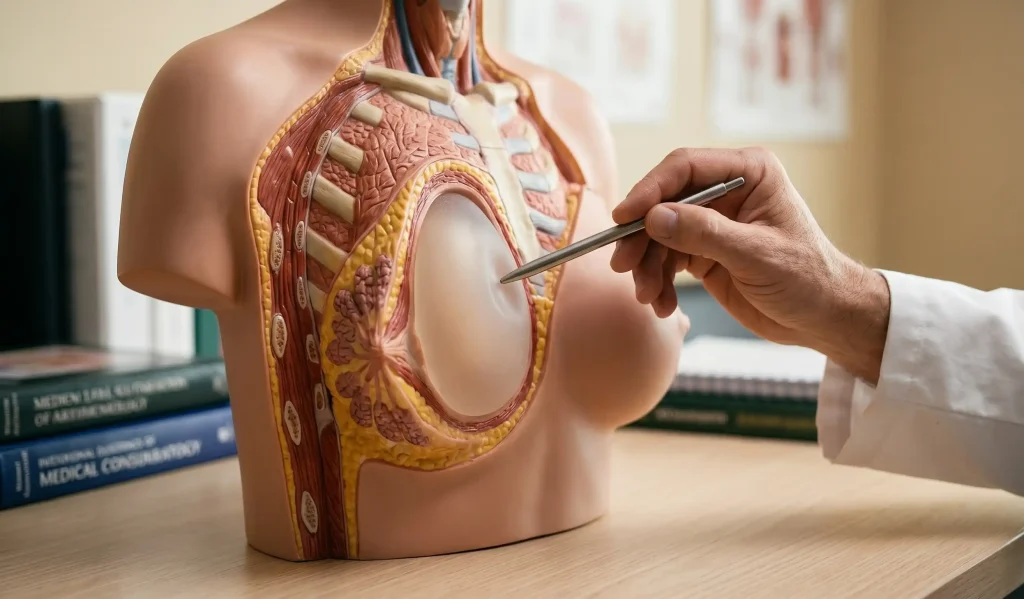
Though implant noises most of the time are harmless, there are a few cases when the ability to hear a noise can be indicative of a change in systemic health. For instance, a newly heard “squeaking” noise can be one of the signs of capsular contracture, which is the tissue tightening around the implant, besides some of the textured implant shells that are textured. When a noise comes along with changes in the body like hardness, pain, or change in the shape, it becomes a medical necessity to undergo a professional examination.
At Lin Health Europe Clinic, professional rigor is our way of life when it comes to monitoring our international clients via high-definition diagnostics, but we also consider the psychological balance of our clients as our top priority. In our clinic in Istanbul, we perform high-definition diagnostic ultrasounds to determine the cause of the noise and, at the same time, ensure that the implant is in complete biologic balance with the pectoral wall. Mastery of the clinic is at the highest level, so even the rarest biometric anomalies are handled with precision which gives you pure enjoyment that comes with the results of your aesthetic evolution without any worry.
Breast Implants in Turkey
With the decision to have your operation with Lin Health Europe Clinic, you will meet a world-class environment where surgical brilliance goes hand in hand with patient education. At our clinic, every sound and sensation in your body will be seen as a highly significant element of your transformation. Given absolute clinical mastery, we will operate your recovery with utmost technical accuracy and empathy so your transition towards a silhouette with confidence remains a smooth journey for you.
When you choose Lin Health Europe Clinic, you are relying on a health system that is highly competent both technically and biologically in the field of breast restoration. Being at the forefront of medical innovations, we thoroughly carry out the highest level of care to ensure that your results are constantly stable, silent, and perfectly conforming to your body. Get acquainted with the experienced and skilled team of Lin Health Europe and delight in the results that are at the topmost level of aesthetic and biological balance. Your road to reaching the high-definition confidence level will be under our control and supervision from the beginning to the very end.
FAQ:
Definitely yes, you can literally hear implants sloshing especially saline ones in the first few weeks after surgery. This is because the breasts are responding to the play of small amounts of air or fluid in them; these get absorbed gradually as the breast settles and becomes structurally harmonious.
If less frequently, they are capable of setting off “clicking” or “popping” as the different muscle layers or the fibrous tissues slide over the implant. When the tissues regain their systemic vitality these also usually diminish.
Theoretically, such sounds should disappear after 2-6 weeks probably earlier. However, if you still hear the noise after that period of time, our Istanbul-based specialists will be able to carry out a high-definition diagnostic evaluation and give you the most reliable assessments about your stability.
Squeaking or such sounds can indicate different issues such as the presence of a contracture but they are not always synonymous with a rupture of the implant. Being a full-fledged clinician entails checking out any new or strange sounds with a medical expert.
Correctly filling the implants and wearing your prescribed compression garments are the two major steps to prevent the occurrence of sloshing and hasten the structural harmony of the breast pocket.
Tebbetts, J. B. (2002). Systemic Vitality and Surgical Precision in Mammary Procedures. Saunders Elsevier.
Adams, W. P. (2011). Breast Augmentation: Professional Rigor in Clinical Mastery and Implant Biometrics. Saunders Elsevier.
Janis, J. E., et al. (2005). Thoracic Anatomy and Structural Harmony: Implications for Post-Operative Audibility. Plastic and Reconstructive Surgery.
Nahai, F. (2011). The Art of Aesthetic Surgery: Principles and Professional Rigor. Quality Medical Publishing.
Maxwell, G. P., and Gabriel, A. (2014). The Evolution of Breast Implants and the Biological Balance of Tissue Interaction. Aesthetic Surgery Journal.