Liposculpture shapes more precisely; liposuction removes bulk fat.
Plastic surgery is an area where sometimes people get confused by the different terms related to reshaping the body, but the differences between liposculpture and liposuction are very significant. Both methods use the same basic tool, that is the suction-assisted lipectomy process, to get rid of fat cells, but the goals, the exact places where the tools work, and the visual results are very different. A conventional liposuction is mainly a volume reduction operation that targets mainly the deep layer fat.
The opposite is liposculpture, also named as high-def or 4D liposuction, is a very detailed artistic work. Besides removing the deep fat, it also includes the surgical reshaping of superficial subdermal plane to expose the muscles more clearly. At Lin Health Europe Clinic, we tell our patients that the decision between the two methods for the stomach area depends on the patient’s body mass index (BMI), the condition of the skin, and the wish for muscular definition in sports. Knowing the pros and cons of each method is indispensable for patients who want to take a beautifying and anatomically correct belly journey in Turkey.
Debulking Vs. Definition: A Different Focus
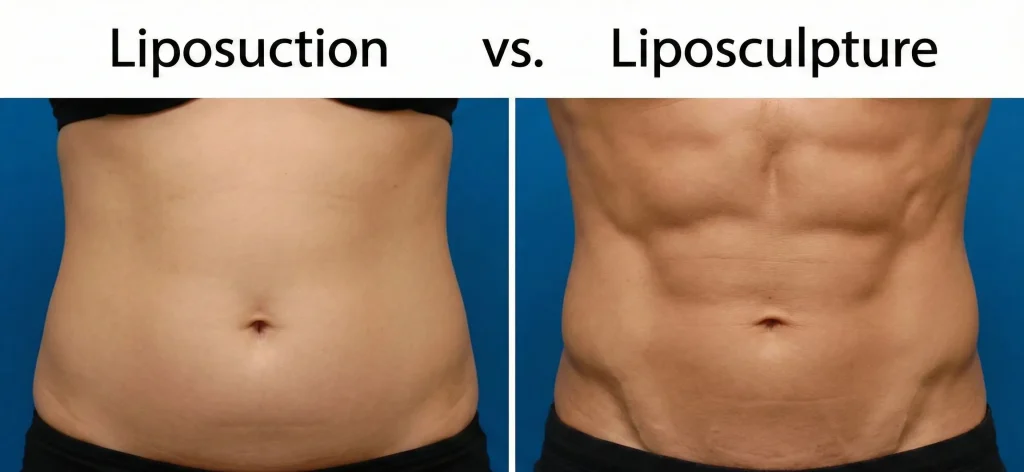
The major difference is the choice of the target of surgery. In a conventional liposuction of the belly, almost 100% of the fat to be removed is the deep subcutaneous fat layer. Very efficient, larger cannulae are used to take out the volume, thereby reducing the waist circumference. A flatter surface is aimed at, but the uppermost layer is not touched to the point where irregularities of the surface would be avoided. This method works well for patients with slight lipodystrophy and whose intention is only to reduce the size, but not to enhance the shape.
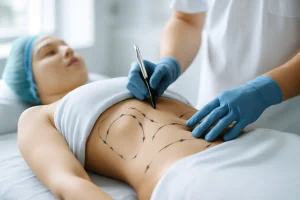
Performing liposculpture is a complex task for the surgeon. He or she has to remove fat selectively and deeply while at the same time epilate the fat layer a little in particular areas to produce ‘negative space.’ This ‘negative space’ matches the contour of the linea alba and the linea semilunaris. Leaving a thin layer of fat over the muscle bellies and interspersing the fat between them, liposculpture simulates the rectus abdominis muscle group development. In fact, this method pushes the skin into the muscular grooves, thus, creating the “six-pack” look or athletic appearance using only liposuction that at this level cannot achieve.
Importance of Energy-Assisted Devices
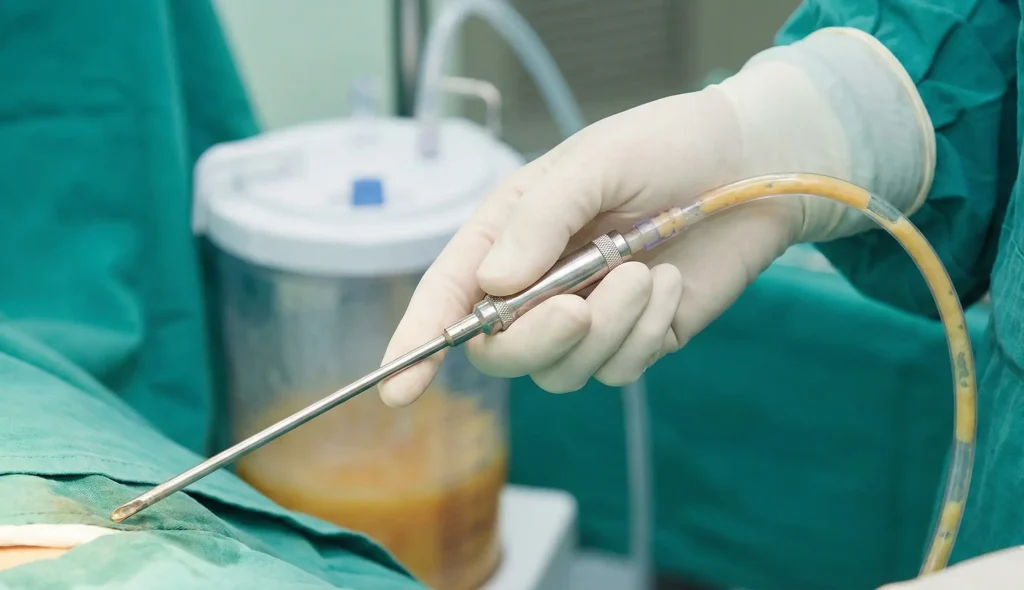
Traditional liposuction using only manual power is still feasible, but liposculpture is so dependent on the use of equipment that, for a good and smooth finish at the superficial layer, it is sometimes necessary to do it. The most common one was VASER. This ultrasound-assisted liposuction exposes the fat cells to the ultrasound energy, and thus the removed volume is liquefied.
Precisely why the fat is liquefied before liposculpture is so that the surgeon is able to stay right under the dermis which is the skin, without destroying the vascular and lymphatic networks. Besides that, the heat from the VASER tip causes the fibroepithelial network, which is the skin’s connector to the muscle fascia to contract. Due to this thermal damage, the body starts to repair the injury by neocollagenesis which results in the tightening of the skin. Particularly in the abdominal area, this effect is indispensable since it makes the skin stick tightly to the newly formed muscular shapes after removing the volume underneath.
Visceral Fat and Patient Selection Criteria
The most important limiting factor medically for both of these methods is the amount of visceral fat a patient has. This is the fat which is located inside the abdomen and around the internal organs (such as intestines or liver) underneath the muscles. Neither liposuction nor liposculpture is capable of reaching the visceral fat, let alone removing it. This is why the selection of the patients is : strict. A conventional liposuction is most suitable for a patient who has a moderately high BMI (around 30-32) and is endowed with a significant quantity of subcutaneous fat that can be targeted by pinching.
The indication for liposculpture is a patient with a low BMI (usually less than 28) and a well-toned musculature. When the raised abdomen of a patient is due to visceral adiposity (clinically known as “beer belly”), the removal of the superficial fat by etching will produce an unnatural look as muscle will appear over a drum. Before surgery, at Lin Health Europe Clinic, we use the “pinch test” and sometimes imaging to help give a precise measurement of how much subcutaneous fat and visceral fat the patient has. Selecting the right method subsequently supports the patient’s anatomy perfectly; hence, one of the main reasons why high-definition etching yields a poor result in body sculpting is the wrong choice of a candidate.
Recovery Dynamics and Lymphatic Drainage
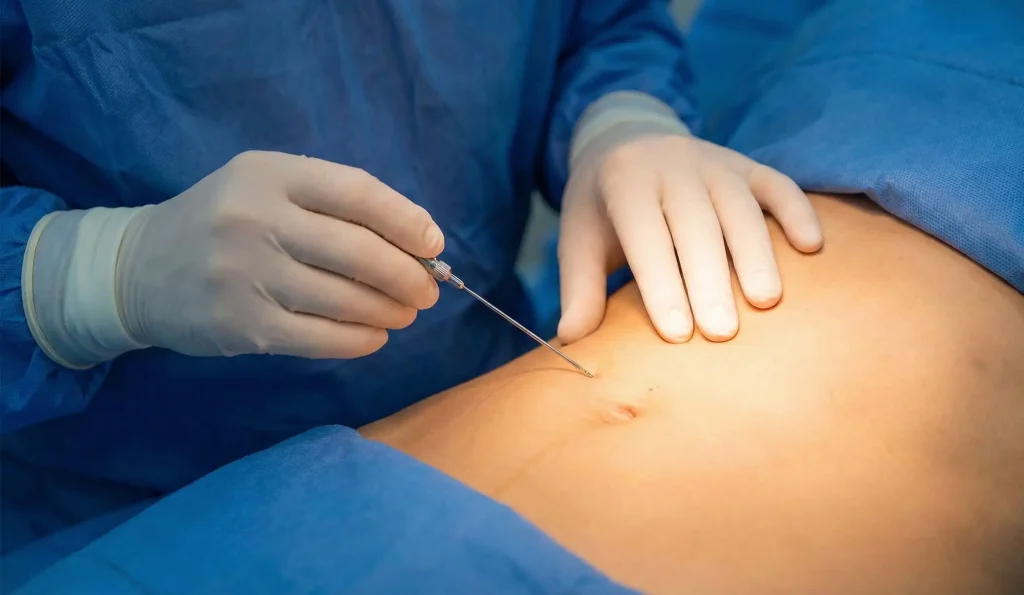
After the interventions, the healing of the stomach area varies. Because liposculpture not only affects the tissues more extensively but also results in the formation of zones of attachment (areas where the skin sticks to the muscles) the inflammation is greater. Your usual swelling and hardness will definitely be more increased than in the case of straightforward liposuction.
To control this, the aftercare of the liposculpture is more demanding. There is a need for the insertion of special foam packs under the compression garments in order to keep the skin pressed to the lines created by the etching. As a matter of fact, manual lymphatic drainage (MLD) helps to prevent the accumulation of liquids inside the body and is not optional but necessary. Whether the fibrosis formed during healing is good to be developed along certain specific lines to continue to have the “etched” look, it is of utmost importance to stay under control so as not to cause a nodule. Today, patients who are to come to Turkey are equipped with a detailed aftercare plan that takes into account.
Liposuction in Turkey
Having a thin abdominal profile is not only a question of having the expertise, but also of artistic creativity, both of which should be the qualities of the surgeon. Our Lin Health Europe Clinic is a predominantly natural anatomical approach that shapes the abdomen. From our extensive experience and with cutting-edge VASER technology, we are proud to say that the physical definition of the human body is not a dream. We purposely emphasize subtle, athletic definition that is progaythe patient’s physique, rather than risk either an”over-etched” or a totally unnatural look in Turkey.
Our topmost priority is safety. We have got ourselves into accredited hospital facilities and with anesthesiologists who are board-certified to be in charge of the hemodynamic stability of the patient throughout the operation. Our full care package includes precise abdominal muscles pre-operative mapping, intraoperative ultrasound guidance, and a post-surgery team dedicated to follow-up. No matter if it is major volume reduction through liposuction or meticulous line definition by liposculpture that a patient is in need of, Lin Health Europe Clinic creates a surgical plan which is tailor-made to give the results that last and are in harmony with the patient’s anatomy.
Frequently Asked Questions About Stomach Liposuction
Basically, the two differ in that liposuction focuses on major deep fat removal to achieve an effective volume and size reduction, whereas liposculpture selectively removes fat to carve and showcase the muscle structure of the abdomen.
No, both of the procedures are unable to remove visceral fat that is located inside the abdominal cavity and around the organs. They only penetrate the subcutaneous fat layer, which is above the muscle.
Indeed, the healing period is usually more demanding due to the surface work component of the procedure. Patients may require special foam inserts and massage therapy for an extended time.
Certainly, the fat cells taken away during the surgery are gone forever and do not regenerate. However, if one gets a lot of weight again, the existing fat cells can get bigger and hide the effects.
If the skin has good elasticity, it will shrink to accommodate the new shape. Nevertheless, those with a lot of loose skin or stretch marks may be better off with a tummy tuck.
Hoyos, A. E., & Millard, J. A. (2007). VASER-assisted high-definition liposculpture. Aesthetic Surgery Journal.
Matarasso, A. (2000). Liposuction of the chest and back. Clinics in Plastic Surgery.
Kenkel, J. M., et al. (2012). Ultrasound-assisted liposuction: a review of the literature. Plastic and Reconstructive Surgery.
Lockwood, T. E. (1991). Superficial fascial system (SFS) of the trunk and extremities: a new concept in body contour surgery. Plastic and Reconstructive Surgery.