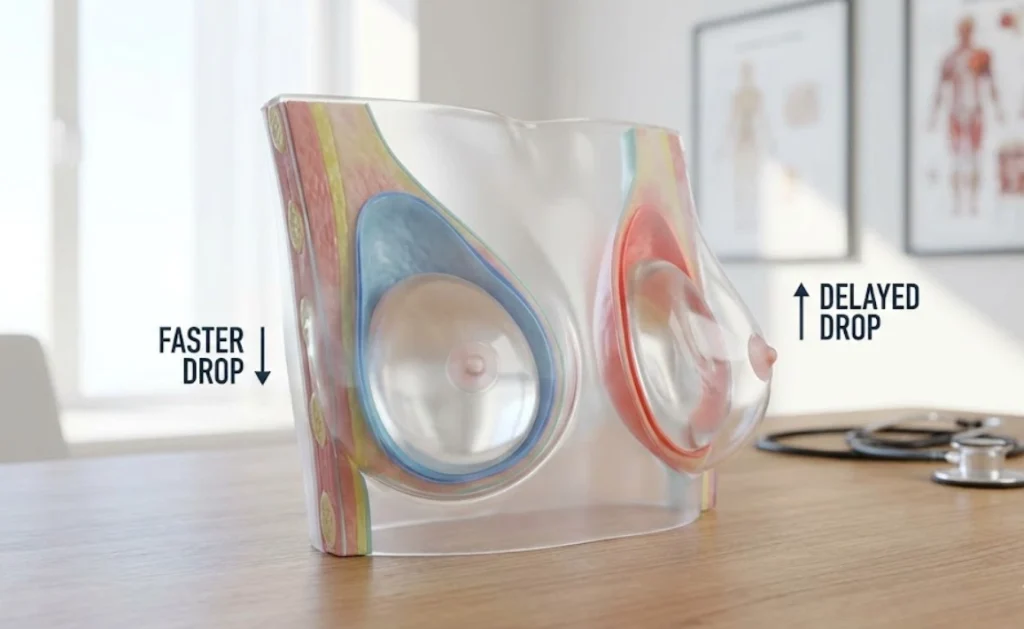
Yes, uneven healing can cause temporary asymmetry.
It’s the typical post-op nightmare: you find yourself three weeks after a breast augmentation, and when you spot your reflection, you almost fall off. What if one breast looks just as expected—soft, round, and in a nice natural curve, but the other just doesn’t—being tight, high, and square, kind of like a shelf stashed near your collarbone? Panic is the first thing that hits you like a ton of bricks. You start doubting the surgery. “Is one of them stuck? Can breast implants lead to asymmetry?”
At Lin Europe Clinic, it is our everyday job to calm patients down and explain that the image they see is not a lasting problem. Actually, it is so common that one implant is seen falling quicker than the other that you’ll hardly find two patients who’ve never experienced this. We can only achieve ideal symmetry during surgery, but post-op is a different story where nature has the final say. In fact, uneven dropping of your new breasts is hardly ever an indication that the surgeon did a bad job; it is often just a transient symptom that your body is working its unique healing route.
The False Notion of Perfectly “Matching Sets”
Sometimes we think of ourselves as being perfectly symmetrical creatures when the truth is that no one is. Your left foot can be a whole shoe size larger than your right, and there are even situations when the left eyebrow goes up more than the right one. Your chest shares this anomaly.
Breast implants—when situated submuscularly (under the muscle)—basically serve to highlight these small differences that already exist naturally between the two sides of the body.
- Skeletal Structure: If your ribcage is slightly twisted (mild scoliosis) or if one side of your chest wall protrudes more than the other, the implants will lay differently against the foundation.
- Tissue Tightness: Maybe one side of your skin was inherently less pliable or one breast had less tissue, so an implant on that “tighter” side will be under a greater resistance and it will have to work longer to open the lower pocket and drop.
The Rule of the “Right Hand”: Muscle Dominance
Your handedness is, without a doubt, the greatest factor contributing to unevenness. If you are, for instance, right-handed, then naturally your right pectoral muscle will be more developed since you have been using it regularly in various activities, from opening heavy doors, carrying groceries, to just blow-drying your hair. A consequence of this is that the muscle will be stronger, thicker, and tighter than the left one.
Once an implant is fitted below the dominant muscle, the latter spasms to protect itself in response to the stretch. Since it is stronger, the muscle clings to the implant more strongly and thus, does not let it move down quickly. On the other hand, the weaker, non-dominant side (for right handers this is typically left) will not resist, will relax earlier, and will therefore be done with the implant dropping way before the other. It is therefore very normal for a patient to see that one breast has completed its cycle by the 4-week mark when the other is still “high” until it hits 8 weeks.
Swelling Does Not Occur Evenly
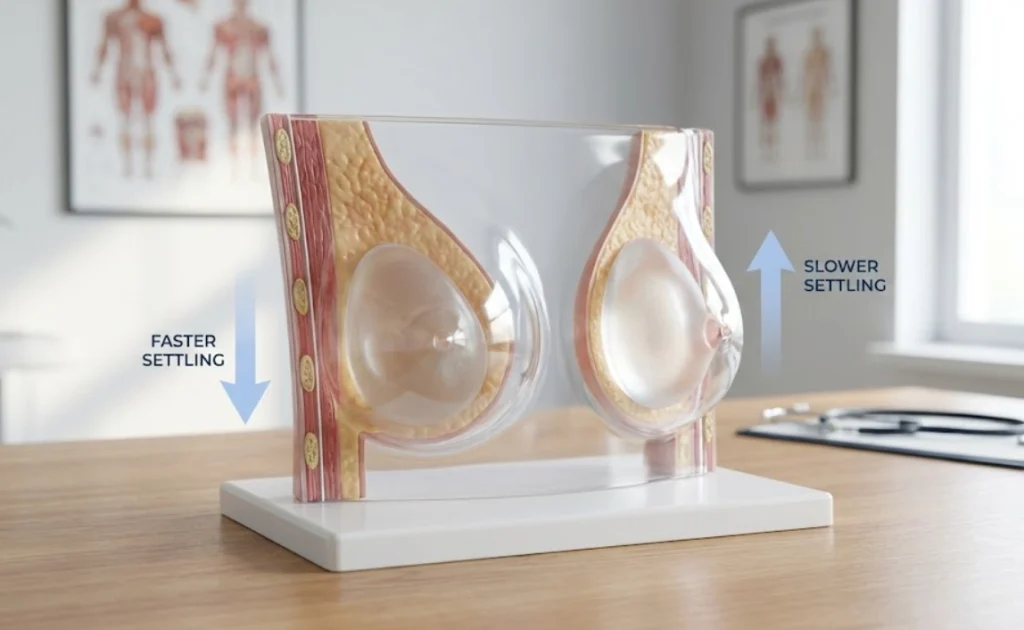
Surgery brings trauma to the tissue in a controlled environment and the body’s response to this is to send in the inflammatory cells to repair the damage. This is not, however, done by the repair cells equally as a couple of different aspects can affect, for instance, your having a faster lymphatic system on one side of the body than the other even if the surgeon performed the same maneuvers on both sides.
It is perfectly normal for one breast to have more fluid retention (edema) or for a larger internal bruise. Since fluid occupies space, if one breast has more internal swelling then that pressure is able to either push the implant higher or make the breast look bigger than the other one. When the swelling finally goes down within the first 3 months, the slower side will typically close the gap and the symmetry will be restored.
A Stabilizer Band Plays Its Part
This stage can be quite challenging, but you are not without options. Here is where your post-op arsenal comes into effect. The breast stabilizer band is specifically made to address the imbalance problem. By putting pressure down on the upper chest, it helps the muscle that is high on the chest and resistant to let go and relax.
Suppose you have a major discrepancy in dropping, your doctor may suggest you wear the band a bit lower and/or tighter on the side that is too high so that the pressure is localized. This, however, needs to be a very cautious approach. You should still comply with your surgeon’s recommendations for where to place the band since overly forcing a high implant down before the pocket is ready can result in complications.
Put Your Faith in the Process in Turkey
Getting through the “uncomfortable stage” of healing is way simpler if there is a whole team behind you explaining what and why. At Lin Europe Clinic in Istanbul, Turkey, we bring our patients face to face with the uneven healing reality before the surgery even starts.
We hold that a well-informed patient is a relaxed patient. During your stay in Istanbul, we keep an eye on the progress of your dropping very carefully. If it turns out that the patient’s dominant side is the one causing a lag, then we instruct you in the use of certain stretching or massage techniques (if your implant type allows it) so that the resistant side can finally catch up. Selecting Turkey as the place for your operation means that you will have a partner at your side through the psychological aspects of recovery, ready to reassure you that the asymmetry you experience today is nothing but a small step towards your perfect result tomorrow.
Frequently Asked Questions About Uneven Dropping
This phenomenon typically happens due to ‘handedness’, meaning that your dominant pectoral muscle (for example, the right side if you are right-handed) is stronger and tighter thus holding the implant high for longer. Besides, uneven swelling or lymphatic drainage may also result in a temporary visual mismatch during the first few months of the recovery process.
Indeed, it is very common and almost expected that one side is “lagging” behind the other by several weeks. Your body, essentially, heals at different paces on each side and the non-dominant muscle is typically the one that relaxes and releases the implant sooner.
During the initial stage of healing, a ‘fix’ is generally pure patience along with the uninterrupted use of a breast stabilizer band to encourage the high side to lower. In the case of a significant asymmetry that lasts more than six months, a surgical revision at Lin Europe Clinic may be necessary for pocket adjustment.
Yes, the majority of women have some natural asymmetry with one breast being lower or having looser skin than the other pre-surgery. Sometimes implants may highlight the differences that already exist on the body which naturally makes one side appear more droopy (ptosis).
If one implant goes way too low or seems to be sliding off the chest, this might be “bottoming out,” and it actually means that it was caused by weak tissue support or an over-dissected pocket. On the other hand, if this is still the early stage of recovery, that side might have simply “dropped and fluffed” quicker than the tight one.
Adams, W. P. (2008). The process of breast augmentation: Four phases of care. Plastic and Reconstructive Surgery.
Spear, S. L., & Baker, J. L. (2011). Classification of capsular contracture after prosthetic breast reconstruction. Plastic and Reconstructive Surgery.
Tebbetts, J. B. (2001). Dual plane breast augmentation: optimizing implant-soft-tissue relationships. Plastic and Reconstructive Surgery.