Yes, nipple sensitivity can temporarily increase or decrease.
When women start looking up breast augmentation, their browser tabs are usually flooded with pictures, size guides, and cleavage comparison charts. We are obsessed with the look — the projection, the profile, the symmetry. But a more profound and private worry often comes up during the quiet moment of a consultation. It is not about how the breasts will look, but how they will feel. “Will I lose sensitivity? Does breast augmentation cause changes to nipple sensation?”
Lin Europe Clinic understands that a breast is not simply an aesthetic accessory but it is also a sensory organ essential for physical intimacy and, for many, maternal bonding. The idea of exchanging sensation for size is a terribly scary thought. The truth is a little complicated: yes, the surgical procedure is almost always followed by a temporary change in sensation, but it is extremely rare for a person to suffer from a permanent loss. Figuring out how the “wiring” of your chest works might help you understand the weird, tingling sensation experienced during nerve recovery.
The Wiring Under the Skin: Anatomy 101
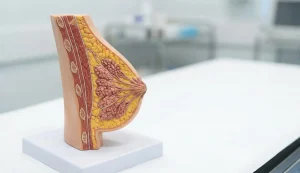
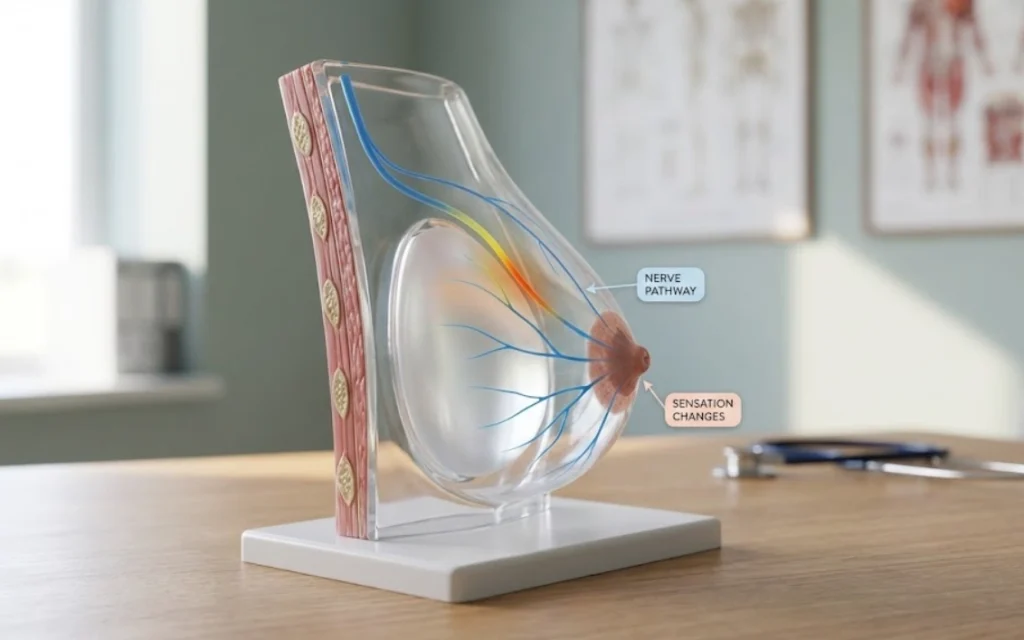
If you want to get to the bottom of why there is a change in sensation, you will have to visualize the anatomy. The nipples get their energy from a network of nerves, mainly the intercostal nerves (mainly 4th, 5th, and 6th), which start at your ribcage and go down through the deep tissue to the surface at the nipple-areola complex.
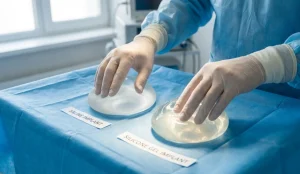
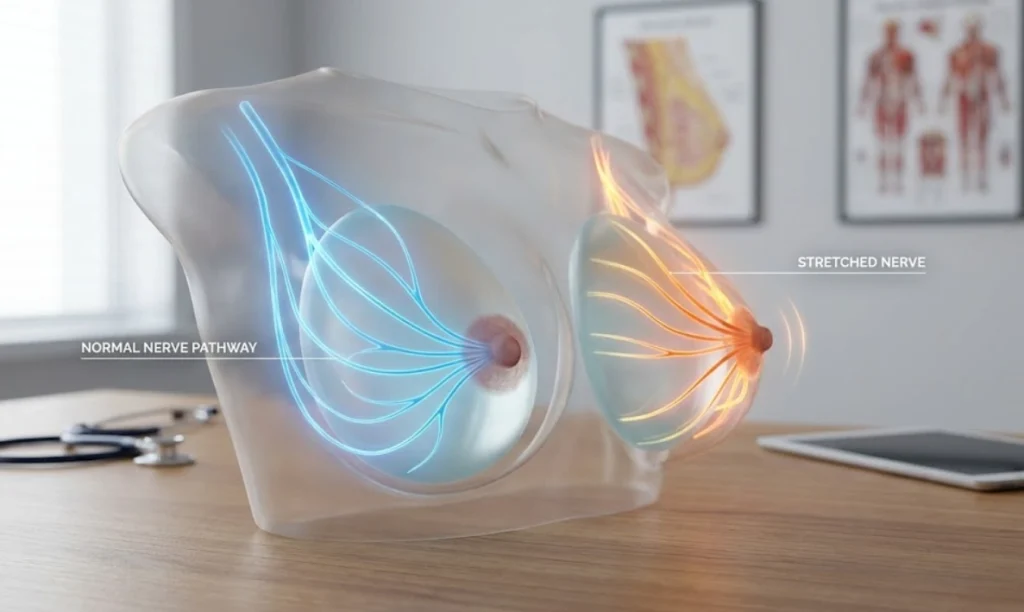
The surgeon, during breast augmentation, creates a pocket—either under the muscle or over it—where the implant will be placed. We do not cut these nerves deliberately, but the mere fact of making a pocket and putting a volume-occupying device in this space will inevitably stretch them. Imagine the nerves as your cell phone charging cables. When you pull them really tight or place a heavy object on them, the signal will get static or will cut out temporarily. The “static” of which you have been experiencing is the “change in sensation”.
The Spectrum of Sensation: Numbness vs. Pain
Being “normal” in terms of sensation right after the operation is a rarity. During the very first few weeks, patients are mostly found to be either of two extremes:
- Hyposensitivity (Numbness): This is the most frequent response. You may consider detaching your skin to see whose it really is or supposedly feel the depth of a finger but not its texture. This is usually caused by neuropraxia—a temporary “stunning” of the nerve due to surgical trauma and swelling. It is like when your leg falls asleep; the nerve is only squeezed, not severed.
- Hypersensitivity (Over-sensation): On the contrary, the reaction of a few might be an extreme one. The nipples become so sensitive that even the frictions of the clothes(or the shower water) will be like the scrapping of sand or fire. This is because of an excited nerve that keeps on firing.
The “Zingers”: Electric Shocks are Good News
From week 3 to week 6, patients usually report a circumstance that can be quite terrifying if they don’t know what to expect: sudden, intense and abrupt pains that run through the breast or the nipple. These “zingers” are the name we gave to these sensations.
They may come as electric shocks but they actually represent a happy sign. A dead nerve is a silent one. A nerve that is reacting with sudden sharp zaps is a nerve that is waking up and regenerating. This is the biological signal that the connection is being re-established. Such pain is always short and normally fades away without intervention as the nerve matures.
Does Incision and Size Matter?
Your risk of losing sensation will depend significantly on the surgical decisions made during planning stage.
- Incision Location: Of all types, the periareolar incision (cut around the nipple) is the most dangerous when it comes to the risk of losing sensation because the surgeon has to cut the nerve network that supplies the nipple. Inframammary incision (in the crease under the breast) which is the most common one at Lin Europe Clinic, is generally considered to be the safest in terms of preserving sensation because it completely avoids the nipple area.
- Implant Size: Physics comes in here as well. A huge implant will definitely stretch up the skin and nerves more than a medium one. Thus, if the nerve fibers are constantly pulled, it can lead to a state of numbness that lasts for a long time. If you have a small body and get an enormous implant, it’s just like asking your “wiring” to stretch beyond its capacity.
The Timeline of Return
Among all tissues, nerve healing is the slowest. While your skin might be fully healed by 2 weeks and muscle by 6 weeks, nerves may take 6 to 18 months to fully regenerate.
Don’t worry if you are still numb at 3 months. Sensation comes back slowly and gradually happens from the periphery of the breast towards the nipple. It is more of a gradual change over time rather than an instantaneous one. Only a very small number of women (estimated at less than 5-10% with the use of modern techniques) suffer from permanent numbness, but for most of them, erotic and tactile sensations are back to almost normal levels within a year.
Precision Surgery in Turkey
To save, as much as possible, sensation requires a surgeon with profound knowledge of human anatomy. At Lin Europe Clinic in Istanbul Turkey, the surgical approach we take is all about “minimal trauma.” A inframammary fold incision and meticulous pocket dissection are our preferred techniques to protect the sensory nerves that feed the nipple.
In your visit to Istanbul, we would first clearly communicate to you what level of sensation is to be expected after operation. If you will not give up on full sensitivity no matter what, it will be our pleasure to direct you to the optimal implant sizes and locations that will hardly cause nerve stretch. We consider the breast a vital organ and make sure that your breast augmentation becomes a part of your life that you love rather than a time when you feel uncomfortable with your own body.
Frequently Asked Questions About Nipple Sensation
Most women do have a temporary sensation change—either numbness or extreme sensitivity— resulting from nerve stretching and swelling. Loss of sensation permanently is quite rare, but it can happen.
Indeed. An incision made around the nipple (periareolar) has a higher likelihood of nerve damage from cutting compared to an incision made in the fold under the breast (inframammary).
In case you have hypersensitivity symptoms (such as wearing clothes being painful), the discomfort usually goes away after 3 to 4 weeks when the first inflammation disappears. But in case you have numbness, it will take much longer and feeling returns only gradually due to nerve regrowth over a period of 6 to 12 months.
The main remedy is patience because nerves are the slowest tissues to recover in the human body. Several doctors advocate using Vitamin B complex supplements for nerve health, and “sensory re-education”—stimulating the area with various textures—can assist the brain to reconnect with the nerves.
People often say they feel “zingers” (sharp, sudden electric shocks), a sensation as if a liquid were flowing under the skin, or even phantom vibrations. These sensations are all normal and good indicators that the sensory nerves are waking up and sending signals as they repair themselves.
Food and Drug Administration. (2020). Breast Implants: Local Complications and Adverse Outcomes.
Hamdi, M., et al. (2012). Sensibility of the nipple-areola complex and types of breast augmentation. Plastic and Reconstructive Surgery.
Tebbetts, J. B. (2001). Dual plane breast augmentation. Plastic and Reconstructive Surgery.