

No, it is usually permanent.
Bariatric and metabolic surgery considers “stomach reduction” to be a very deep, lifechanging anatomical intervention. When patients inquire whether these surgeries are reversible, the medical truth must be very honest: most of the effective and popular stomach reduction surgeries are permanent at their core. Having bariatric surgery as a temporary “trial” or as a reversible diet tool is a dangerously misleading idea. The biological target of these surgeries is to permanently change your endocrine system, decrease your stomach volume, and reprogram your metabolic baseline to fight against obesity effectively.
Lin Health Europe Clinic places education and psychological readiness of the patient on parity with metabolic surgery as the non-negotiable basics. For our international patients coming to Turkey, we tell them that although we are the surgical masters who can change your health, your mind and body must be ready to make a lifelong commitment with your new anatomy. Our center is a great destination for complete bariatric care, and in addition to giving you the best surgical options, we also ensure you are completely aware of the permanence of your surgery and the biological effects the rest of your life that come with it.
The Sleeve Gastrectomy: The Irreversible Reality
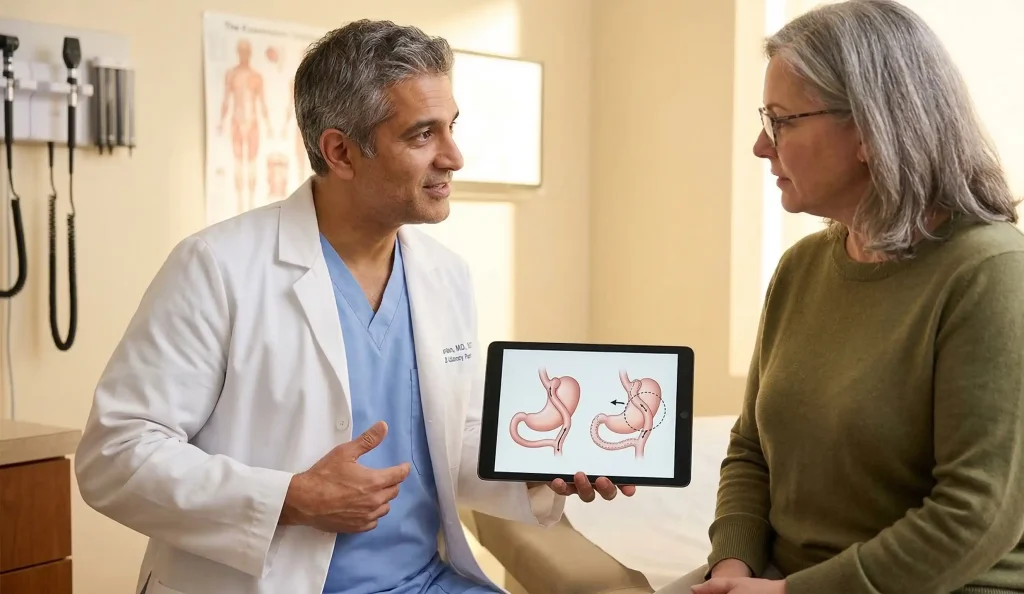
A Sleeve Gastrectomy is the bariatric surgery most commonly performed worldwide today. Through the operation, the doctor cuts out and throws away about 80% of the stomach with a permanent surgical amputation, so that instead of a pouch, the stomach looks like a thin, banana-shaped tube.
In medical terms, a gastric sleeve is completely irreversible. The part of the stomach that is removed — including the fundus, the main area producing the hunger hormone ghrelin — is physically cut out, placed in formalin, and sent to the pathology lab. At Lin Health Europe Clinic, our surgeons in Turkey will explicitly state during your consultation that it is biologically impossible to recreate or restore your original stomach once that tissue is removed. Choosing a surgery at one of our renowned clinics means you will be given a full, distinct explanation of this permanent anatomical commitment before surgery.
The Roux-en-Y Gastric Bypass: Technically Reversible, Clinically Rare
During a Roux-en-Y Gastric Bypass, the surgeon cuts the stomach into two parts, creating a small upper sac and then connects the small intestine to that new pouch thus bypassing the larger part of the stomach and the first part of the intestine.
Since no stomach tissue is excised, the bypassed stomach is alive and still inside the abdomen—a gastric bypass is technically reversible. Yet, doing the reversal again is an extremely difficult, hazardous, and challenging surgical operation. In Turkey, the Lin Health Europe Clinic professionals will only do the bypass reversal if the patient is critically ill and in mortal danger, starving, with ulcers or with anatomical changes that, if not corrected, could lead to death. It is never done just because a patient is unhappy with the surgery or desires to resume eating large meals.
Revision Surgery vs. Reversibility
Though true reversibility is either impossible or highly discouraged, bariatric surgeries can be modified or revised if they fail to provide adequate weight loss or if severe complications (like intractable acid reflux) develop. Such surgery is called Bariatric Revision Surgery.
One of the strengths of Lin Health Europe Clinic is our ability to perform these difficult 2nd surgeries. Say, for instance, a patient regains weight or gets a severe GERD after a Sleeve Gastrectomy, our surgeons in Turkey can’t “reverse” the sleeve, but we can safely revise it by changing it into a Roux-en-Y Gastric Bypass. We think that trying to accomplish the best result needs a long-term, adaptable approach to your metabolic health, which involves expert surgical solutions rather than risking dangerous anatomical reversals.
Temporary Alternatives: Gastric Bands and Balloons

If a person is totally unready mentally to endure a permanent change in anatomy, they can consider the temporary alternative. A Laparoscopic Gastric Band (Lap-Band) is done by putting a silicone ring around the upper stomach. When taken off, the stomach becomes normal again. Also, an Intragastric Balloon is a non-surgical device that is placed endoscopically into the stomach for six months only to limit the volume of food and then completely removed.
At Lin Health Europe Clinic, we offer complete metabolic tool solutions to our international patients in Turkey. Even though bands and balloons are fully reversible, we truthfully state that they generally result in significantly less weight loss and have higher rates of long-term weight regain than permanent surgical reductions. Our clinic is the leader in Turkey in terms of matching the right intervention not only to your physiological but also your psychological readiness.
Stomach Reduction in Turkey
Lin Health Europe Clinic stands by the principle that the greatest type of medical luxury is complete openness and the highest ethical care. Our hospital in Turkey is a haven of medical excellence, where advanced metabolic science is supported with theoretical and practical psychological and dietary care. We run in modern JCI-accredited hospitals that reflect our position as a global leader in international medical tourism and bariatric surgery.
Choosing Lin Health Europe Clinic, you choose a medical partner for a lifetime patient transformation and safety. The surgeons based in Istanbul, who are the best in their field worldwide, will not let short-term trends dictate your health. From your initial psychiatric and biometric screening to your final, stabilized goal weight, you will be shown the professional rigor and elite hospitality that has made us the leading name in metabolic medicine. A healthier, revitalized body is a journey managed by the very best in the world with us.
FAQ:
The majority of stomach reduction surgeries today, like the gastric sleeve, are permanent since they involve physically removing a large part of the stomach. Technically, a gastric bypass can be undone, but this is an extremely complicated, risky operation that is only done in rare life-threatening situations, never for a change of mind of the patient.
Unfortunately, the gastric sleeve procedure cannot be reversed. The surgeon essentially cuts off and removes 80% of your stomach which makes it impossible to biologically restore the organ to its full size.
Excessive, stubborn weight loss is a very rare occurrence and is usually resolved by changing your diet or giving you special pancreatic enzymes to help your body absorb nutrients better. If these simple methods don’t work after a gastric bypass, our surgery team in Turkey might do a special revision operation to lengthen the part of your intestines that absorb nutrients, not completely reverse the surgery.
Certainly, the laparoscopic gastric band (Lap-Band) is totally reversible because it consists of simply putting a removable silicone ring around the stomach as opposed to cutting tissues. Alternatively, the gastric balloon is a temporary, non-surgical device that is placed in the stomach for six months to help with weight loss and then it is easily removed.
Although it is not possible to regrow the stomach tissue that was removed during a sleeve gastrectomy, the remaining pouch may become permanently stretched if you consistently eat in excess. This stretching will do away with the restrictive effects of your surgery in Turkey and result in major weight regain and subsequently, possibly the need for a complicated revision surgery.
ASMBS (American Society for Metabolic and Bariatric Surgery). (2021). Bariatric Surgery Procedures.
Schauer, P. R., et al. (2012). Bariatric surgery versus intensive medical therapy in obese patients with diabetes. New England Journal of Medicine.
Brethauer, S. A., et al. (2014). Systematic review on reoperative bariatric surgery. Surgery for Obesity and Related Diseases.
Buchwald, H., et al. (2004). Bariatric surgery: a systematic review and meta-analysis. JAMA.