Cold compress and head elevation help.
At the expert level of high-definition rhytidectomy and structural facial restoration, controlling post-operative edema (swelling) is one of the main clinical objectives. Edema is basically the visible sign of inflammation, which happens when the SMAS (Superficial Musculoaponeurotic System) and the skin layers are surgically manipulated. During the body’s complex phase of neocollagenesis, when it is rebuilding the dermal matrix to support the newly lifted facial contours, localized lymphatic stasis is likely to interfere with the visual realization of the surgical result. A proper way to deal with this buildup of fluid is through a scientifically supported and multi-modal approach that maximizes hemodynamic flow and cellular homeostasis in Turkey.
Phased Clinical Interventions for Edema Resolution
Guided by a biological timeline, the process of resolving facial edema necessitates the use of targeted treatments at our center in Istanbul:
- Acute Inflammatory Phase (0–72 Hours): The aim in this period is to cause focal vasoconstriction. Applying controlled cryotherapy will induce localized vasoconstriction, which results in the closing of the capillary walls, so the amount of interstitial fluid that gets into the facial compartments decreases to a minimum.
- Lymphatic Drainage Phase (Days 4–14): Now, the therapeutic mainstay is the facilitation of postural drainage. Gravity is used in this limb to move the fluid towards the cervical lymphatic chains by elevating the head and keeping the constant angle of 45 degrees.
- Metabolic Maturation Phase (Weeks 2–6): At this juncture, therapists are dealing with osmolarity. A low-sodium diet that is controlled very tightly both prevents water retention and supplies enough protein, so substrates needed for neocollagenesis are abundantly present.
- Chronic Stabilization Phase (Months 1+): Systemic microcirculation is stimulated by the help of mild walking, thus boosting the ability of the lymphatic system to process residual micro-edema from the deep tissue layers in Turkey.
Hydrostatic Pressure and the Efficacy of Postural Alignment
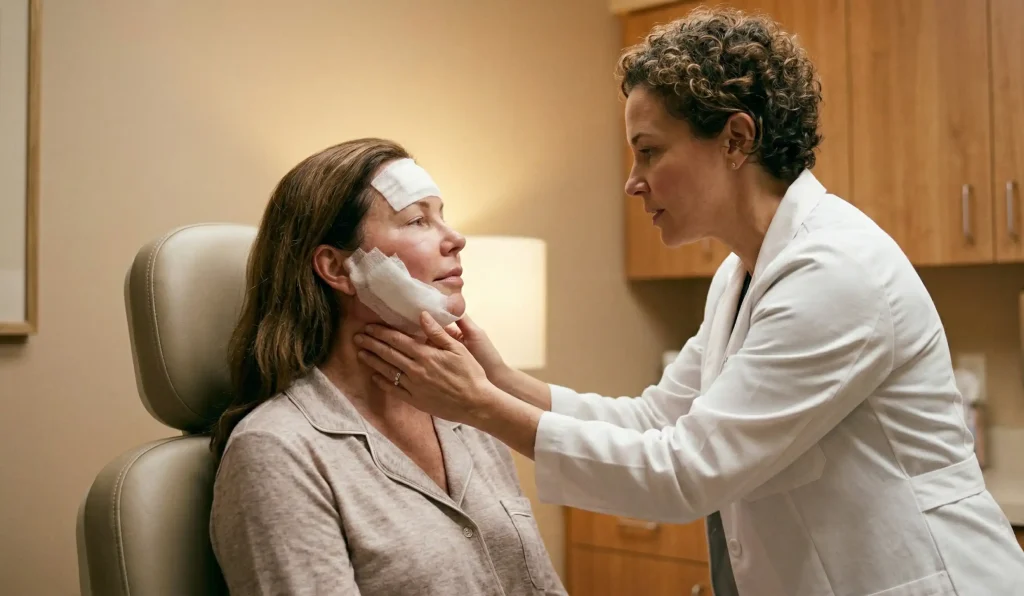
The most potent non-invasive tool to diminish facial edema is, without doubt, the systematic use of gravitational forces. The principles of hydrostatic pressure dictate fluid movement in soft tissues of the face; when the head is at the same level as the heart, fluid naturally collects in the dependent periorbital and malar regions. Creating a “Bio-Postural Alignment” at 45 degrees, health workers benefit from gravity in displacing the interstitial fluid from the facial area to the main thoracic lymphatic ducts.
At Lin Health Europe Clinic, sleep position is treated as a recovery mandate of the highest precision. The biometrically designed orthopedic support systems used by our professionals in Turkey help maintain an elevation of 45 degrees with absolute professional rigor. We do HD facial contour imaging in Istanbul so as to track the reabsorption rate of fluids, thus ensuring low pressure during the phase of neocollagenesis, which leads to better tissue adhesion and a more finely tuned aesthetic look.
Controlled Cryotherapy and Microvascular Regulation
The inflammatory response is at its highest immediately after 72 hours post-rhytidectomy. When vasoconstriction is achieved by performing local cooling, blood vessels are narrowed significantly and the accumulation of the inflammatory exudate is slowed down. At the same time, it is very necessary to make sure that ice is not in direct contact with the skin, even though cooling the skin quickly to very low temperatures results in numbness and sometimes even pain relief (this can be a problem if the patient is not aware of the skin temperature, and the skin can be severely injured).
The service at Lin Health Europe Clinic follows a “Thermal Regulation Protocol” for patient guests in Turkey. Our team in Istanbul is constantly on the lookout to provide their patients with therapeutic thermal masks that will cool the face uniformly with air, but the masks will be well-cushioned so that they do not exert any kind of mechanical pressure on the skin that has been incised.
Nutritional Osmosis and Cellular Recovery

It is well known that the systemic nutritional status of a patient post-surgery largely determines the degree of fluid retention. Sodium ions are the major extracellular cations with the ability to exert osmotic effects; therefore, sufficient sodium intake will increase the volume of extracellular fluid (including interstitial) an,d consequently, it will enforce the facial swelling.
At Lin Health Europe Clinic, our clinical nutritionists craft a special “Anti-Edema Metabolic Blueprint” for all international patients traveling to Turkey. We focus on providing electrolyte-balanced hydration, which supports cellular regeneration and, at the same time, does not encourage fluid retention. We consider a strict professional approach to be one which reaches out to every single metabolic marker of your recovery, and our crew here in Turkey is wholeheartedly concentrating on making sure that your internal milieu is at its best for a high-definition result. By handling the nutritional aspects, we make certain that your revived facial contours visibly emerge from the edema with complete surgical clarity.
Facial Restoration at Lin Health Europe Clinic
Lin Health Europe Clinic is recognized worldwide as the locale of seamless integration between the highest level of medical skill and exceptional hospitality. Our center in Turkey shines as the place where modern Deep-Plane technology is coupled with the highest standards of JCI-accredited safety and professional rigor. Choosing our clinic will be the choice of entrusting your care to the most experienced and safety-conscious teams in Istanbul, who hold clinical reverence to every patient as a priority. We are international guests’ biggest attraction who not only want the most natural outcomes but also want the most scientifically advanced surgical experience in the world.
Whatever your problem is, pressing a first-time facelift or carrying out a revision to bring back youthful features, our globally recognizable surgeons always keep your beauty and health as the first goal. Our team is producing works of art, which are not only a reflection of your most beautiful and vivacious self but also a representation of your empowerment. Our world-class surgical brilliance that is accompanied by genuine care is what you will see, hear and feel through the entire process, from your first biometric evaluation to the grand unveiling of your beautifully sculpted profile. Your quest to meet a healthier, more sophisticated and empowered self will be skillfully handled by us in the heart of Turkey.
FAQ:
The best clinical methods to reduce facial swelling are keeping your head at a 45-degree angle, using controlled icing for the first 72 hours, and following a strict low-sodium diet. We in Istanbul offer you a personalized anti-swelling program in Turkey that not only speeds up your recovery but also supports the phase of new collagen formation.
After the major inflammatory peak goes down, which is usually between 10 and 14 days, scar edema may still be present for some months. Our medical staff in Istanbul will accompany your healing process thoroughly to help the tissue get properly stabilized in the Turkey maturation phase.
Right, variations in lymphatic drainage or sleeping habits sometimes lead to one half of the face being more swollen than the other. Besides biometrics monitoring, we also make sure that your ultimate outcome reflects perfect aesthetic symmetry at our clinic.
It is advisable to take a walk for the first time within the first 24 hours in Istanbul if you want to increase your blood flow. On the other hand, it is a good idea to stay away from any physical activity that involves a large amount of exertion for 4 weeks. The reason is that vascular pressure can bring about swelling.
Indeed, sodium causes osmotic water retention which in turn raises the volume and pressure of facial edema. At Lin Health Europe Clinic, we offer a tailor-made low-salt diet in Turkey for the internal environment to stay at an optimum level for the phase of new collagen formation in Istanbul.
Rohrich, R. J., et al. (2011). The evolution of facelift vectors and the management of post-operative edema. Plastic and Reconstructive Surgery.
Jacono, A. A. (2018). The Art and Science of Deep-Plane Rhytidectomy and Lymphatic Recovery. Quality Medical Publishing.
Tzikas, T. L. (2004). Post-operative management of the rhytidectomy patient: a clinical review of edema. Aesthetic Surgery Journal.
Williams, E. F., et al. (2011). Biometric mapping and the prevention of prolonged swelling in facial surgery. Archives of Facial Plastic Surgery.
Coleman, S. R. (2006). Structural fat grafting and the optimization of facial healing through neocollagenesis. Plastic and Reconstructive Surgery.