Drainage and compression are used.
Apart from being a process that demands patience, recovering from plastic surgery can unexpectedly bring some patients an unpleasant feeling. Maybe you are only a week after a Tummy Tuck or Liposuction and out of a sudden, you spot a soft, movable swelling just under your incision or you may change your position in the bed and feel something like a waterbed moving under your skin. This situation is called a seroma and it is the most typical minor complication after body contouring surgery. Although finding a fluid-filled sac can be quite frightening – and thus, people may think of internal bleeding or infection – the truth is that it is just a harmless collection of sterile fluid in most cases. Knowing exactly what kind of fluid it is, understanding why your body produces it, and learning the ways in which we handle it will definitely help you keep your composure and complete the recovery successfully. Managing a seroma at Lin Health Europe Clinic doesn’t mean just tending to symptoms; it is considered a part of the surgical technique.
The Anatomy of the “Dead Space”
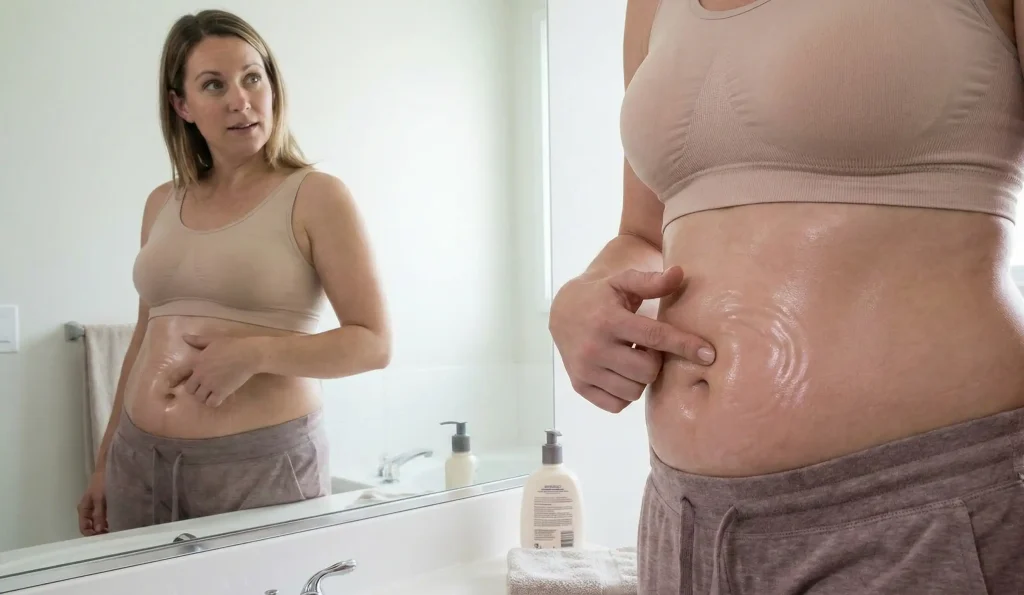
It’s hardly a secret that to know how to deal with a seroma, first, one should comprehend how it was formed in the first place. Among the procedures like Abdominoplasty (Tummy Tuck) or large-volume Liposuction with these body reshaping methods, the skin and fat layer are separated from the underlying muscle fascia in order to tighten or reshape the body. This surgical detachment results in a temporary empty space between the two tissue layers, which the doctors call “Dead Space.” No wonder the human body rejects an empty space biologically. On top of that, it got the surgical trauma, too, and the lymphatic system by initiating an inflammatory response leaks clear, yellow plasma—serum—into the gap to help the tissues heal. Usually, this fluid gets absorbed back into the body as the skin is reattached to the muscle. Yet, if the amount of fluid made is bigger than the ability of the lymph drainage system to take it away, or if the two layers cannot stick together because there is too much friction between them, the fluid will start to build up in the hollow until a seroma is formed.
The First Line of Defense: Compression and Patience
The seroma occurrence itself doesn’t always call for a drastic treatment path. A minor irritation from a small amount of fluid under the skin that doesn’t cause pain or put tension on the wound is easily manageable with the most effective remedy being the combination of compression and patience. And here is where the use of post-operative compression garment, what is more – ”faja”, turns from a simple shaping assistant into a close-to-medical device. The garment’s function here is to take the pressure so as to be able to physically push the skin flap down to the muscle. It acts as if a clamp is put on and by shutting the ”Dead Space”, the lymphatic channels are forced to work and fluid is reabsorbed. Our patients are always in for a surprise when we tell them that the most frequent reasons for running into persistent seromas are the irregular use of the garment; if you take off the pressure too soon you basically allow the space to open up again and fill with fluid.
Medical Intervention: Needle Aspiration
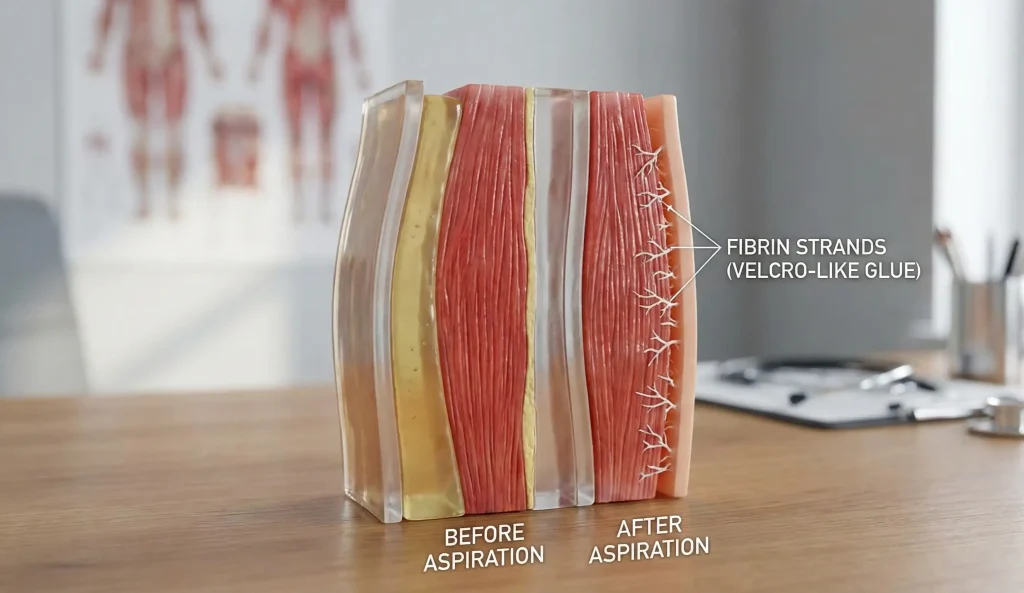
Occasionally, seroma lesion might become significant enough, visible and uncomfortable to be able to treat it yourself, hence, you must solve it with the help of a doctor in order to not stretch the skin that is getting healed or breaking through the incision. The best method to this end would be needle aspiration. Most patients find the idea of a needle very frightening but the procedure is usually not painful at all because the skin over a tummy tuck or major liposuction site is often numb by the surgery, at least superficially. In aspiration, the doctor uses a sterile needle to penetrate a fluid pocket and removes the liquid by manually drawing it up with a syringe. Patients are almost always immediately relieved when the pressure, which causes the problem, is released and the bulge disappears. Still, they have to brace themselves for the fact that one aspiration is rarely enough. Because the fluid can, sooner or later, refill the space, albeit very small amounts, there will be two or three more follow-up appointments after aspiration during which the tissue flaps will adhere.
Differentiating Seroma from Infection
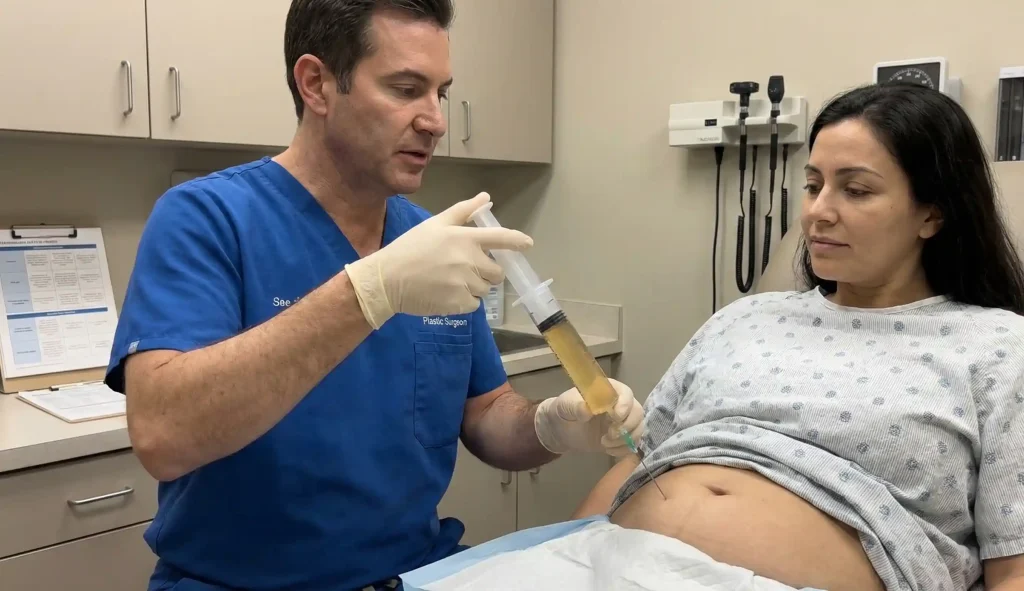
An important part of seroma management is confirming that the fluid collected is actually sterile serum and not the result of an infection that has spread deeper, e.g., an abscess. The fluid of a typical seroma is clear and of a straw color and looks like either urine or apple juice. Sometimes, the skin can be slightly red due to the stretch effect, but the patient will have no fever and, most probably, will feel well. On the contrary, an abscess is a result of bacteria and it is a collection of pus. The fluid obtained would be thick, cloudy, and foul-smelling. Furthermore, an abscess will be accompanied by other symptoms of infection such as high fever, shaking chills, and the skin being overheated, extremely painful, and tender. It is important to know such differences because, when it comes to an abscess, you have to do incision and antibiotics while to drain a seroma, only a bedside procedure is needed.
Lin Health Europe Clinic: Prevention Through Quilting
It is the opinion of Lin Health Europe Clinic that the most important step in treating a seroma is not to let it happen at all. In order to do so, the surgeons at Lin Europe Clinic use a state-of-the-art technique known as Progressive Tension Sutures, or “Quilting.” In addition to using drains or compression to get rid of the dead space, the doctor puts internal, absorbable stitches all over the surgical area, attaching the skin flap to the muscle fascia every few centimeters. The essence of the method lies in that the tissue layers are literally “quilted” together, thus any gap that the fluid could possibly fill is physically excluded. By mechanically closing the dead space we drastically lower the risk of developing a seroma and most probably, we do not have to use the isolating post-operative drains which allow our patients to have a drier, more comfortable, and faster recovery.
Frequently Asked Questions About Seroma Treatment
Not really. Most of the time a sterile seroma is little more than a nuisance rather than an emergency. Nevertheless, an untreated seroma may result in infection (abscess) or the formation of a hard capsule (encapsulated seroma) that would have to be removed through surgery.
Actually, no. Usually, the area around the seroma is numb from the surgery (especially after a tummy tuck). Patients generally feel relief from pressure rather than pain.
Yes, quite often. It may be necessary to have 2 or 3 aspirations. The amount of fluid drained should get smaller and smaller each time (e.g.,100ml, then 50ml, then 10ml) until the seroma disappears completely.
The only home remedy is wearing your compression garment. Do not attempt to drain a seroma with a needle on your own at home. You may cause bacteria to enter and develop a serious infection.
Small ones disappear on their own. Large ones may turn into “pseudocysts” that are basically permanent lumps. The only way to get rid of the scar tissue capsule is through a second surgery.
Baroudi, R., & Ferreira, C. A. (1998). Seroma: how to avoid it and how to treat it. Aesthetic Surgery Journal.
Pollock, H., & Pollock, T. (2000). Progressive tension sutures: a technique to reduce local complications in abdominoplasty. Plastic and Reconstructive Surgery.
Srivastava, V., et al. (2009). Seroma formation after breast surgery: what we have learned in the last two decades. Journal of Breast Cancer.