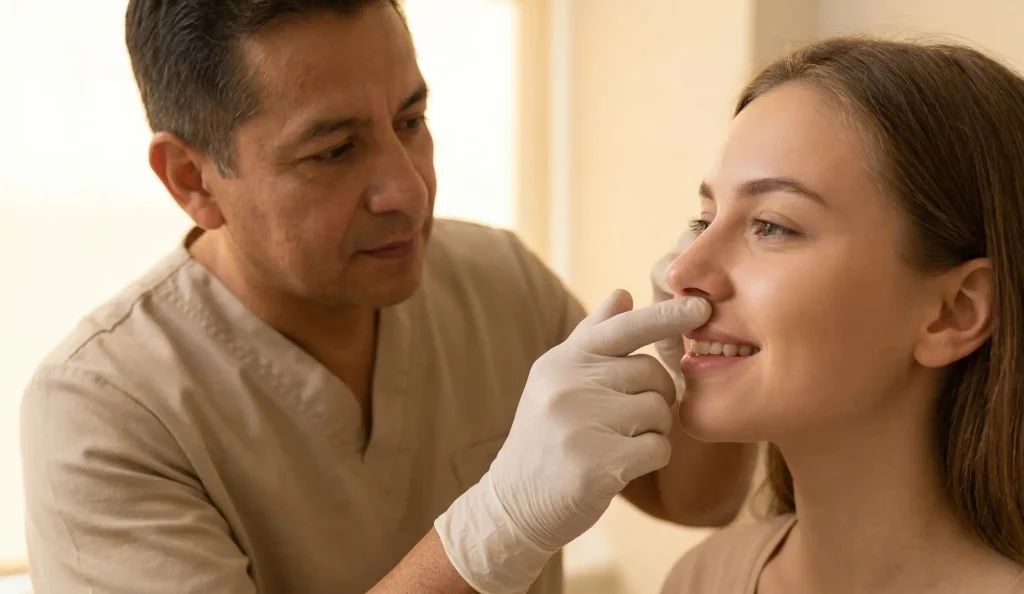
Temporary smile stiffness may occur.
Most people see rhinoplasty as a surgery that only changes the appearance of the nose and doesn’t affect anything else. But in fact, the nose and the middle part of the face are a complex system of muscles, tissues, and nerves all so closely linked that any change in one part might have an effect elsewhere. Actually, when patients raise the question of whether a nose job will change their smile or their upper lip, clinically, the answer is that it might—but in most cases, only for a very short time. After surgery, it is quite normal for your smile to feel a bit stiff and as if you are holding back or even a little unnatural. This temporary change happens because of physical reasons such as swelling after surgery, nerves being somewhat “stunned” temporarily, and the intentional adjustment of the muscles that join the nose to the lip.
At Lin Health Europe Clinic, we think that a patient’s knowledge and understanding are the best way of fighting off postoperative anxiety. Especially for our international patients who might be traveling to Turkey, we point out that structural nasal tweaking inevitably involves addressing the upper lip’s complex anatomy. Our clinic is the top choice if you are considering undergoing advanced ultrasonic and structural rhinoplasty, as we not only maintain the highest medical standards but also ensure that your facial expressions remain dynamic and natural, all the while giving you a perfect and harmonious profile.
The Anatomical Connection: The Depressor Septi Nasi Muscle
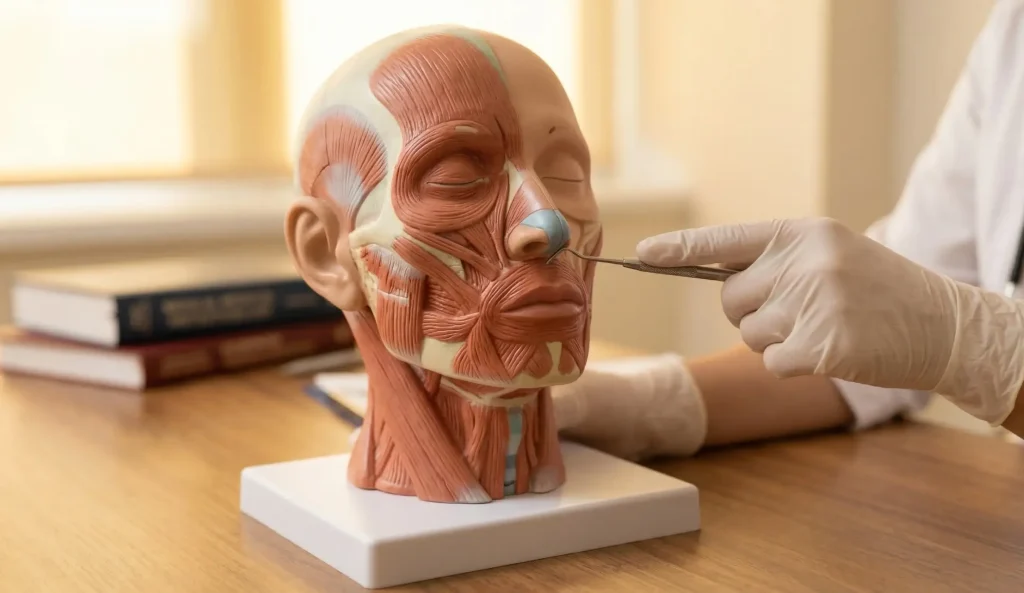
The reason your smile might be affected post-surgery is that you don’t know how the nasal base works biomechanically. The depressor septi nasi is a very small muscle, but it is quite strong. It links the nose’s base (columella) with the middle of the upper lip. It is normal for this muscle to be overactive in many people, pulling the nose’s tip downward and raising the upper lip too much every time they smile.
Our Lin Health Europe Clinic surgeons in Turkey are not only aware of the fact that this muscle has to be cut or loosened most of the time during a rhinoplasty, but they consider it an important step, as it helps in avoiding the nasal tip from hanging down in facial expressions. As a result of this relaxation of the upper lip, it may not feel connected, or it may feel slightly longer for a short while. A visit to our highly reputable clinic will guarantee you that this very fine muscle work will be done to the highest standard of accuracy, so as to form a well-supported nasal tip at the same time as preserving the natural beauty of your mouth.
Postoperative Edema and Physical Restriction
The reason why the smile looks very restricted is, in fact, due to the edema (swelling) after surgery. When the tip and the columella of the nose are traumatized through surgery, the entire area rushes with inflammatory fluids through a process of inflammation. Gravity pulls this fluid directly down into the upper lip.
Once the upper lip is swollen with fluids, it gets a lot heavier and less flexible. When a person tries to smile, the swollen tissues get stretched and because of that, the person will feel the tightness and discomfort of these tissues and, at the same time, a smile will look flat or “stuck.” At Lin Health Europe Clinic in Turkey, our staff is proficient in the use of lymphatic drainage and elevation of the head which are aimed at speeding up the patient’s recovery. We also teach our patients that as the swelling naturally decreases during the first weeks, the physical burden will be gone and full muscle mobility will be available.
Transient Neuropraxia (Nerve Stunning)
In addition to the swelling in physical tissues, the nerves that sense and control the mid-face are operating within a very sensitive environment and so quite easily get affected by any kind of surgical manipulation. The injection of local anesthesia, together with the fact that tissue around the base of the nose is dissected, most of the time results in a situation called transient neuropraxia—the nerves getting “stunned” temporarily.
The surgical expertise and excellence at Lin Health Europe Clinic are demonstrated by the handling of patients with surgical techniques that are very precise, minimizing injury to tissues. Still, even with the smoothest technique, such nerve stunning can make your upper lip feel numb and tingly and when you try to smile, your lip can be unresponsive. We always comfort our international patients by letting them know that this is a perfectly normal, expected phase of neocollagenesis (production of new collagen) and tissue regeneration. The nerves will recover and “wake up,” and gradually your natural, dynamic smile will be restored without any permanent damage.
Long-Term Enhancements: Curing the Gummy Smile
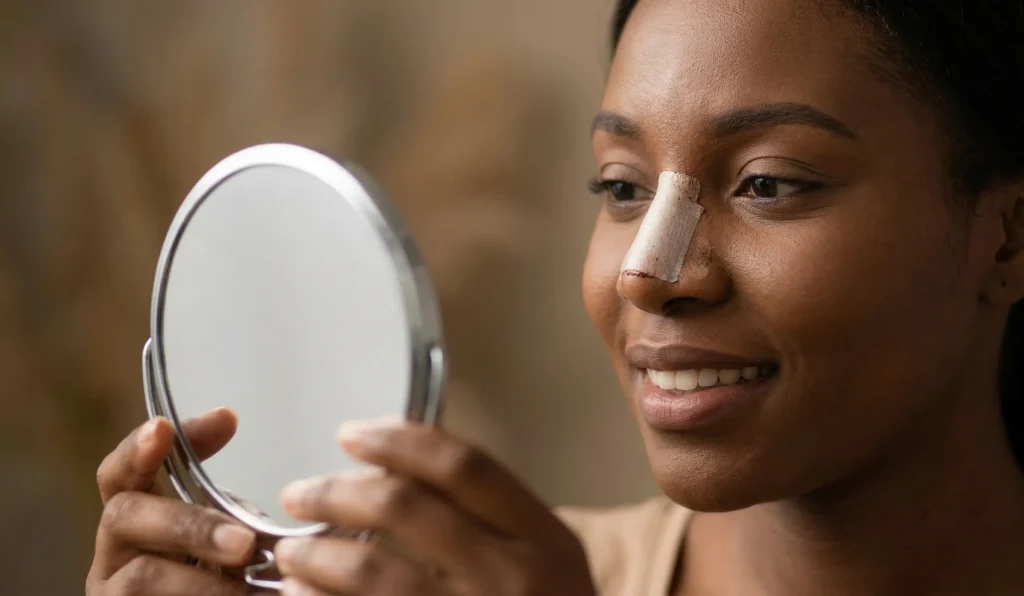
Although this feeling of restriction lasts for a short time only, there is one permanent benefit to the smile that a lot of patients find really desirable. In case you have had a “gummy smile” (which means that when you smile, you show a large part of your gums), then cutting the depressor septi nasi muscle during your rhinoplasty will very likely solve this problem for good.
Because that muscle has been the main one responsible for pulling up the upper lip in a very forceful way, the lip now just remains in a more relaxed and a little bit lower position. Here at Lin Health Europe Clinic, we regard the face as one whole unit. When our Turkey plastic surgery team is able to discover that undergoing a muscle release will both help in maintaining the support of your new nasal tip and, at the same time, improve the smile, then this is brought into your surgical plan. The outcome is a strikingly improved, perfectly balanced perioral aesthetic.
Rhinoplasty in Turkey
We at the Lin Health Europe Clinic take the view that real beauty in aesthetic surgery stems from an in-depth understanding of how the face moves rather than a preoccupation with its appearance when at rest. Our Turkey tertiary care hospital is a refuge of medical quality where innovations in facial plastic surgery are combined with the highest level of international patient service.
We work in cutting-edge, JCI-accredited hospitals that are representative of our position as the absolute leader of medical tourism and rhinoplasty worldwide. When you choose Lin Health Europe Clinic, you are placing yourself in the hands of the most capable surgeons in Istanbul. Our internationally renowned experts are foremost in structural integrity and facial harmony without compromise for every international guest who comes to us. Starting from your first 3D dynamic facial movement analysis session through the delighted restoration of your natural, bright smile, you will undergo the professional rigor and the top-notch hospitality that have made us the premier name in aesthetic medicine. Your path with us to a perfectly balanced profile will be led by the best.
FAQ:
Rhinoplasty can alter your smile for a limited period because of surgical swelling and changing the muscles connecting the nose and upper lip. When the nose tissues get fully healed the smile reverts to its natural state.
The stiffness in your upper lip is because of fluid retention (edema) and nerve stunning (neuropraxia) caused by surgery. The numbness and stiffness will go away and the normal lip movement will be restored as inflammation goes down over weeks.
If the surgeon has severed the muscle that connects the nasal tip with the lip, then the upper lip may drop and show a longer, more attractive configuration. This is very frequently a desired, very attractive aesthetic change used to correct a hanging nasal tip or a gummy smile.
Internal tissues undergo remodeling and that is the time between 4 to 12 weeks post-surgery during which most patients get their natural smile back. Structural healing phase is closely observed by our team of experts in Istanbul to ensure complete and flawless functional recovery.
Experiencing a very limited, “flat” smile where you cannot expose your teeth fully is totally normal. The physical weight of the swelling is preventing the lip from being elevated, but this will disappear as the body processes the fluid.
Daniel, R. K. (2007). Mastering Rhinoplasty. Springer.
Guyuron, B. (2012). Dynamics in rhinoplasty. Plastic and Reconstructive Surgery.
Rohrich, R. J., et al. (2000). The depressor septi nasi muscle: anatomy and clinical applications. Plastic and Reconstructive Surgery.
Tardy, M. E. (1997). Rhinoplasty: The Art and the Science.