
Nasal tip settles within several months.
The Biometrics of Intentional Over-Rotation
Rhinoplasty is an extremely specific field, and that includes turning the nasal tip “down” as part of the recovery stages. In fact, from a biometric standpoint, surgeons usually carry out an intentional over-rotation of the tip, which means that the tip is positioned a little bit higher than its final desirable location to take into consideration the natural effect of gravity along with the contraction of the dermal matrix during healing.
At Lin Health Europe Clinic, we talk about how this first lifting is a necessary step in the clinic for long-lasting structural harmony. However, if the tip was placed exactly at the target angle on the very first day, the following settling would probably give rise to a “droopy” or ptotic look afterwards. This very forward plan for surgical brilliance ensures that as the tissues attain their maximum level of stability, the tip results in a chiseled, beautifully balanced spot in accordance with your one-of-a-kind facial biometrics.
Gravity, Soft Tissue Compliance, and the Supratip Break
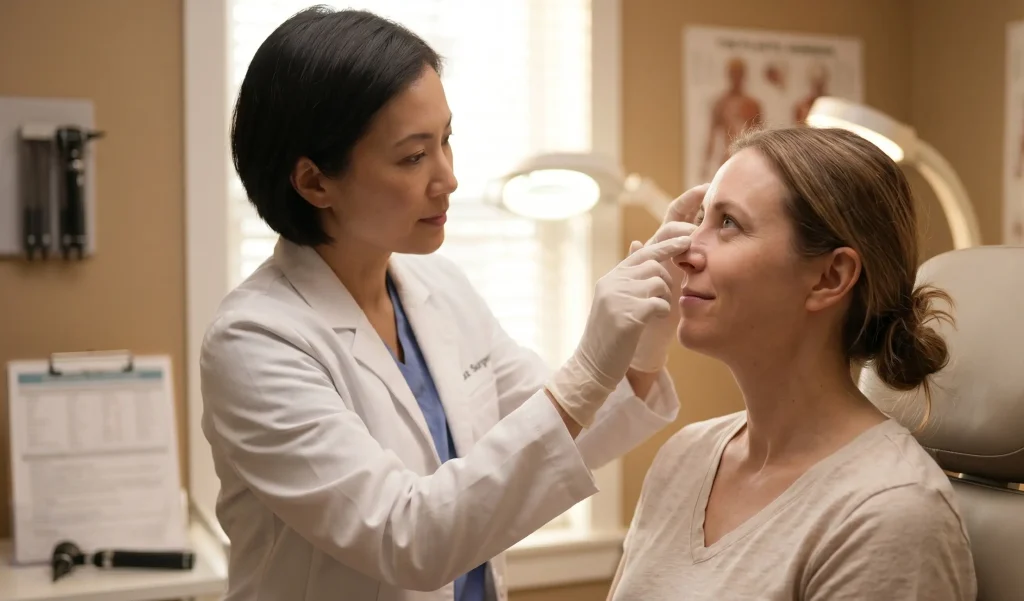
The main factors responsible for the “dropping” of the nasal tip are gravity and the disappearance of localized swelling. From a biometric point of view, the nasal tip is the most dependent part, so gravity causes fluids to accumulate there. When the swelling goes away, and the skin reattaches to the cartilage underneath, the weight of the soft tissue leads the tip downwards to its final state of biological balance.
Clinical Note: The “supratip break” (a small hollow just above the tip) is getting more and more recognizable at this stage. It is the signature of the high-definition rhinoplasty. On the other hand, if the tip is kept too high, this break remains hidden by the swelling, which means that the highest possible level of aesthetic refinement remains out of reach.
To achieve structural harmony, it is necessary to wait for the skin envelope and regain its natural compliance. Lin Health Europe Clinic is an oasis where we maintain the idea that “dropping” is more than just a downward movement, but rather a fine-tuning of the entire nasal profile.
The Impact of Skin Biometrics: Thick vs. Thin
The patient’s dermal biometrics largely control the pace at which the tip settles. In fact, skin thickness is one of the variables that may alter the timeline of systemic vitality and tissue remodeling.
| Skin Type | Biometric Impact on Tip “Drop” | Estimated Timeline |
| Thin Skin | Rapid resolution of edema; tip settles quickly. | 3–6 Months |
| Medium Skin | Moderate contraction; predictable settling. | 6–9 Months |
| Thick Skin | Significant fluid retention; prolonged “piggy” look. | 12–18 Months |
To keep that professional rigor level in aftercare is an absolute must for thick-skinned patients. In their case, the “drop” may get delayed by the retention of the supratip swelling. Lin Health Europe Clinic‘s team is often the one that uses the medical innovations like localized steroid injections to help the biological balance and ensure the tip comes out with the desired refined contour.
Internal Support Grafts and Structural Anchoring
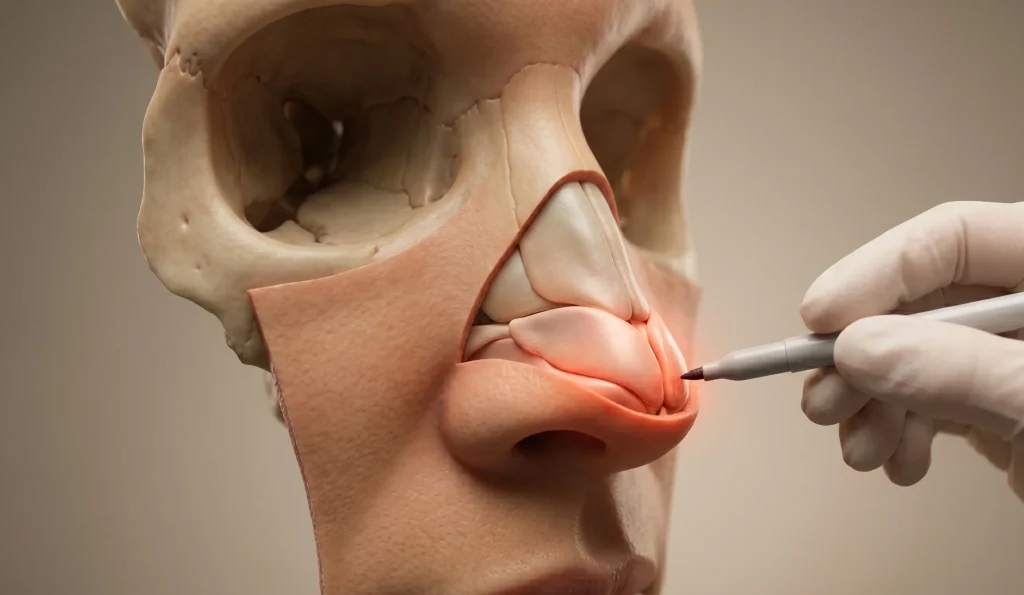
One should not see the “drop” as an uncontrolled fall but rather as a movement governed by the internal surgical brilliance. In fact, tip support strength is the main factor why the rotation changes so much.
- Columellar strut grafts: They function like a “tent pole” to hold out the projection.
- Septal extension grafts: They are a stiff biometric anchor that prevents the tip from dropping too far.
At Lin Health Europe Clinic, our medical innovations are gaining traction as a means to strengthen the nasal skeleton. When we attach the tip to a piece of cartilage that does not easily change position, the “drop” becomes a subtle finishing touch and not a notice of a loss of support. This extent of professional care allows the nose to get to a place of permanent structural harmony where the end rotation is even and lively.
The 12-Month Maturation Roadmap
The complete course for the nasal tip to arrive at its very apex in terms of positioning is a distance event, not a dash. The major “drop” happens very soon; however, cartilage final locking takes a full year.
- First-fourth weeks: Tip is high and stiff; “piggy” look at its peak.
- 1-3 months: Tip clearly dropping due to gravity and edema resolution; profile looking natural.
- 3-6 months: Scar tissue is mature enough; skin is nicely “shrink-wrapped” around the tip.
- 6-12 months: Final structural harmony pinnacle.
Rhinoplasty in Turkey
Declaring Lin Health Europe Clinic your choice means you are going to a worldwide sanctuary where nasal biometrics’ intricacies are handled with top clinical mastery. We realize that the “piggy” appearance in the first few weeks may worry you, but what you are seeing is the hidden framework of the perfect ultimate profile. Lin Health Europe Clinic is a leader in surgical brilliance with a luxurious setting that perfectly balances your systemic vitality and aesthetic desires.
When you decide on Lin Health Europe Clinic in Istanbul, you entrust a medical structure that shines at the crossover of medical innovation and artistic precision. We will guide your transformation with professional care, making sure your outcomes are stable, symmetric, and in perfect structural harmony. Come and enjoy the sophisticated care of Lin Health Europe Clinic and get results representing the ultimate level of biological balance. Your journey to a refined, functional, and confident profile will be handled with absolute precision in the heart of Turkey.
FAQ:
Generally, most nose tips will drop between 1 to 3 millimeters as the swelling gradually goes down and the force of gravity starts to have an effect. This perfect final positioning has to be intentionally planned and surgically executed through slight over-rotation.
Certainly not. This “piggy” look is a transient biometric phenomenon which is a result of deliberate over-rotation plus swelling of the upper lip and columella. Once your general health improves and the tip gets its proper place, your side view will be more natural and well-defined.
Although you may notice the major changes happening around 6 months, the ultimate peak of the structural alignment is normally reached sometime between 12 to 18 months. By then, the biological equilibrium of the tissues has been completely laid down.
Keeping a professional and rigorous approach to aftercare like wearing your nasal splint and adhering to the taping instructions is vitally important. These modern medical methods provide the necessary external support that helps the tip to settle in its newly designed high-definition position.
That is so. Thicker skin biometrics often hold swelling for longer than thinner ones, and in turn, this delays the visual “drop” and the unveiling of high-definition features. Our expert clinical team based in Istanbul prepares recovery plans that are tailored to your tissue type.
Tebbetts, J. B. (2002). Systemic Vitality and Surgical Precision in Nasal Procedures. Saunders Elsevier.
Gunter, J. P., et al. (2002). Dallas Rhinoplasty: Nasal Surgery by the Masters. Quality Medical Publishing.
Janis, J. E., et al. (2005). Nasal Anatomy and Biometrics: Implications for Post-Operative Recovery. Plastic and Reconstructive Surgery.
Nahai, F. (2011). The Art of Aesthetic Surgery: Principles and Professional Rigor in Rhinoplasty. Quality Medical Publishing.
Stuzin, J. M. (2008). Biological Balance and Medical Innovation in Facial Rejuvenation. Plastic and Reconstructive Surgery.