

Implants are longer-lasting than filler.
Among the different types of imbalances of the facial structure, a weak or underdeveloped chin is the most frequent one. Despite this, it is the most disregarded one. Oftentimes, patients come with complaints about a large nose or a “fleshy” neck, not realizing that their dissatisfaction is caused by the lack of lower face skeletal support. A chin that is set back disrupts the entire appearance and causes the nose to seem larger and the neck angle less defined. As soon as this is diagnosed, patients are given a critical choice whether to go for a non-surgical treatment option using dermal fillers or to undergo surgery with a chin implant.
Generally, the decision between chin implants and fillers goes on as a debate between convenience and permanence. Fillers provide an immediate, low-risk solution with no downtime, making them a tempting “try before you buy” option for people who are unsure about surgery. On the contrary, implants need an operation, but they guarantee a lifetime result, and the implant feel is very close to natural bone. That is why it is not only about the logistics, but it is more about the basic physics of materials. At Lin Europe Clinic, we help our patients understand how gel differs from solid silicone, and this knowledge enables them to decide on a result that is sharp and natural-looking rather than soft and undefined.
The Physics of Projection: Gel vs. Solid Structure
The main drawback of a dermal filler is that it is a gel in its physical state, and no matter how much the cross-linking of the Hyaluronic Acid is made, it still is a soft, moldable substance. When you aim to get a chin projection by injecting filler, it is like you are trying to build a structural foundation with the use of a liquid. It is true that the filler can push the skin forward, but it cannot copy the hard and clear mandible edges. As a result, filler generally leads to a rounded and soft projection. This is perfect for patients who require a slight modification, but those who need a bigger change will be disappointed by filler because it will not give the sharp definition that comes with a chiseled jawline.
On the contrary, a chin implant is a firm, anatomical product typically composed of medical-grade silicone or porous polyethylene. Because it is inflexible, it utilizes the same powerful sound tissue, which is arranged uniformly, as the natural bone. This stiffness enables the implant to cast shadows and delineate lines between the chin and the neck with a gel that is just not capable of producing. With an implant, a “tent pole” effect is produced, the skin and muscle stretched tightly over the new structure, thus, the clean, angular look that most patients want when they request jawline enhancement is produced.
The Migration Myth: Why Fillers Move Over Time

Filler migration is one of the reasons that putting too much chin filler is not a good idea. The chin is an area of the face that is very active; it has to move every time we talk, eat or show emotions. The mentalis muscle is very strong and actively covers the chin. Over time, because of the continuous force, the muscle can press against the filler gel that is soft so it turns flat or just scatters sideways to the jowls. Consequently, the chin looks heavier and wider instead of being sharper.
This kind of migration may also result in the loss of the well-defined chin-line, so that facial feature visually merges with the jaw-line indistinctly, causing the whole face to appear overfilled and rounded like a “moon face”. The use of implants negates this issue. When an implant for the chin is put in the correct position and heals, it is kept in place forever; it is, in a way, an anatomical one-bone. It does not spread, squash, or change shape under muscle pressure, so the sharp profile you saw one month after surgery will be the same profile you’ll see ten years later.
The Financial Equation: The Subscription vs. The Investment
Even though surgery has a high initial cost, it is crucial to consider the decision from a financial perspective in the long run. Chin filler only works as a monthly subscription service for the face. Besides, the results last only about 12-18 months because the body metabolizes hyaluronic acid; hence, there is a need to carry out the treatments regularly for the projection to be maintained. For a patient with a moderate recession who, in each session, needs 2-3 milliliters of premium filler, the expenses rapidly pile up. In about 3-4 years, the total amount spent on filler injections will have already exceeded the single cost of a chin implant surgery.
Hence, chin implants are a good financial way out for patients still in their twenties and thirties. It is a one-time expense. You only pay for the surgery and own that result throughout your life. This way, you never have to go to a clinic for a top-up. Filler is a great way to start if you’re not sure about a bigger chin; however, if you decide to use it as your permanent strategy, it will become the most expensive way to keep a certain profile.
The Aesthetic Risk: Avoiding the “Pillow Face”
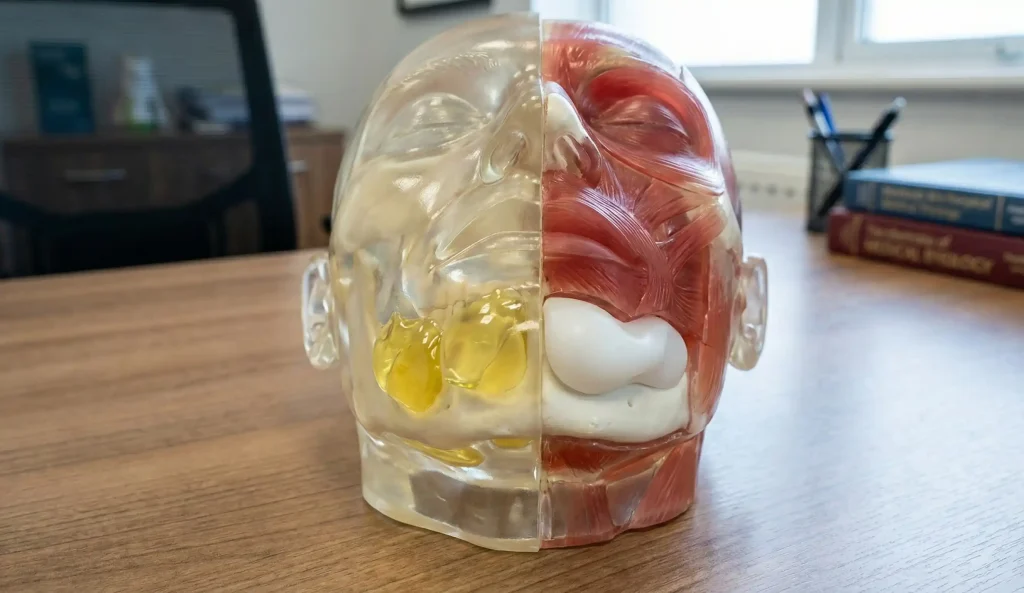
Before they start becoming unnatural in appearance, fillers have a limited capacity to increase the chin size. To get rid of serious chin recession (retrognathia) with filler, the healthcare practitioner might have to administer a large quantity of product. If you add 4 or 5 syringes of gel to a small closed space, internal hydrostatic pressure will build up. This is possibly the reason for “Pillow Face” or “Witch’s Chin,” a condition characterized by a chin that looks swollen excessively, highly shiny, or does not align well with the natural jawline because it droops lower.
Implants prevent volume distorsiom because they do not add extra bulk to the soft tissue layer while they provide the extension from the structural level. It is referred to pushing the existing soft tissue forward rather than inflating it when an implant is used. Hence, the skin texture and the muscle natural indentations are kept. It is pretty much a surgical achievement that may look more natural than a high-volume filler result because it acknowledges the facial anatomical boundaries that have been distorted by excessive liquid volume.
Lin Health Europe Clinic: Comprehensive Profiloplasty
At Lin Europe Clinic in Turkey, we don’t see the chin as a solitary feature but the face’s anchor. Our method revolves around the term “Profiloplasty”, which is the nose, lips, and chin relationship in-measurement of harmony. To show you how much a chin implant would change your proportions compared to filler, we employ advanced 3D imaging technology at your consultation. We provide a simulation of the result, whereby you observe the difference between the softer appearance of filler and the sharper one of an implant before making the commitment.
In the use of surgery for our patients, we resort to a wide selection of anatomical implants that narrow towards the jawline to make it perfectly smooth and natural, thus, avoiding the “stuck-on” button look that was common with old implants. Also, we specialize in a one-time session combining chin implants with Rhinoplasty. It is indeed a powerful combination that profoundly harmonizes the profile. Either you take the temporary flexibility of filler or the every lasting forced of an implant, we ensure the outcome is the jawline you were born with instead of the one you bought.
Frequently Asked Questions About Chin Implants and Fillers
Yes, in the beginning. Chin filler only causes slight discomfort when the needle is injected. A chin implant involves surgical operation, so you will get swelling, soreness, and tightness for about 5-7 days after the operation, but it can be easily controlled with medicine.
Yes. Since the chin implant is placed very deep under the muscle and next to the jawbone, it will be firm and structural, just like your own natural bone. On the other hand, treatment with chin filler may sometimes be felt as being soft or pliable when touched.
Partly. Chin filler by extending the lower jaw will bring the skin under the chin tighter and therefore enhance the appearance of the neck. On the other hand, a chin implant will give you a significantly more powerful structural push which means that the submental (double chin) area will be capable of going through better tightening.
The majority of solid chin fillers (such as Volux or Voluma) have a duration in the range of 12 to 24 months. On the other hand, performance decreases with time so you may notice the protrusion level going down even before the product is completely eliminated. Meanwhile, a chin implant is for the whole lifetime.
It is possible but you have to get rid of your chin filler first. It is highly important that the chin be restored to its normal precondition so that the surgeon is able to get an accurate bone measurement and thus be able to choose the right size for the chin implant.
Sykes, J. M., et al. (2016). Chin augmentation: anatomy, exam, and surgical techniques. Facial Plastic Surgery.
Bertossi, D., et al. (2017). Chin Microgenia: A Clinical Comparative Study: Chin Implants Versus Hyaluronic Acid Injections. Aesthetic Plastic Surgery.
Patel, B. C. (2020). Chin Augmentation. StatPearls Publishing.