Implants have more established safety data.
Breast Tissue Biometrics and Injectables
In the niche field of body design and breast rebuilding, the notion of safety is often the greatest allure of nonsurgical options. One of the regular questions posed during a consultation is the safety comparison between breast fillers and breast implants. Globally, the medical fraternity, when looking strictly at biometrics, emphatically states that implants are the safer option. While fillers are recognized for skipping surgical cuts, their contact with the delicate, glandular, and richly vascularized breast tissue remains highly uncertain and can pose serious systemic risks.
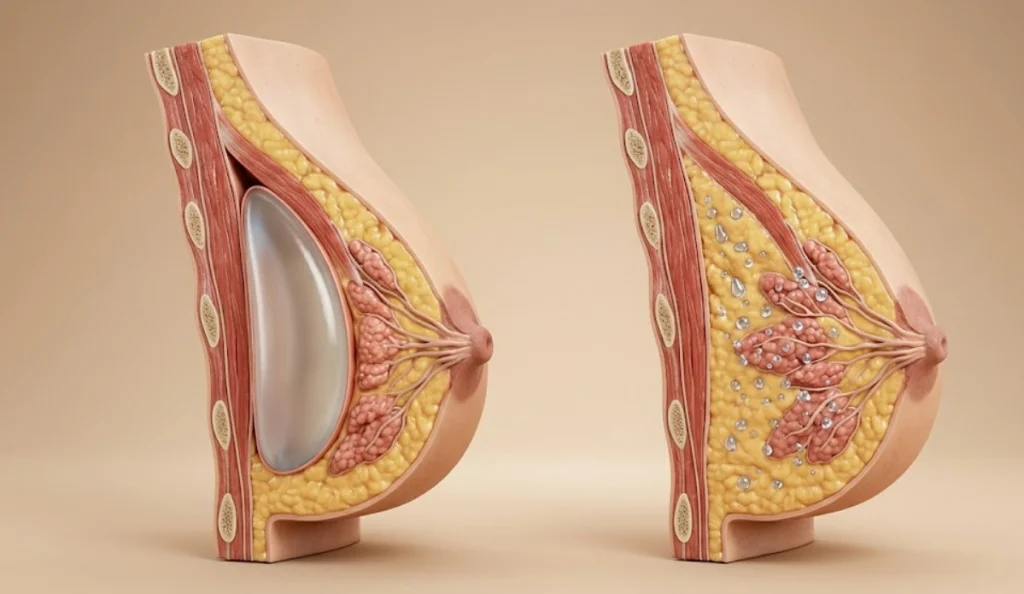
Here at LIN Europe Clinic, we illustrate that a permanent breast implant is safely tucked away inside a highly resistant, cohesive silicone elastomer. This casing delivers a clear divide between the implant material and your natural body, keeping a condition of structural harmony. Liquid fillers, whether they are made of hyaluronic acid, polyacrylamide hydrogels, or liquid silicone, don’t have this containment feature. Injected right into the breast, the liquid spreads within the milk ducts, Cooper’s ligaments, and blood vessels. This uncontrolled distribution throws off the native biological balance of the breast and starts a long-lasting inflammatory reaction that can cause tissue death, serious infection, and permanent structural change.
The Diagnostic Problem: Mammography and Filler Calcifications

The main health risk from breast fillers is in how they affect cancer detection methods. To reach the highest level of systemic health, clear and unimpeded diagnostic imaging is essential throughout one’s life. Once synthetic fillers are introduced into the breast tissue, they no longer stay as a smooth, uniform liquid. The body tries to isolate the foreign matter by surrounding the filler, which eventually leads to the breakdown of the filler into micro-nodules and the formation of chronic foreign-body granulomas.
These granulomas calcify over time. On mammograms or breast MRIs, these hardened filler calcifications are indistinguishable from early-stage breast cancer (ductal carcinoma in situ) or other micro-malignancies. This can lead to the following severe diagnostic problems:
- False Positives: Resulting in unnecessary, very-invasive tissue biopsies and severe psychological trauma to the patient.
- Diagnostic Masking: The density of the migrated filler might literally cover up actual malignant tumors, leading to delays in life-saving cancer diagnoses.
Conversely, breast implants, especially of the latest generation, are surgically positioned either behind the breast gland or under the pectoralis major muscle. They provide a clean anatomical separation that allows radiologists to use standard displacement techniques ( Eklund views) to obtain crystal-clear images of the native breast tissue, thereby ensuring your long-term diagnostic safety is completely safeguarded.
Irreversibility vs. Containment: Reality of the Materials
Analyzing the safety track for a lifetime of any cosmetic procedure, the notion of reversibility forms the cornerstone of clinical decision-making. When a patient has problems from a breast implant, like capsular contracture or a change in the symmetry of the breasts, treatment involves only a few steps. With the help of surgical brilliance, the surgeon can perform a clean capsulectomy, removing the implant and the scar capsule without any trace, bringing the body back to its fairness.
The case with liquid breast fillers is a whole different ballgame. Biological reversibility after the injection of a synthetic fluid does not exist. Once it is introduced, the product behaves like water pouring into a sponge. It clings to sensitive nerve endings, finds a way into the lobules, and due to the force of gravity, it can even go down to the abdominal wall. If a filler gets infected chronically or forms an inflamed, painful mass, it is not a case of mere “suctioning.” Dealing with the problem of migrated filler means a wide area surgical excision which resembles subcutaneous mastectomy.
The Overarching Status and Guidance of the Medical Community

The highest level of professional integrity in the medical field is defined by global regulatory authorities. Worldwide, the consensus in regard to synthetic breast fillers is clear: either heavily restricted or completely banned for breast enlargement purposes. The FDA has been firm in issuing warnings against the use of injectable fillers in breasts, and the European CE regulatory bodies have withdrawn the conformity certificates for historical breast fillers due to the high number of severe, delayed complications.
| Safety Category | Cohesive Silicone Implants | Synthetic Breast Fillers |
| Regulatory Status | FDA-Approved & Universally Accepted. | Banned or Strongly Warned Against. |
| Material Behavior | Fully contained within an elastic shell. | Uncontained liquid that diffuses freely. |
| Reversibility | 100% Removable via capsulectomy. | Irreversible; infiltrates native tissues. |
| Cancer Screening | Clean displacement; no imaging interference. | Forms calcifications; masks malignancies. |
| Long-Term Stability | High-definition contour for decades. | High risk of migration and granulomas. |
Today’s cohesive silicone gel implants, like those we have at LIN Europe Clinic, have been subjected to stringent scientific studies, epidemiological research, and technological progress for decades. The implants are designed to hold the gel inside, even if the shell is damaged, making it impossible for the material to enter your systemic circulation. Implant choice approved by the FDA is a must for a person aiming for a refined, lovely change that does not come at the expense of health.
New Risks Are Reduced: Autologous Fat Grafting Is the Only Liquid Option
In case a client hates medical devices of foreign origin and still wants a non-surgical enhancement, medical innovation supplies a safe, biologically acceptable alternative: autologous fat transfer. This procedure relies on your own live fat cells taken out by liposuction in a gentle manner from sites such as the belly or thighs. The cells are then used to naturally round out the breasts. Since fat grafting makes use of autologous tissue, there is no danger of chemical toxicity, migration, or immunologic rejection.
The grafted cells integrate naturally into the pre-existing dermal and subcutaneous matrix, thereby preserving an ideal biological balance and delivering a natural softness. Even though the transfer of fat demands an unusual degree of clinical mastery to have high graft survival, it is the only clinically valid “injectable” option for breast enhancement. At LIN Europe Clinic, we offer our clients honest and research-based advice; therefore, the very dangerous synthetic liquids are avoided, and the solutions that maintain systemic vitality are revealed.
FAQ:
No, the FDA has not approved any injectable fillers for breast enhancement. Besides, using them could be extremely dangerous to your health.
Yes, fillers replicate breast tumors by forming lumps and calcifications. This is because they can either mask tumors or create false tumors that resemble malignant ones on mammograms. This can prevent the patient from getting an accurate diagnostic screening on time.
No, since liquid fillers diffuse and permanently bind to your native breast tissue, their removal usually necessitates an extensive surgical debridement followed by reconstructive surgery.
Implants are enclosed and isolated from your natural tissue layers by a silicone membrane which can be totally extracted if needed and which does not leak or implode in the tissue layers.
No, fat grafting uses living cells from your body instead of synthetic liquids. In fact, the procedure is tightly regulated and does not possess the chemical risk.
Tebbetts, J. B. (2002). Systemic Vitality and Surgical Precision in Mammary Procedures. Saunders Elsevier.
U.S. Food and Drug Administration (2024). Safety Warnings Regarding Injectable Silicone and Dermal Fillers for Body Contouring. FDA Consumer Health Information.
Janis, J. E., et al. (2005). Thoracic Anatomy and Biometrics: Radiographic Interference in Breast Imaging. Plastic and Reconstructive Surgery.
Nahai, F. (2011). The Art of Aesthetic Surgery: Principles and Professional Rigor in Patient Safety. Quality Medical Publishing.
Macrolane Consensus Group (2012). Clinical Mastery and the Discontinuation of Hyaluronic Acid for Breast Augmentation. Aesthetic Surgery Journal.