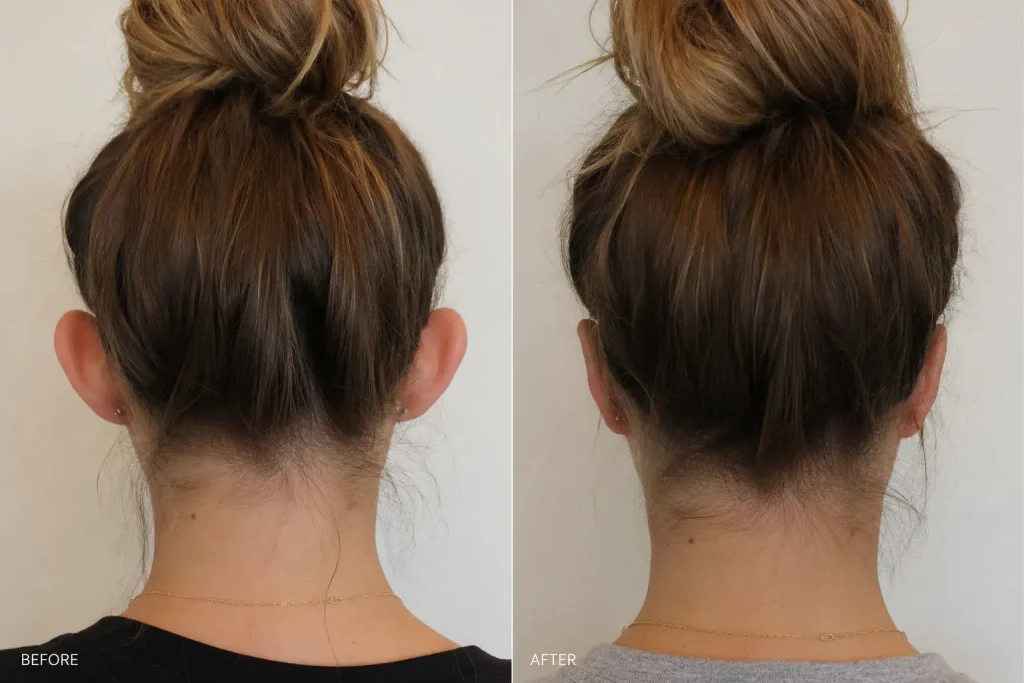
Ears heal into a more balanced position.
The Process: Cartilage Sculpting and Internal Suture Anchoring
Otoplasty, also known as ear pinning or reshaping, which is part of plastic and reconstructive surgery, significantly changes the structure of the outer ear cartilage. The main causes of prominent or protruding ears are an underdeveloped antihelical fold (the cartilage that forms the inner curved ridge of the ear) or a very large and deep conchal bowl (the part of the ear cavity adjacent to the ear canal).
A well-hidden incision behind the ear is made for the purpose of this surgical method, and the surgeon uses cartilage-scoring techniques to weaken the cartilage’s structural memory to enable a smooth bend of the cartilage backward. Permanent, strong, internal sutures (like Mustarde or Furnas stitches) are then used to lock the ear in a new, more natural-looking position. In fact, such high-strength internal stitches work very well in drawing up the cartilage to the mastoid part of the skull. That action immediately resolves the issue of protrusion and makes the face look more naturally balanced.
Early postoperative Tissue Changes
With the surgical part being completed, the ear tissues will go through a number of physical changes as they begin to heal after the surgery:
Local Edema and Contusions (Days 1–7): The ear cartilage has a very good supply of blood without a lot of fat above it. Therefore, when subjected to any changes due to a surgical procedure, it can show very intense localized swelling as well as a very purple or deep red bruised appearance. The pain and swelling will be very prominent for the entire first week.
Reduced Sensation (Weeks 2–8): Due to the surgical cuts and changes made to the underlying tissues, the delicate sensory nerve cells of the skin that provide feeling to the outer ear are temporarily “numbed.” For most people, experiencing some degree of numbness, rubber-like or disconnectedness from the face on their ears for several weeks is a normal and natural process as nerves slowly start healing.
Final Relaxation and Settling (Months 1–3): As time gets to be a factor and the residual fluid is finally gone from the surgery, besides the scars getting a little softer, the ears can go through a subtle, natural relaxation phase. Basically, they will move a bit forward, 1 to 2 mm at most from their initial state after the surgery, when they were pushed pretty tightly, but still, they will finally settle into their own natural shape that was meant for them.
Musculoskeletal Lines and Splinting the Ear
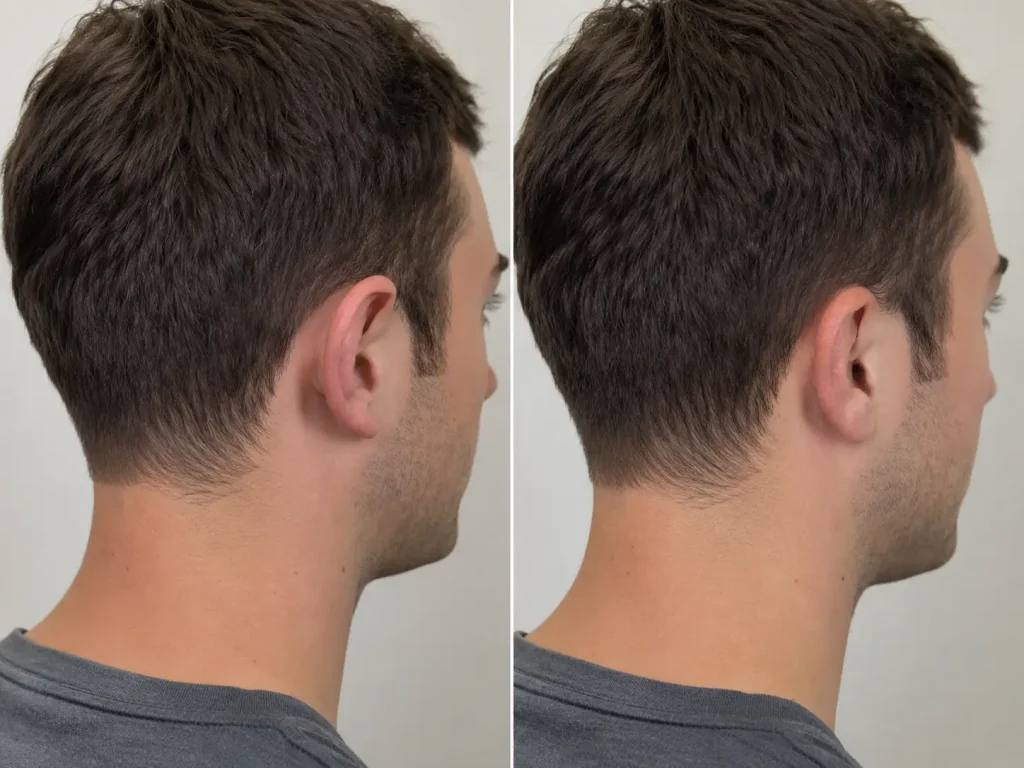
For those who are highly dedicated to their looks and who want perfection, it is absolutely essential to follow your instructions carefully and strictly without any deviations or shortcuts. For a period of six weeks post-op, the ears can only be stabilized and held in place if internal sutures are intact. The cartilage by this time is still at the immature and very soft stage, as it has not developed or matured its own fibrous scarring. Any unnecessary and abrupt movements or contact with the affected ear can lead to internal suture damage. The consequence of that is that the ear may return to its initial position of sticking out. One of the most important ways you can safeguard your beautiful, newly sculpted look and make your body’s contours align perfectly with what you wanted is by following the use of your customized after-surgery head compression gear.
For the first seven postoperative days, you will wear it throughout the day and at night, during all of the deep sleep cycles, at any rate. The second time that you will wear it will be for another couple of weeks, but this time, only while you are sleeping. This measure is there to protect your ears from being forced into a bent position against the pillow. Also, completely eliminating the intake to nicotine and the use of all types of tobacco is not up for debate. The reason this is important is that nicotine is quite a strong vasodilator in the system, and when the tiny blood vessels narrow, the very thin layer of skin on top of the ears will not be nourished sufficiently by oxygen- and nutrient-carrying blood which can, in turn, cause the skin to break down or healing to be delayed.
The Ear Maturation Timeline
Become familiar with the standard maturation timetable and you will easily be able to tell the difference between the temporary fluid build-up as a result of the operation and your true permanent anatomy.
| Recovery Phase | External Presentation | Underlying Biological Activity |
| Week 1 | Marked swelling and deep bruising | Primary inflammatory phase; ears are protected by a thick head bandage. |
| Weeks 2–4 | Edema recedes; ears look slightly “over-corrected” | Acute swelling drains downward; skin begins to contract over the new fold. |
| Months 2–3 | Cartilage softens; ears settle slightly forward | Internal sutures integrate fully with tissue; natural ear flexibility returns. |
| Month 6+ | Sharp, permanent antihelical contours | The scar behind the ear fades into a thin line; definitive final symmetry is achieved. |
Otoplasty in Turkey
Making LIN Europe Clinic your choice means you are getting access to an elite facility on the planet where both your facial aesthetics and structural remodeling are handled with absolute dedication and profound levels of medical expertise, as well as empathy and compassion. We appreciate that the process of going through advanced phases of recovery and protection that an advanced Otoplasty can require requires that the environment in which you get these care instructions is a very highly sophisticated, very clean, and completely supportive space. LIN Europe Clinic in Turkey is not just one more place to heal. It truly has become an international leader in the field of advanced facial contouring, plastic aftercare and other cosmetic surgeries, offering a serene and peaceful environment where your health plans and recovery processes are strictly supervised with world-class safety procedures.
The trust in the expertise of specialists at LIN Europe Clinic in Istanbul will be well worth it. Our team will monitor your body structures very closely without missing any single point. The post-operative care you will receive from us will be very detail-oriented and personalized; you will learn about tissue Kinetics at very high levels through HD imaging, and also receive healing checklists so that you can easily follow the steps towards full recovery of the tissue and integration into a new lifestyle. Your body contouring investment and the integrity of your systemic health will both be protected in a perfectly secure way so you can fully and confidently settle in at your ideal silhouette. With LIN Europe Clinic, the whole experience will be a refined and comprehensive care where you will feel like a very special patient with your unique medical needs being the priority. Masterfully Balanced results are safely and masterfully delivered in the heart of Turkey.
FAQ:
The cartilage of the ear is reshaped and folded towards the head, and fixed in the desired position through the use of permanent internal stitches. This technique allows for a significant reduction of the ears being out of line with the head, and thus results in a more balanced facial structure.
Your ears will naturally loosen, and move forward slightly, about 1-2 millimeters, within the first 2-3 months as the swelling decreases and tissues get softer. This phenomenon is perfectly normal and anticipated by the surgeon when the initial plan for the surgery is made.
It is natural for a certain level of numbing to remain following surgery as the minor surface nerves of the outer ear have been briefly affected by the surgical cuts. It usually takes between 4 and 12 weeks for the sensation to be restored totally.
In most cases, you will be asked to wear a very tight dressing around your head day and night for an entire week, and then a supportive elastic headband while you are sleeping for another 3 to 4 weeks if you prefer, since you might unconsciously scratch or press in such positions while in bed.
Indeed, after an Otoplasty, the internal permanent stitches and scar tissues that are formed are so well-anchored that they keep the cartilage in its new shape permanently as long as you do not let the healing process get injured by your hands for example during initial healing phases.
Mustarde, J. C. (1963). The correction of prominent ears using internal mattress sutures: Analyzing structural stability and cartilage memory. Plastic and Reconstructive Surgery, 32(6), 637-643.
Furnas, D. W. (1968). Correction of prominent ears by conchal-mastoid sutures: Evaluating mechanical tension vectors and long-term tissue adherence limits. Clinics in Plastic Surgery, 5(3), 181-192.
Rohrich, R. J., et al. (2014). Advanced postoperative care, nighttime headband garment protocols, and structural stability in secondary facial contouring. Aesthetic Surgery Journal, 34(5), 587-595.