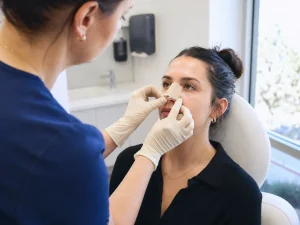

Temporary resonance change after surgery.
In the medical areas of ENT and facial plastic surgery, the voice depends on two main factors: the sound of the larynx and the “nasal resonance.” If people say their voice sounds “nasal” after a nose job, they most often mean a condition that doctors call hyponasality. Basically, it is when the nasal airway is so narrow that the phonation of the letters “m,” “n,” and “ng” through the nose is impossible, as these sounds are normally vibrated through the paranasal sinuses. Rather than the voice acquiring a “nasal,” i.e. high-pitched twang, it sounds “plugged” or similar to a voice during a severe head cold.
At Lin Health Europe Clinic, we view changes in voice as a temporary physiological stage of the healing process. For patients who are coming from abroad to Turkey, it is vital to understand that the change in voice is almost always linked to the inflammatory reaction of the first few days and the internal healing process. Our clinic is a leader in functional aesthetic surgery where we combine surgical skills with an in-depth knowledge of the relationship between nasal anatomy and acoustic resonance.
The Role of Internal Edema and Mucosal Swelling

Up to 90% of the cause of one having a “plugged” or nasal voice right after a rhinoplasty is due to internal edema (swelling). The mucosa of the nose is extremely vascular and sensitive; thus, the micro-trauma of the surgery makes them swell, which drastically shrinks the space inside the nasal airway. The temporary blockage stops the sound waves from reaching the “resonant chambers” of the nose, which causes a flat, hyponasal way of speaking.
At Lin Health Europe Clinic, our expert plastic surgeons in Turkey employ complex surgical methods together with postoperative care and special internal splints to minimize the swelling from the time the operation is over. We assure our clients that as the internal tissues become less congested in the next 2 to 4 weeks, the airway will gradually become wider, and the voice will be restored to its original pitch. Your choice to entrust us with your care will guarantee that your healing is in the hands of professionals who know how to keep your new facial profile safe and maintain your breathing at its best.
Nasal Packing and Postoperative Splints
Most patients undergo a procedure in Turkey where internal splints or sometimes soft packing is used to support the reshaped nasal framework and the septum during the first few days of recovery. Such medical appliances not only support the new structure but also completely block the nasal passage making it impossible for the voice to be resonated through the nose i.e. “nasal” voice. This voice is most “nasal” at this time and it is completely normal to expect the voice to be “nasally”.
It is the core competence of Lin Health Europe Clinic to craft the best healing environment through the use of state-of-the-art internal splints which have good air permeability. Therefore, one can enjoy the flow of air even in the initial stage of recovery. After symptoms of nasal stuffiness have subsided upon removal of the splints done by our clinical team in Turkey, usually after 5-7 days, patients can feel a great difference in their vocal tone and sound. We are committed to our patients’ comfort and therefore, we never hesitate to use the latest technology to ensure that the “nasal” period lasts the shortest time possible for you.
Structural Changes vs. Temporary Obstruction
It is true that a patient can normally experience temporary hyponasality after a surgery but if you have secretly been worrying whether a “nose job” can cause your voice to be permanently changed, then here is some relief, the only time your vocal identity can be altered is if the internal nasal valves are very significantly narrowed or if the nasal cavity’s overall volume is drastically reduced. That is why “functional” rhinoplasty is a must; the doctor needs to make sure that a handsome reduction of the nose is combined with the maintenance of a well-functioning, open breathing passage.
At Lin Health Europe Clinic in Turkey, we employ high-definition anatomical scanning to locate the internal valves precisely so we can preserve their position and function. By directing our efforts at reinforcing the nasal cartilages, we safeguard both the airway of life (breathing) and the avenue of vocal resonance for years to come. Our campus, set in world-famous locations, is known for producing results that are elegant and harmonious with the natural features and which therefore function optimally, thus your voice stays as free, natural, and your own as ever.
The Recovery Timeline for Vocal Clarity
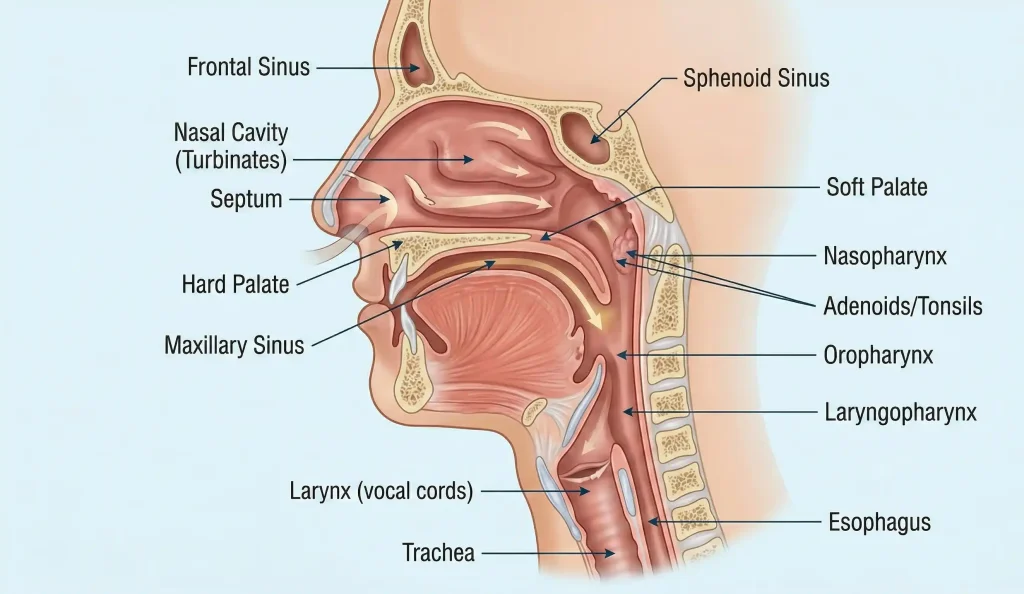
It is typical to observe “nasal” voice (more precisely, hyponasal voice) following the clinical timeline of symptoms of the surgery or recovery. The first week is the worst, with maximum edema and the splints all blocking the nasal sounds out; at around week 3, after removing the splints and during the tapering of the swelling, the voice starts to get back to normal. Nonetheless, due to the fact that a slight internal swelling can last for months, patients may perceive a faint resonance change when lying down or working out for a period of six months.
We at Lin Health Europe Clinic provide our clients from abroad with personalized nasal saline spray and an anti-inflammatory medicine regimen in Turkey to maintain the comfort and well-being of the nasal mucosa. Our innovation in the recovery environment is second to none, and we consider each detail of your physical health to lay the medical groundwork for a faster return of your normal voice.
Rhinoplasty in Turkey
At Lin Health Europe Clinic, a successful rhinoplasty is one that shows you off to the world at your very best while still preserving your natural functions. The medical and surgical professionals at our Turkey facility are among the most highly trained and knowledgeable, equipping us to offer you cutting-edge surgery services in a setting that represents the most extravagant patient care at the same time. The hospitals we partner with to carry out our complex procedures are modern, JCI-accredited, and uphold the highest standards worldwide, making a visually and functionally harmonious outcome our constant goal as the global gold standard in international aesthetic and functional surgery.
Choosing Lin Health Europe Clinic means entering a lifelong partnership with a team that will be with you every step of the way to a total transformation. The surgeons in Turkey are among the world’s best; they are passionate about making sure the delicate balance of the nasal airways is not compromised. We make sure that you will get the highest level of professionalism and the finest hospitality at all stages of your journey to a new nose—a journey that is managed by the best medical minds in the world.
Frequently Asked Questions About the “Nasal” Voice
Unfortunately nasal voice is predominantly caused by internal swelling and the presence of splints which block your nasal resonance. This is a hyponasality and it is only temporary which will gradually get better as your tissues heal.
The voice usually returns to normal within 2 to 4 weeks after the internal splints removal. However, subtle changes may be noticed up to three months when the final edema disappears.
Saline sprays on a regular basis will effectively keep the nasal lining moisturized and internally calm down the inflammation. Additionally, the natural voice will come back quicker if you follow all the postoperative instructions for rest and hydration.
Very swollen tissues can still present a deviation of the nose at the time of measurement, so even though the nose was straightened surgically, this illusion of a deviated nose may still be there. In some instances, the cartilage beneath the surface may have a slight inclination to shift, although it may be less noticeable, during the long healing process.
In some cases, otolaryngologists can perform functional surgeries such as turbinate reduction or septoplasty which help to clear the nasal airway and thus eliminate chronic hyponasality. The main focus of these procedures is to increase internal nasal volume and help achieve normal vocal resonance.
Sazgar, A. A., et al. (2010). The effect of rhinoplasty on voice. Journal of Plastic, Reconstructive & Aesthetic Surgery.
Constantian, M. B. (1994). The effect of rhinoplasty on nasal airflow. Clinics in Plastic Surgery.
Behrman, A. (2007). Speech and Voice Science.
Grymer, L. F., et al. (1991). The effect of septorhinoplasty on the nasal airway. Laryngoscope.