They cover the full waist, abdomen, flanks, and back zones.
When patients come to us talking about body contouring, they usually first point at their navel and say, “I just want this area gone.” But the truth is, the human body’s shape is like a 3D cylinder and not a flat 2D surface. So, if you pull fat from the front and leave it on the sides and back, you’ll get a very unnatural, “boxy” result. That’s the reason why nowadays, plastic surgery has moved from traditional liposuction to Lipo 360.
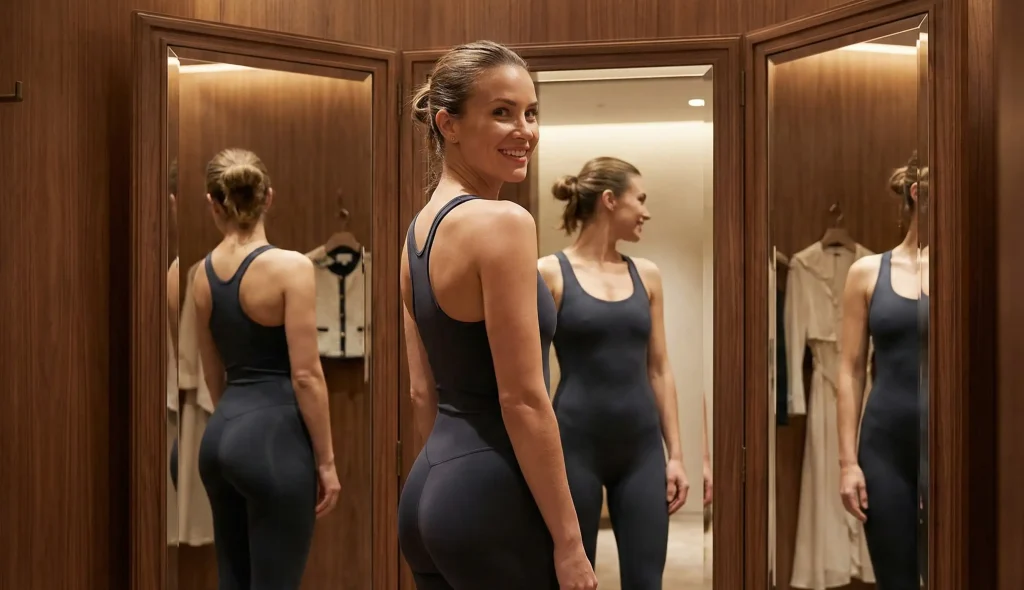
Lipo 360 (Circumferential Liposuction) means fat removal from the whole midsection—front, sides, and back—to give a complete silhouette. But what exactly does that mean? While there can be slight differences in the understanding of this between surgeons, the “12 areas” usually refer to a very detailed subdivision of the outer torso into aesthetic units. Applying the procedure to all 12 means that after you twist, bend, or wear a tight dress, you will definitely not have bumps, lumps, or bulges.” Here at the Lin Health Europe Clinic, we consider the torso a continuous canvas where each zone has to flow naturally into the other.
The Front: Upper and Lower Abdomen (Areas 1-4)
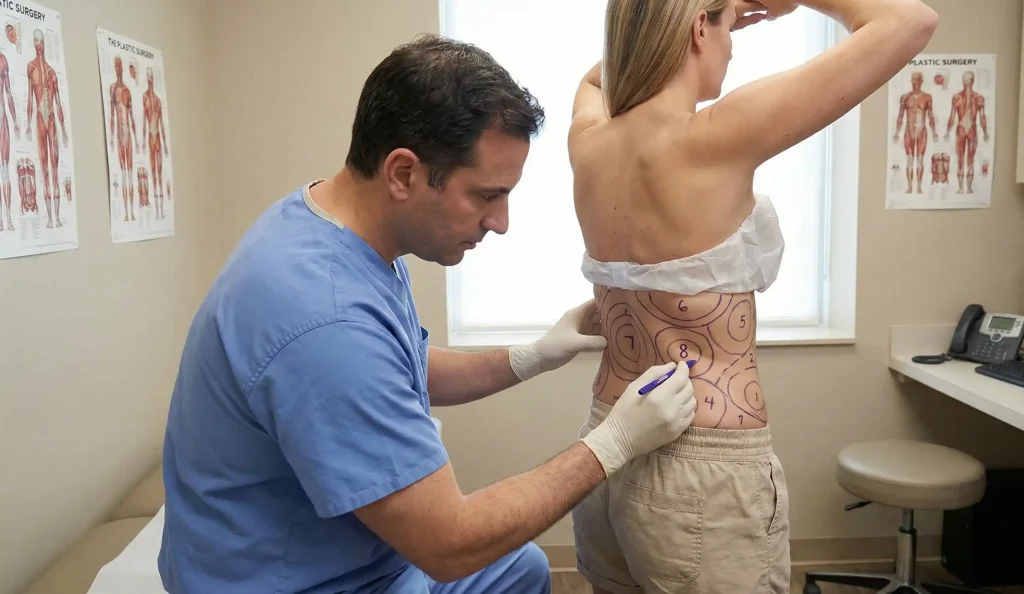
The first four zones are actually quite straightforward as they are the actual stomach. However, the stomach is not treated as one big blob here. We separate it into quarters:
- Upper Abdomen (Right & Left): This is the area between the ribs and the belly button. It is often quite tough and fibrous, so it is harder to treat. The main effect of contouring here is to define the “top” of the abs and thus to avoid the creation of that “shelf” under the breasts.
- Lower Abdomen (Right & Left): This refers to the area extending from the belly button all the way to the pubic bone (aka the “pooch”). Usually, this fat is softer and located deeper. When this area is treated aggressively, the profile becomes flat but the result should be gradually merged with the upper parts so that any step-off deformity is avoided.
The Sides: Flanks and Waist (Areas 5-8)
Such zones can almost be called magic. If you had a flat tummy but a wide set of flanks, you would still appear “thick” when wearing clothes.
- The Flanks (Love Handles): They are situated a bit above the hip bone on the side. Fat removal from this site is what brings about the “snatched” waist look and the revealing of the pelvic curve.
- The Waist (Mid-Axillary Line): This area is actually a very small one and it is the one that makes the transition between front abs and back. We contour this zone so that the feature of an hourglass is emphatically exhibited. Thus, a thorough, anterior (front), and posterior (back) waist treatment, physically reduces torso width, not just its thickness.
The Back: Bra Rolls and Sacrum (Areas 9-12)
That is where the “360” really comes from. Back is usually the part overlooked by most patients until they get a picture from behind in their hand.
- Mid-Back / Bra Rolls (Right & Left): These are the areas where the fat bulges around the bra straps. Getting rid of the fat in this zone results in elongating the torso and is even better for the exhibition of posture.
- Lower Back / Presacral Triangle: This refers to the area just above the buttocks. This area is considered extremely important (sometimes it is referred to as “Champagne Diamond”) because the gluteal crease top arrives visually cleared and the butts look nice and rounded due to the sacrum fat-pad removal. Moreover, one gets the athletic V-shaped or Venus Dimples, which is what most patients want.
The Harmony Principle: Why All 12?
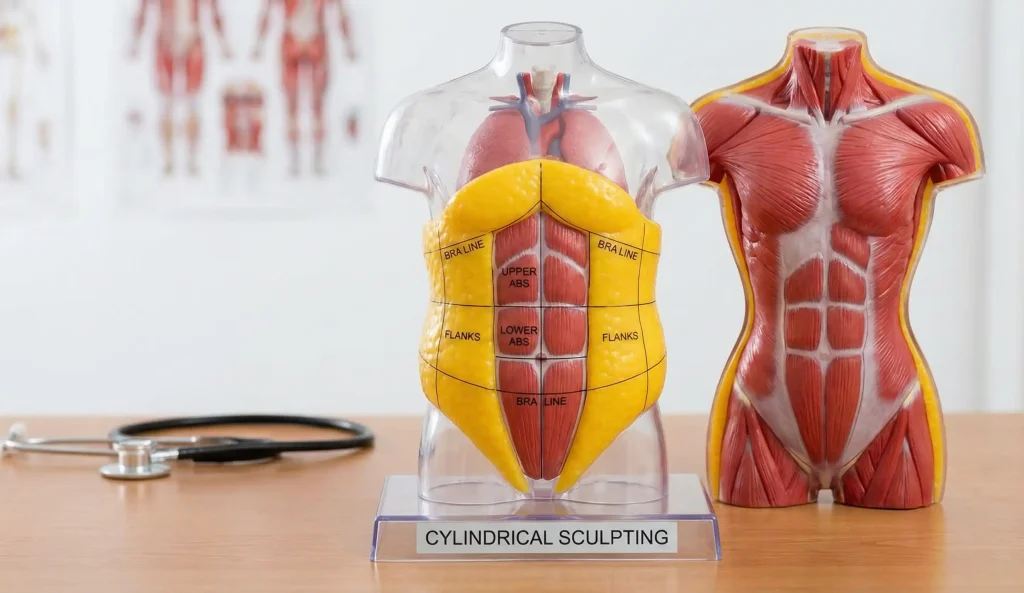
Why not just pick the areas you hate? That is because “spot treating” destroys one’s natural body lines. Thus, if the stomach only (zones 1-4) is lipoed and the flanks (5-8) are left untreated, the result is a front rectangular view. Thus, if the flanks are treated but the back (9-12) is ignored, the front view will be slim while the side will be wide.
Once all 12 spots are treated, the skin has a chance to retract in a balanced way around the muscles. Also, changing the recovery aspect by treating the whole circumference, is a great advantage. In fact, since the skin has been detached from the muscle in a 360-degree ring, the swelling that will appear will naturally Fig. 1 due to gravity migrate downward. Patients can get swollen pubic area or thighs after a couple of days following the surgery. That is the reason why a Faja is more than just a fashionable item; it’s actually a mold. The latter ensures that as the different zones heal and the skin retracts, it perfectly sticks to the new underlying muscle architecture without creating seromas (fluid pockets).
Lin Health Europe Clinic: VASER High Definition
Carrying out the procedure of 12 areas at Lin Health Europe Clinic goes way beyond using a cannula, but this is exactly why it brings about energy technology at a higher level. This is a technique that harnesses VASER Liposuction energy to sculpt the body after the fat cells in all 12 areas have been broken down first by ultrasound waves and then the loose fat is sucked out.
This is especially important for the between fibrous areas of the upper back and upper abs. With the aid of a VASER system, we manage to implement the treatment extensively yet gently, thereby blood vessels and nerves are preserved. Hence, the resulting bruises are few, and the skin’s retraction is much smoother. We frequently bring in J-Plasma (Renuvion) as well to provide the final touch through shrinking and tightening the skin on the newly-formed 12 zone contour so that your new 360-degree figure will be flawless, toned, and altogether free of any ripples.
Frequently Asked Questions About Lipo 360
No. Lipo 360 is a procedure that only focuses on the trunk (abdomen, flanks, and back). The arms, thighs, and chin are the areas that the patient can add on if they wish (“Lipo 360 + Arms”).
Since the procedure treats the whole torso, Lipo 360 recovery is comparable to the level of pain you would feel after a very intense full-body workout. For the first 5-7 days, you will be sore and stiff, especially when you try to twist or sit up.
It is a case of “It depends”. If you had a BBL (fat transfer to hips/butt) as well, then you cannot sleep on your back. If it was only Lipo 360 that you had, sleeping on your back is perfectly okay. However, due to the tenderness in the back, most patients find sleeping on their side is more comfortable at first.
If you have extra skin that is loose and muscles that are separated (diastasis recti), Lipo 360 will not be the solution; a tummy tuck is necessary. Lipo 360 is a fat removal procedure, but the skin must have sufficient elasticity to contract after it.
No. Lipo 360 only targets the subcutaneous fat (under the skin) for removal. It does not take away the hard “beer belly” fat (visceral fat) that lies just around your organs. The only way to get rid of that is through diet.
Hoyos, A. E., & Millard, J. A. (2007). VASER-assisted high-definition liposuction. Aesthetic Surgery Journal.
Rubin, J. P., et al. (2012). Body Contouring and Liposuction. Elsevier Health Sciences.
Matarasso, A. (2000). Superwet anesthesia for circumferential body contouring. Clinics in Plastic Surgery.