Wait at least one year after surgery.
The Biometrics of Fascial Healing and Tissue Maturation
Core restoration experts view abdominoplasty as a permanent structural change to the front abdominal wall. A common question among women considering long-term family planning is the safe timing for pregnancy post-tummy tuck. Biometrically, the procedure is not limited to skin but also deeply affects the fascia layers by detaching a large tissue flap and changing the local blood supply.
At LIN Europe Clinic, it is highlighted that the tissues need a very long time to return to their normal softness and maximum strength. Even after the initial inflammatory and growth stages of healing, the realignment of collagen fibers is followed by a very slow and extended maturation that can last as long as a year. Pregnancy attempts during this microscopic level of stabilization may result in significant mechanical strain on tissues that have not yet fully developed structurally. Taking care of one’s overall health first means allowing the body enough time to get back to its natural biological equilibrium before it is exposed to the significant stretching of the abdomen during pregnancy.
Mechanical Impact of Pregnancy on Muscle Plication
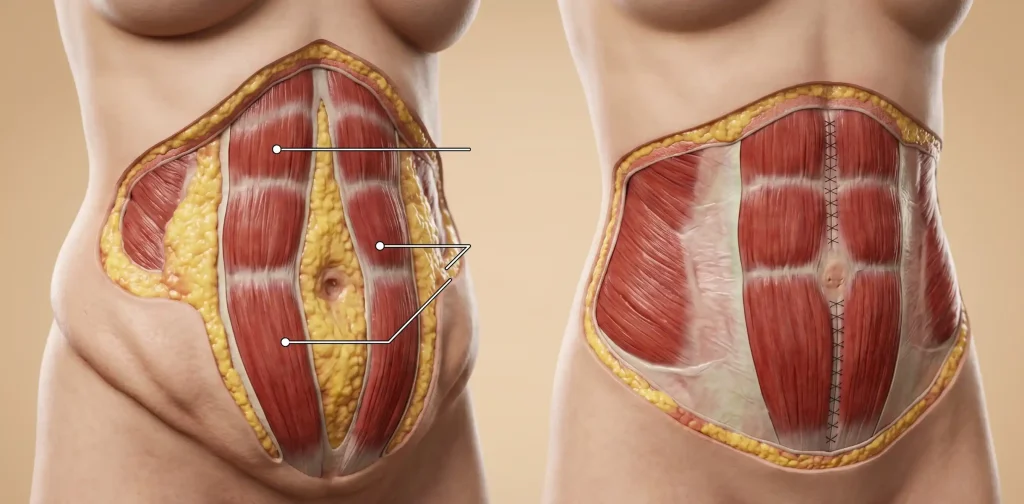
Muscle plication is the key step in a post-pregnancy or corrective tummy tuck, whereby separated rectus abdominis muscles are stitched together internally. This technique forms a muscular corset that is able to flatten the abdomen and stabilize the core. During pregnancy, the expanding uterus exerts growing pressure continuously on this repaired muscular wall. In case the pregnancy happens in the early recovery phase, this strong pressure may upset the structural stability of the plication. The heavy-duty internal sutures may tear through the still-healing fascial tissues, resulting in the recurrence of the muscle separation. Hence, the human body is very capable of expanding to protect the new life; therefore, there is no danger to the fetus.
However, it does the surgical repair of the core very clearly, in contrast to a great extent. Your internal musculature, along with the rest of your framework, should be fully anchored and matured before you put it to the test of accommodating the biological demands of a new pregnancy, if you are to keep the tightcore framework that we created at LIN Europe Clinic.
The Golden Window: Safe Clinical Timelines
The consensus of top plastic surgeons worldwide is that after an abdominoplasty, women should wait at least one to two years before trying to conceive. This “Golden Window” is necessary to make sure that the mom is safe and that the aesthetic results will last.
| Post-Op Timeline | Internal Biological State | Pregnancy Recommendation |
| 0 to 6 Months | Acute scar maturation; active fascial remodeling. | Strictly Contraindicated. High risk of tissue damage. |
| 6 to 12 Months | Tissue softening begins; microcirculation stabilizes. | Not Recommended. Risk of stretching unrepaired fibers. |
| 12 to 24 Months | Peak tensile strength achieved; biological balance restored. | Safe Window. The abdominal wall can safely expand. |
Waiting at least one year up to two years leads to the scar tissue under the skin envelope completely softening. The importance of this tissue elasticity is that it allows the abdomen to expand during pregnancy in a very natural and smooth way, which in turn minimizes the discomfort in the area and protects the whole body’s health. By being this extensive in your family plan with a high level of professionalism, you are setting your body physically for a childbearing experience that is not only beautiful and dynamic but also stable internally structurally.
Aesthetic Consequences and Recurrent Dermal Laxity
Generally speaking, a post-abdominoplasty pregnancy will not jeopardize the health of the mother or the baby at the biological level if it occurs after one year from surgery. Aesthetically, it will definitely take its toll on the original tummy tuck’s result. The dermal matrix can only endure a certain amount of stretching before its elastic fibers break once again. Another pregnancy will, in all likelihood, generate new skin sagging, stretch marks, and the possibility of the midline muscles being pulled apart. This is not to say that the outcome of your tummy will go backward all the way to your pre-surgery stage, as the overall fat storage and the anatomical contours are frequently very well kept. Having said that, to get back the very topmost degree of a tightly, symmetrically, and beautifully shaped midsection, most people tend to go for a secondary “touch-up” or revision operation after their last childbirth.
Here at LIN Europe Clinic, we are very supportive of dealing with such multi-stage journeys, and we take great professional care in balancing between designing initial surgeries that leave room for future maternity, and paving the road for advanced revision procedures when the time is right to regain one’s absolute silhouette.
Tummy Tuck in Turkey
By deciding to undergo a tummy tuck at LIN Europe Clinic, you are actually going to embed yourself in a global place of healing where such big changes in life and aesthetic ones as well are led with an elite level of clinical mastery. We are fully aware that family planning and body rejuvenation are two very closely related subjects that, through many layers of balance, anatomically need a lot of patient empathy too. Our high-end centre located in Turkey is a flagship among the international leaders in advanced body contouring, with the result that you feel totally safe not only from a health perspective but also as a person who has made a substantial aesthetic investment. And now, by coming to us in Istanbul, you will be operating within a medical setting that will emphasize from start to finish long-term safety and surgical brilliance.
Everything that you go through, in fact, both your transformation and family growth, will be totally under our control, so that you get a very clear, evidence-based, and practical guidance on how to get through these two aspects combined. We invite you to experience the outstanding care at LIN Europe Clinic, the place where your transformation to a confident, beautifully sculpted body is carried out to the highest precision standard right in the heart of Turkey.
FAQ:
Pregnancy after a tummy tuck is 100% safe for the baby. Your abdominal wall will still have the ability to expand naturally to accommodate the growth of the baby.
A lot of surgeons advise waiting for at least twelve to twenty-four months before trying to get pregnant. During this time, your internal tissues will gain maximum strength and return to biological balance.
Probably, the pregnancy will stretch the skin, which has been tightened, and also the abdominal muscles. The result of this expansion is the loss of the sculpted look, which may necessitate a revision later on.
Permanent sutures won’t actually break in a harmful way if the tissue has been fully matured. What will happen is that the fascial matrix around the sutures will stretch gradually to allow the expansion.
A C-section is completely safe and feasible after an abdominoplasty, yes. Usually, obstetricians can even work with the lower abdominal incision scar left from the previous surgery.
Tebbetts, J. B. (2002). Systemic Vitality and Surgical Precision in Body Contouring. Saunders Elsevier.
Janis, J. E., et al. (2005). Abdominal Anatomy and Biometrics: Implications for Abdominoplasty and Gestation. Plastic and Reconstructive Surgery.
Nahai, F. (2011). The Art of Aesthetic Surgery: Principles and Professional Rigor in Maternal Restorations. Quality Medical Publishing.
Lockwood, T. (1995). High-Lateral-Tension Abdominoplasty: Clinical Mastery of Fascial Healing. Plastic and Reconstructive Surgery.