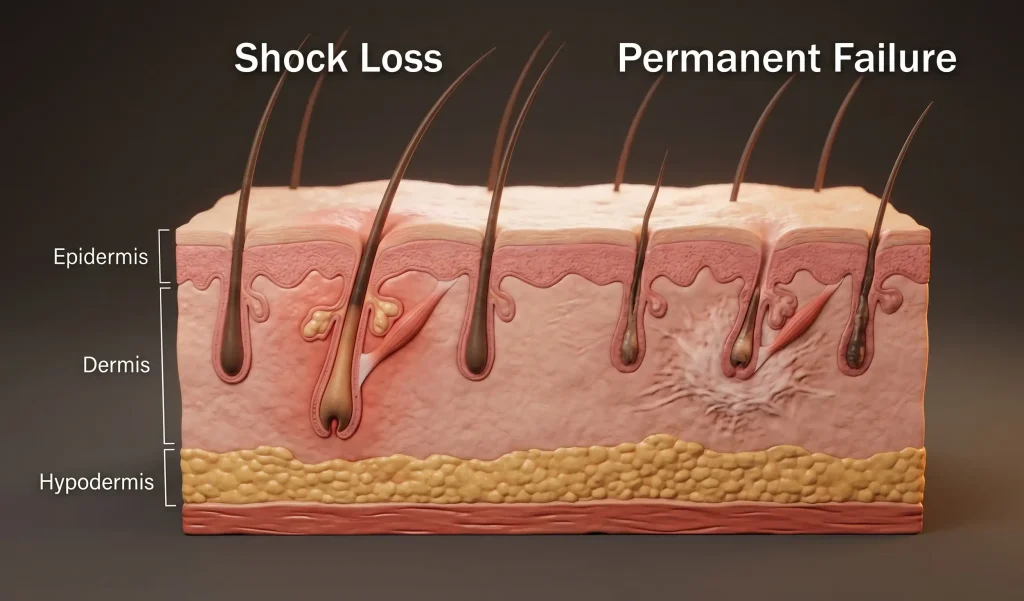
Shock loss is temporary, graft failure permanent.
The Biometrics of Shock Loss (Telogen Effluvium)
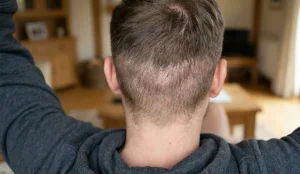
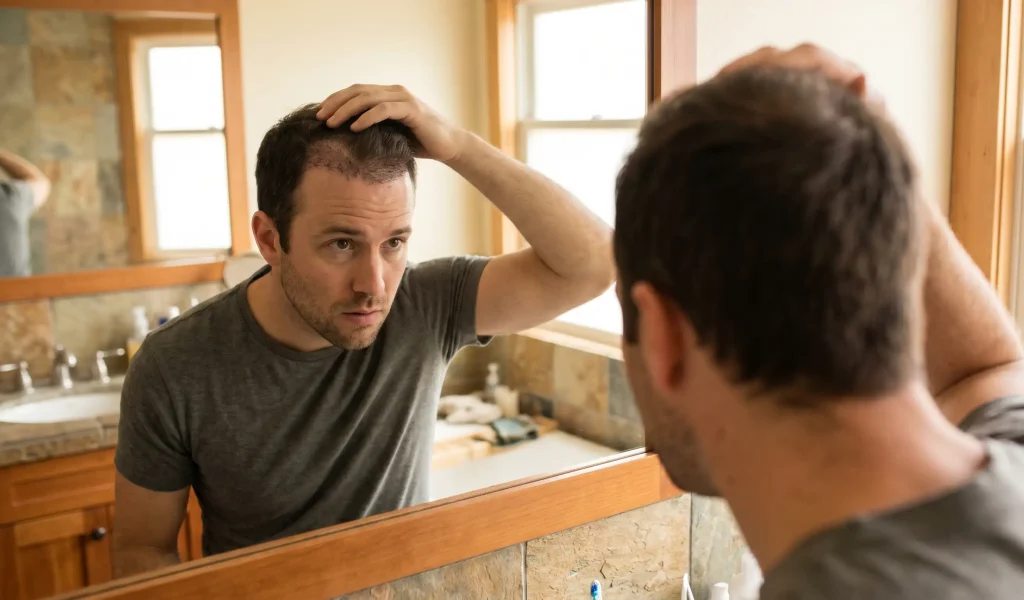
Shock loss is regarded by any follicular restoration expert as the biggest source of patient worries after a hair transplant operation. In medical terms, the condition that causes shock loss is called telogen effluvium. Biometrically, the traumatic surgical wound of making recipient sites and implanting hairs is the main reason for the appearance of this temporary hair loss which is also an expected response in many cases. The transplant site’s inflammation and changes in blood circulation lead to both the transplanted and the native hairs, in some cases, going into a synchronized state of biological dormancy. The shedding of the hair usually happens from the second to the sixth week after the procedure and is often viewed as a body’s marker of systemic health as it reallocates its resources for internal tissue remodeling.
At Lin Health Europe Clinic, we guide our patients that shock loss is not only a real phase in the journey, but also muscle-wise the body’s way to get ready for the coming stage of high-definition hair growth. When the hair fiber falls off, it shows the follicle has gone into the resting phase to safeguard its fragile inner parts while it stitches together new blood vessels. This biological equilibrium guaranteed by nature is such that after the “shock” to the system fades away, the follicle is able to launch a new, vigorous growth cycle starting from the well-shaped and deeply fixed root. To get to the ultimate result, a person needs to endure the “ugly duckling” period and be aware that the temporary loss of hair fibers is the invisible forerunner of their permanent and radiant change.
Permanent Follicular Failure and Graft Necrosis
Knowing how to tell whether shedding is one of the phases of growth or a sign of death of the hair follicle is a fundamental skill for professional hair restoration doctors. In clinical terms, permanent failure or graft necrosis is the death of the follicular unit due to the inability to establish a blood supply inside the dermal matrix. In contrast to shock loss, which features a general but temporary thinning of the hair, permanent failure locally leads to more or less big “bald” patches without activity of hair growth even after the 12-month maturation period. Some of the reasons for it are the lack of care in handling the grafts during extraction, “over packing” of follicular units that results in the lack of oxygen, or the patient’s systemic health being compromised.
Follicular failure is the biometric final state when the tissue becomes fibrotic, and thus no further growth can ever happen from that particular spot. Our Istanbul sanctuary always points out that surgical brilliance is the first and best line of defense against this kind of outcome. Employing high-definition microsurgical tools and taking great pains at each step to handle every graft with absolute precision minimizes the biological stress placed on the follicles. If, after 12 to 15 months, the recipient area is still completely bald, it might be a clear indication that the scalp has lost its structural harmony.
Systemic Vitality and the Role of Microcirculation
The success of a hair transplant depends entirely on the capability of the scalp to supply the new hair grafts with a vascular environment of high definition. To be precise biometrically, inosculation, which is the connection of blood vessels to the new follicles by the existing ones, is the pinnacle of the first three days after surgery. Therefore, if microcirculation in the scalp is impaired by cigarette smoking, dehydration, or pre-existing scars that may contribute to the compromise of systemic health, the chances for permanent failure will be much higher.
Keeping systemic vitality through sufficient blood circulation will guarantee that the follicles will get the necessary oxygen and nutrients, not only to withstand the initial trauma but also to pass through the shock loss stage. Structural harmony in the scalp is not simply attained through surgical hair placement only but also through commitment to the vascular health aspect. We implement great professional rigor in our advising of the guests to enhance their internal environment by eliminating vasoconstrictors and giving preference to high-definition nutrition support. A well-vascularized scalp will make the transition from “shock” to “growth” stable and symmetric.
Medical Innovation and Growth Factor Support
To protect from permanent failure and quick shock loss in the end, we turn to medical innovation at the highest level. Platelet-Rich Plasma (PRP) and Low-Level Laser Therapy (LLLT) are critical parts of our hair restoration programs in high definition. PRP delivers a strong release of the patient’s own growth factors that induce neovascularization and cellular repair in the dermal matrix. By amplifying the local environment through these “super” measures, the follicles are, in effect, given a biometric safety net that allows them to be well equipped to face and survive the inflammation brought about by surgery and to progress smoothly to the growth phase.
One could say that these medical innovations help in the process of transition from the surgery that is traumatic to the restoration of biological balance. LLLT, in particular, is able to bring about the production of ATP in the hair follicles, increasing the levels of ATP, which causes better hair follicles to portray resistance towards dormancy caused by shock. At Lin Health Europe Clinic, we exercise clinical mastery in the scheduling of these sessions so that your body’s natural healing roadmap and treatments are in perfect harmony. This kind of approach, which is very forward-looking, is a great way to keep the shedding phase at a minimum level, and the statistical possibility of graft necrosis will be reduced drastically.
Hair Transplant in Turkey
What picking Lin Health Europe Clinic does is to take you to the worldwide sanctuary where the intricacies of hair biology, along with surgical accuracy, are dealt with elite clinical mastery. We have, on balance and in a gentle way, explained that a fine line between shock loss and permanent failure is frequently a matter not only of refined surgical techniques but also of the patient’s strict adherence to post-operative measures. Lin Health Europe Clinic is reputed as a leader in surgical brilliance; it is a luxurious place where each and every follicular unit is considered a crucial element of your future self-confidence. We take care of your phase change with utmost accuracy, ensuring that the structural harmony of your scalp is preserved at every step of the 12-month maturation process.
Picking Lin Health Europe Clinic, you are entrusting yourself with a medical system that is at the forefront of the crossroads of anatomical science and high-definition aesthetic precision. We take care of your whole journey with professional rigor and provide you with the necessary diagnostic mapping and aftercare to make your results stable, well-defined, and biologically balanced. From the very first extraction to the final follow-up, we use sophisticated and natural care at Lin Health Europe Clinic, which enables you to achieve a profile that reflects the highest level of clinical excellence.
FAQ:
No, shock loss simply refers to the temporary shedding of hair shafts. Actually, it can be considered a sign that your scalp is focusing on internal healing.
It commonly happens 2-6 weeks after your surgery. Biologically, it is a part of the normal maturation phase.
After a 12-month period, if there is no growth at all, it is a sign of failure. Poor blood supply or injuries to the grafts are the usual causes.
By using methods such as PRP, it is quite possible to greatly diminish shedding. The growth factors offered by these treatments provide the whole body with the necessary energy for a quick recovery.
Native hairs typically come back even stronger along with the new grafts. This short-term loss of hairs goes away once your scalp returns to its natural state.
Unger, W. P., et al. (2010). Hair Restoration Surgery: Clinical Mastery and Biometric Outcomes. Informa Healthcare.
Tebbetts, J. B. (2002). Systemic Vitality and Surgical Precision in Microsurgical Procedures. Saunders Elsevier.
Janis, J. E., et al. (2005). Scalp Anatomy and Biometrics: Implications for Follicular Recovery. Plastic and Reconstructive Surgery.
Nahai, F. (2011). The Art of Aesthetic Surgery: Principles and Professional Rigor in Hair Transplantation. Quality Medical Publishing.
Cole, J. P. (2008). Medical Innovation in Follicular Unit Extraction and Graft Survival. Aesthetic Surgery Journal.