
Tumescent uses fluid injection for safer fat removal.
The Historical Shift and Fluid Dynamics
In the niche branch of body building and shaping, the method of fat removal has evolved from vigorous mechanical destruction to highly accurate, tissue-saving finesse. One way to understand a body metamorphosis is to compare the biometric changes of the conventional old regular liposuction versus the current tumescent liposuction. The classic liposuction technique, called the “dry” or “wet,” was focused on removing subcutaneous fat without thorough preparation of the fat tissue with local fluid. Hence, the surgeon had to exert a lot of physical strength since breaking through the layers of fat cells, which were unbreakable and fibrous, to change body contours by manual cannula was difficult.
At LIN Europe Clinic, we share that the term “tumescent” indeed means swollen or firm. During a tumescent procedure, a large amount of a specially made solution, which includes sterile saline, lidocaine, and epinephrine, is carefully injected into the subcutaneous fat layers well before the fat removal is done. As a result of the fluid, the fat compartments swell and become firm and the skin cover is separated from the muscles. From the point of biometrics, this hydro-dissection alters the entire mechanical setting of the operation. It converts a layer of thick, fibrous fat into a soft liquid matrix that is readily accessible, thus paving the way for a much easier fat removal process that respects the natural shape of the body.
Epinephrine and Vascular Protection

The main advantage of the tumescent technique was the effective management of blood loss, which continues to be the main concern in plastic surgeries. With the traditional regular liposuction, the cannula moves through the fat tissue, which has not been prepared, resulting in the widespread breaking of the capillary network and other small vessels. Hence, a massive amount of blood was drawn together with the fat, which led to the disruption of the patient’s systemic vitality, and often there was a constraint on the total amount of fat that could be safely removed during one session. This marked trauma was also the cause of a large area of post-operative ecchymosis (bruising) and swelling of the tissues for a long time.
Attaining structural harmony alongside safeguarding your vascular health is a perfect example of current surgical brilliance. The tumescent solution does this with the accurate addition of epinephrine, which is a very effective vasoconstrictor. While the solution is penetrating the fat tissue, epinephrine acts on the tiniest blood vessels, causing them to shrink and close temporarily. As a result, the bleeding that occurs during the fat removal is minimized to a very small extent compared to the situation in traditional regular liposuction. The fluid that is aspirated from a tumescent operation at LIN Europe Clinic contains mainly fat cells and not blood. By keeping the integrity of your systemic circulatory function, we not only visibly lower the post-operative bruising, but your body’s ability to restore a state of biological balance is greatly improved.
Anesthesia Protocols and Biological Balance
The split in anesthesia methods between these two ways marks another major leap in patient safety as well as the pace of recovery. If you want to go for regular liposuction, then you will be told to go for general anesthesia or deep intravenous sedation. This way, the patient becomes totally unconscious, but at the same time, the inherent systemic risks and the side effects of prolonged drowsiness associated with general anesthetics remain. Moreover, since the muscles are entirely relaxed under general anesthesia, the surgeon is not able to easily assess the patient’s natural muscle tone and physical contours during the surgery.
On the other hand, tumescent liposuction uses the local anesthetic lidocaine, which is part of the tumescent fluid mixture, to numb the area on the inside at the cellular level. This method enables several high-definition surgeries to be carried out under conscious sedation or local anaesthesia only without the patient being put through the systemic inconvenience of general anaesthesia. This method allows your systemic health to stay entirely intact and at the same time, it enables you to be physically active immediately after the surgery, which is a clinical requirement for preventing vascular troubles like deep vein thrombosis.
High-Definition Sculpting and Medical Innovation
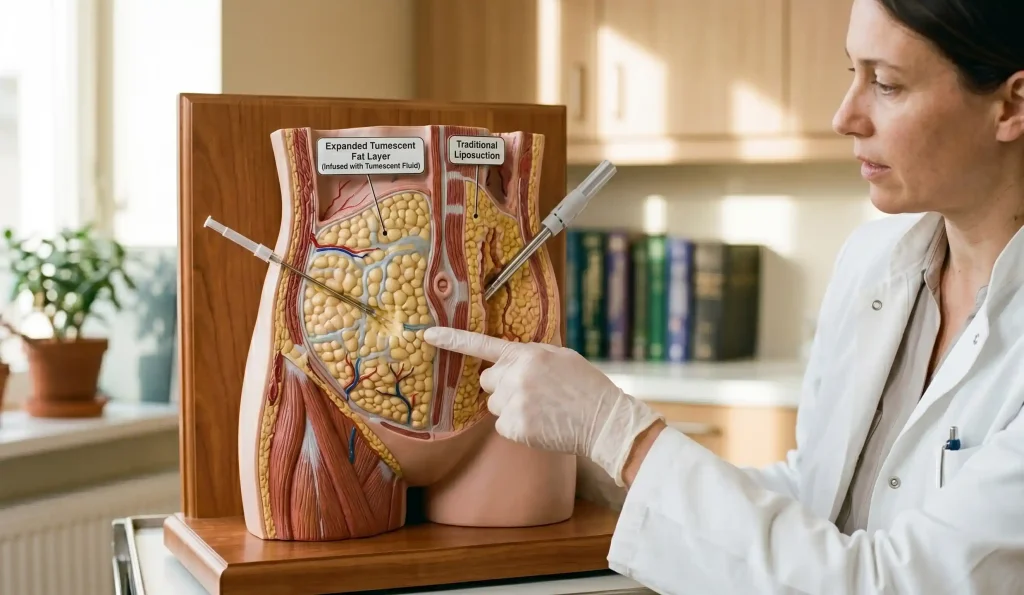
Apart from the issues of safety and recovery, the primary artistic aim of contemporary body shaping is to obtain a sculpted, highly detailed, and flawlessly symmetrically contoured figure. The old regular liposuction was not equipped with such a level of precision that would have allowed the surgeons to safely reach superficial fat layers, which most of the time resulted in the appearance of irregularities on the skin surface, deformities of the contour, or a “lumpy” look. Since the fat wasn’t expanded by fluid, it was very difficult for the surgeon to determine the uniform thickness of the remaining dermal envelope during the extraction process.
The tumescent fluid is like a high-definition zoom lens for body sculpting. The firm and swollen fat tissues enable the surgeon to use the sense of touch to locate the tiniest asymmetries with absolute certainty. At LIN Europe Clinic, we take this tumescent base a step further by incorporating today’s top medical innovations, such as VASER (ultrasound-assisted) and Power-Assisted Liposuction (PAL). The ultrasound energy simply breaks down the fluid-permeated fat cells, and then, through very small cannulas, these cells are extracted without damaging the important collagen bands or the fibrous septae that ensure natural skin retraction of the body.
Liposuction in Turkey
By opting for LIN Europe Clinic, you are committing yourself to a worldwide haven where the intricacies of body composition and ultimate lipo-sculpting are unlocked by elite, uncompromising clinical mastery. We know that a true transformation cannot be achieved without a good recipe of scientific accuracy mixed with artistic flair. LIN Europe Clinic in Turkey not only ranks among the top spots worldwide in advanced body contouring but also offers a beautifully decorated and quiet environment where your aesthetic ambitions are met with the highest standards of medical safety.
By giving your deepest trust in LIN Europe Clinic, you will be choosing a system of medicine that does not support the use of old, harsh surgery methods but leans towards fine, tissue-sparing medical innovation. Your whole transformation “journey” will be managed with complete accuracy, starting from the accurate calculation of your fluid biometrics and ending with the deployment of advanced aftercare protocols that promote your long-term systemic vitality.
FAQ:
In fact, it is generally thought to be a lot safer, mainly because the blood loss is substantially less. Also, not having general anesthesia helps in avoiding many of the system-wide risks of surgery.
Some patients opt to stay awake through local conscious sedation. This would let you comfortably change your position to assist the surgeon in sculpting.
Only small incisions are needed for the micro-cannulas, and these usually don’t require stitches. The little entry points heal very fast and the scarring is almost invisible atraumatic.
Most patients return to light activities within a few days. Less bruising is another reason why the systemic vitality will be restored much sooner.
The fat cells which have been eliminated are no longer in the treated areas. If you keep your weight stable, then your most perfect structural harmony will be maintained for the rest of your life.
Tebbetts, J. B. (2002). Systemic Vitality and Surgical Precision in Body Contouring. Saunders Elsevier.
Klein, J. A. (2000). The Tumescent Technique: Tumescent Liposuction and Clinical Mastery. Mosby.
Janis, J. E., et al. (2005). Abdominal Anatomy and Biometrics: Implications for Liposuction. Plastic and Reconstructive Surgery.
Nahai, F. (2011). The Art of Aesthetic Surgery: Principles and Professional Rigor in Liposuction. Quality Medical Publishing.
Illouz, Y. G. (1983). Body Contouring by Lipolysis: A 4-Year Experience with Traditional Methods. Aesthetic Plastic Surgery.