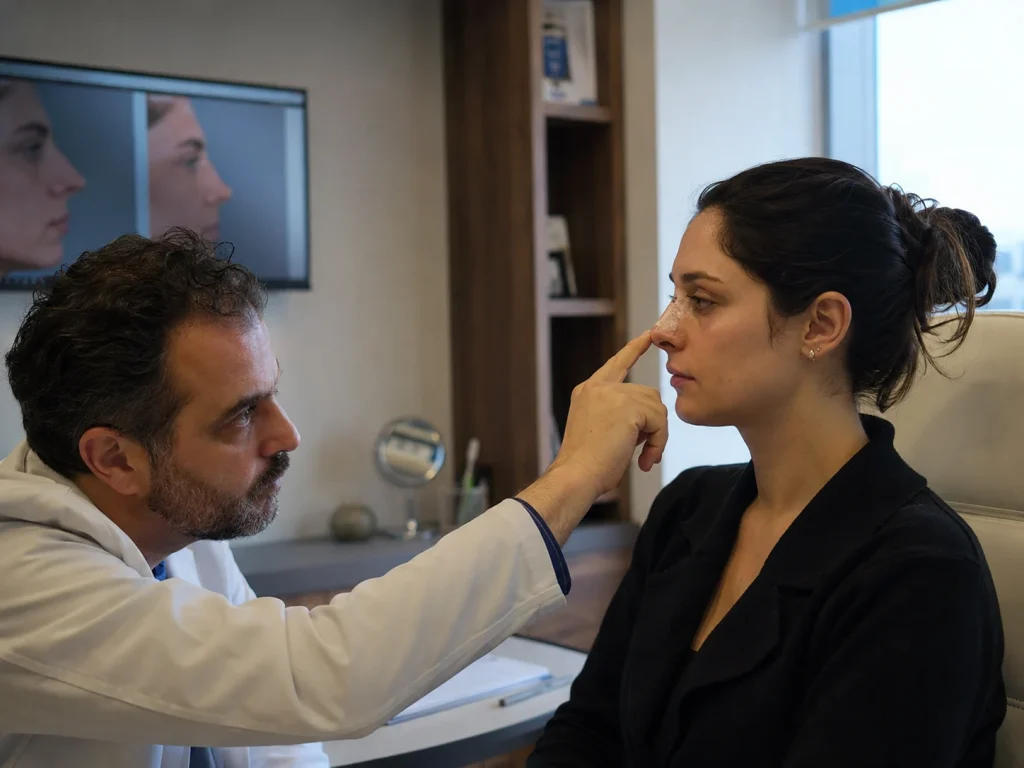
Swelling and healing can temporarily affect the tip.
Recovery Period Vs. Permanent Tip Drooping
Reconstructive nose surgery or nasal structural rhinoplasty is a highly specialized and technically advanced surgical field. It is important to distinguish between temporary healing phases and deeper changes in anatomy when watching how the profile of your nose changes after surgery. Feeling that your nasal tip has dropped or gone down a little compared with your first post-cast view may not be as serious as it seems.
Definitely, a lower nose tip after rhinoplasty is very often just a perfectly normal part of the healing process. Right after the removal of your cast, your nasal bridge and tip are very swollen, so your tip is held at a high, artificial (over-rotated) position. During the first 3 to 6 months, the swelling at the upper part of your nose goes away and allows your nasal tip to descend slowly into its correct anatomical position. Nevertheless, should there be a true and progressive drooping of the tip (nose tip ptosis) after 6 to 12 months, most probably the nose has lost its structural cartilage support for the lower 1/3 of the nose.
Common Reasons Behind Post-Rhinoplasty Nose Tip Ptosis
Getting an idea of why your nose tip is altering its position as time flies will largely depend on the main biological and structural aspects that you need to check:
- Swell Subsiding after Cast Removal (Natural Settling): Plastic surgeons often leave the patients’ nose tips a bit over-rotated on purpose during an operation, so that eventually the tip comes down via the gravity’s and swelling’s influence in a perfect, natural way. Therefore, the ‘drooping’ that you see might just be the nose coming together after surgery.
- Reducing Cartilage Support (Insufficient Grafting): A loss, a decrease in the size of the supporting structures as well as insufficient support through grafting if the trimming done on lower lateral cartilages has been so drastic and/or no structural support has been provided to them through structural grafts, the tip of the nose could slowly be pushed or pull down by gravity, the heavy nose skin, and scar pulling.
- Depressor Septi Nasi Muscle Pull: The depressor septi nasi muscle is the one who gets the connection from the nasal septum to the mouth. It is possible that in the presence of a very strong depressor septi nasi muscle in some patients, a very downward motion of the nasal tip at the time of smile and while talking can be perceived. The downward movement of this muscle can cause ptosis of the tip if the muscle was not released or weakened during the operation, which was a decision point.
- Thick Nasal Skin: If a person has thick, oily nasal skin, their nasal tip is going to be a heavier soft tissue bag. Therefore, if there is a shortage of strong, rigid cartilage scaffolds to hold up this additional weight, heavy skin along with contracting internal scars may make it easy for the tip to drop down a little or move downward at least.
Awareness Strategy: Grafting for Structural Cartilage
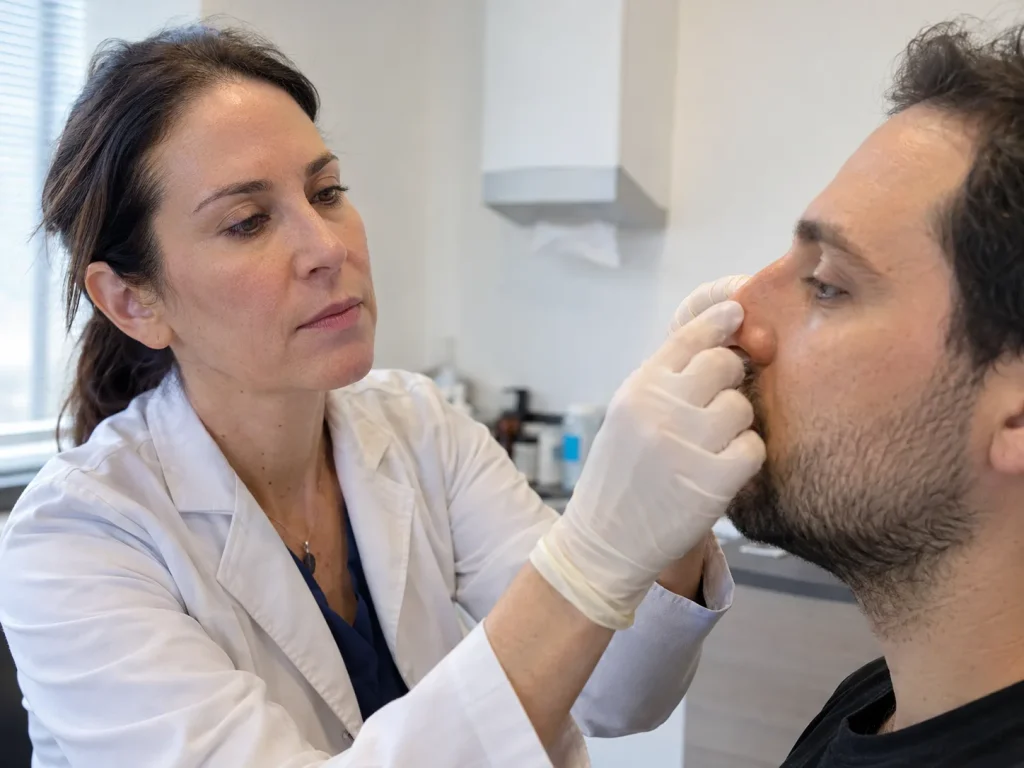
Nasal reshaping in the modern rhinoplasty era is more about preservation of the nasal structure and making use of grafts rather than aggressive removal of large amounts of nasal cartilage. As the goal for rhinoplasty surgeons is to prevent a drop in the tip at late stages, they use their grafts to create a secure and stable foundation for your face. The method that is most likely used by the experts is called auto-grafting. The surgeon places a septal extension graft or a columellar strut graft from the patient’s own septum or rib cartilage. Hence, through it, the surgeons fix your nose tip structures (which is your nose’s lower cartilage) to the face’s central skeleton very tightly. This whole framework structure of cartilage is such a durable one that even with the passage of time and as the skin gets thinner over decades, your nose tip will sustain its height and protrusion at a perfect level with no sign of dropping.
Keep Everything Firmly Secured and Respect Post-Operative Rules
The period after surgery, when the tissues are healing and the patient is still recovering, must be followed with discipline to the letter so that everything is in the right position and no complications come into play. The newly carved cartilage frameworks and the fine stitching used to hold it in place depend totally on being protected so that the scars that heal after the first 6 to 8 weeks become a part of the tissue. Therefore, you will need to strictly avoid placing eyeglasses and sunglasses directly on the bridge of the nose for at least the first 6 to 8 weeks, because the pressure on the bridge can squish the tissues and move the implants underneath. It is a similar story where you need to avoid getting hit on the forehead, blowing your nose hard, or doing contact sports or high-intensity exercise during the early recovery period.
Rhinarinoplastie en Turkish
Choose LIN Europe Clinic, and you will be in a top-notch global medical haven that not only focuses on facial harmony and structural nasal surgery but also provides a holistic view towards surgical management. We see the process of precisely planning, executing, and understanding the cartilage grafts, structural reinforcement points, and soft tissue transformations in a highly exceptional rhinoplasty operation as something that necessitates an exceptionally advanced setup, full transparency of the processes, and strong backing from a supportive team.
We are the kind of a professional place in Turkey that is known for the world’s best advanced facial contouring operations and the most advanced plastic postoperative care, which provides your health with a safe environment with a very low chance of complications. By fully trusting and placing a reliance on our passionate group of medical experts at LIN Europe Clinic, you’ll always have every structure monitored in detail with absolute accuracy. We’ll help you by showing you what’s on your nose from all angles and providing an explanation before the operation through detailed facial imaging and mapping. We give you the freedom to understand the surgical process by showing you a step-by-step explanation of the procedures.
FAQ:
This is definitely normal. The swelling immediately after rhinoplasty makes the tip look higher than the actual post-operated result as it has not yet settled. When the upper bridge swelling gradually goes away over 3 to 6 months, the tip slowly droops by a little bit before stabilizing at its anatomical location.
Surgery swelling usually goes away first, so that’s when most of the settling happens. However, tissue healing and final cartilage adjustment are still processes that take until complete recovery, which is at 12 to 18 months post-surgery.
This facial movement occurs due to active depressor septi nasi muscle that is attached to the upper lip and the tip of the nose. When you smile, this muscle contracts and pushes your nose tip downward into the smile. If someone has very sensitive facial muscles, the surgeon might cut the muscle at the operation to remove or at least reduce the tendency to droop of the tip with smiling.
In case of actual tip ptosis after healing has been completed and there was a structural weakness, the support system can be reconstructed through the use of strong cartilage grafts via the revision rhinoplasty (e.g., a septal extension graft or a columellar strut) and this operation can bring back the permanent tip lift.
Certainly. A thick, heavy skin on the nose adds the physical weight to the nose which may not get fully balanced when the inside of the nose is healed only via internal scar tissue without the support offered by the strong cartilage structure of a nose. If internal scar tissue matures, heavy skin might cause the tip to drop.
Tardy, M. E., et al. (1990). The drooping nasal tip: Surgical correction, structural grafting vectors, and long-term stability. Facial Plastic Surgery Clinics of North America, 4(2), 121-135.
Toriumi, D. M. (2006). Structure rhinoplasty: Maintaining long-term tip projection, rotation, and cartilage stability. Facial Plastic Surgery Clinics of North America, 14(4), 289-301.
Rohrich, R. J., et al. (2014). Advanced postoperative care, cartilage graft preservation, and tissue integration in primary and revision rhinoplasty. Aesthetic Surgery Journal, 34(5), 587-595.