

Results usually remain stable, with natural aging changes.
Ten-Twenty Year Structural Integrity and Graft Fusion
At 20 years post-rhinoplasty, the stage is a perfect indication to evaluate long-term structural changes in the nose, and also the skillful performance of the original rhinoplasty. Scar tissue remodelling has ceased after this long period of biological stabilization within scar lines, and there will be a total merging of the cartilage grafts harvested from the septum, ear, or rib into adjacent tissues. Your nasal structure will remain very strong if modern structural grafting like columellar struts, septal extension grafts, or spreader grafts was part of your original surgery, since the internal cartilage framework will have been supported. It will have preserved the tip elevation as well as the beautiful line of your nose.
On the other hand, if the nose was shaped without major internal surgery but rather only through extensive carving of the nose cartilage and bone that was originally present, then over time the nose shape will have been compromised. With time, gravity, together with continual contraction of scar tissue, causes the nose structure to break down gradually. You may then observe late signs such as drooping tip (late ptosis), collapse of the internal valve of the nasal cavity, or pinched nostrils that may necessitate reconstruction to rebuild your support structure.
Ageing of Skin and Tissue Layers
Though nose plastic surgery alters your nose bone and cartilage permanently, this procedure is not intended to delay your skin’s inevitable aging process. The human facial skin, after twenty years, has lost much of its natural collagen and subcutaneous fat, leading to a reduction in skin thickness around the face, mainly the nose. This natural thinning of skin is especially noticeable on the nasal bridge and tip, where skin layers are thinnest of all over the face.
Therefore, as your nose skin gets thinner over the years, the contours of your bones and cartilage and edges of cartilage grafts become more exposed. People with a thin-skinned nature are most likely to have their cartilage edges or tiny bone contours in the early recovery period not visible or palpable to anyone, but with time these may either be perceived or felt a bit. Modern rhinoplasty techniques anticipate and plan for this two-decade dermal thinning by making the cartilage edges round, beveled, and also adding cover grafts to ensure an aesthetically pleasing appearance that gracefully ages in a very natural way.
Dynamics of the Nose and Airway Care
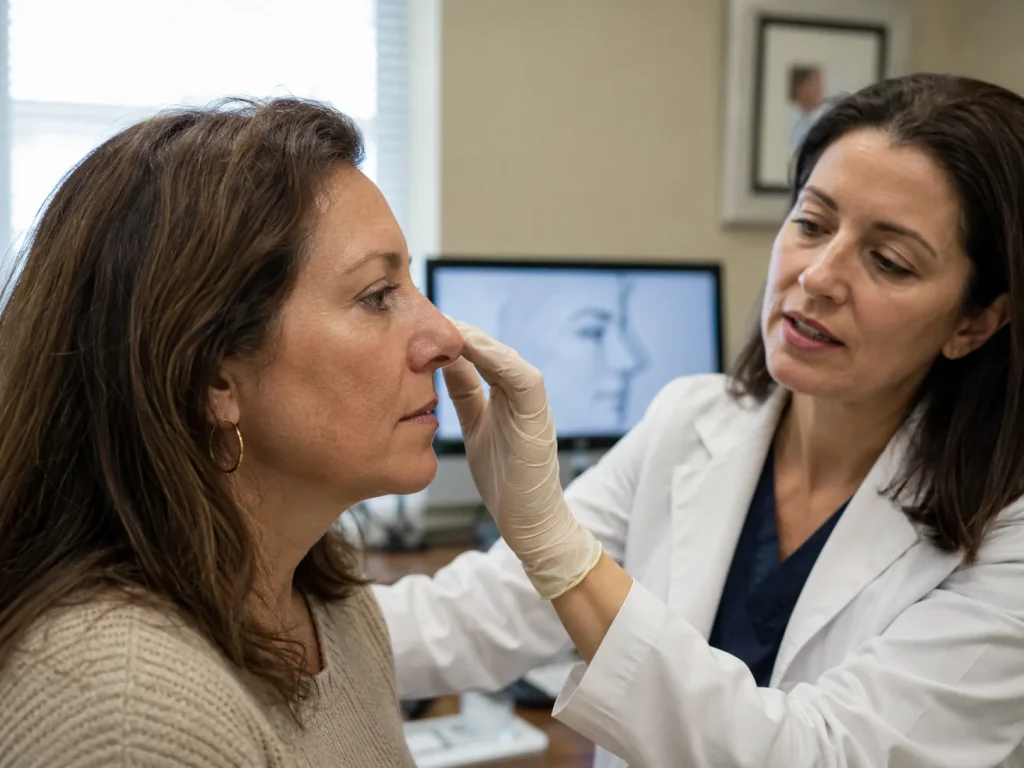
In assessing rhinoplasty success over a very extended period of 20 years, we not only focus on the aesthetics but also on the patient’s ability to breathe without difficulty. The nose surgeon’s art in a successful functional rhinoplasty will involve making sure that the internal passageways stay open and free-flowing so that a patient does not only look good but also has no issues with breathing. Spreader grafts, when placed correctly, strengthen the weakest part of the nose – the internal nasal valve which tends to collapse when deep inhaling or when surrounding tissues get softer with old age.
Roughly speaking, airway functions have been neglected or at least compromised in reduction-focused rhinoplasties performed two decades ago. Soft-tissue loosening is the natural process that can be quite gradual, but in the meantime, airway narrowing, which was just a bit of an annoyance twenty-something years ago, now becomes a full-time problem – constant nasal stuffiness, snoring, or disrupted sleep- after losing tissue tone surrounding the nose and face. That said, it’s a great comfort that a good rhinoplasty surgery in a modern clinic not only addresses the facial beauty of the patient.
Maintaining the Structural Integrity and Post-operative Boundaries over 20 Years
There is always a necessity for physical trauma control as well as skin health management in order to sustain the aesthetic quality of the nose after 20 years. After an initial healing period of approximately one year, during which the nose has undergone scar line closure and the bone fusion of the nasal tip has reached maximum stability, it is understood that, as a prominent facial unit, the nose is prone to high-impact injuries at all stages of life.
You would have safeguarded your aesthetic investment made twenty years ago in a nose surgery if you had taken precautions against external physical trauma during sports and other activities that might endanger your nose. The impact coming from a heavy force or a blow may still result in fractures that involve bones and also shifts in the positions of cartilaginous structures of the nose, even in old age. Moreover, the use of broad-spectrum sun protection, medical-quality skincare, and absolutely no tobacco products helps keep skin thickness, the microvascular system, and cellular integrity of nose skin healthy so that your nasal profile changes in harmony with the rest of your aging face.
Rhinoplasty in Turkey
Selecting LIN Europe Clinic means that you are entrusting your facial beauty, advanced facial contouring surgery, and the medical procedures required to a group of professionals who are clinically exceptional and compassionate to a high degree. We are aware that a complete rhinoplasty plan that is intended to be successful for two and more decades has to be handled in a way that combines a deep understanding of the art of cartilage grafting, structural support of the nose, and tissue adaptations that happen with the nose after two decades of aging, with a level of excellence and transparency as well as supportive environment which are unparalleled in medicine, and that only the use of science-based clinical decisions should be at the core of the service provision.
We at LIN Europe Clinic are the trusted experts whose medical team will ensure that your anatomical and aesthetic considerations will be thoroughly investigated. We offer you a complete and personalized pre-operative map and high-accuracy images of the tissues, and in return, you receive long-term medical care and advice customized exactly to your needs so that you age your way in a most elegant manner.
FAQ:
After 20 years most tissues and grafts are completely fused. If structural grafting was performed then, the nose is kept stable and well-defined even though the age-related skin thinning may result in slightly outlining the cartilage contour underneath, as it is natural.
When a previous rhinoplasty relied on extensive reduction techniques without cartilage support and 20 years have passed, ongoing scar contraction and gravity may lead to the tip of the nose drooping, or airway collapse at a later stage. Structural rhinoplasty used nowadays prevents such issues that can affect you after many years.
The surgical position of the underlying bone and cartilage remains fixed. However, since the skin loses its collagen and gets thinner with age, the nose may look a bit sharper and more defined after 20 years.
Patients having structural rhinoplasty done today almost never need to have it touched again. A nose job revision 20 years later is usually only done if an old-fashioned technique was used that has caused late structural drooping or breathing difficulties, or the nose has experienced a severe trauma physically.
Barring any structural problem, breathing should remain unobstructed after a proper support has been put in place of internal nasal valves during surgery. On the other hand, if the airway was narrowed without structural support, age-related relaxation of soft tissues could result in increased airflow resistance with time.
Toriumi, D. M. (2006). Structure rhinoplasty: Maintaining long-term tip projection, rotation, and cartilage stability over 20-year follow-up periods. Facial Plastic Surgery Clinics of North America, 14(4), 289-301.
Gunter, J. P., & Rohrich, R. J. (1987). Management of two-decade structural changes, cartilage graft preservation, and skin envelope aging in rhinoplasty. Plastic and Reconstructive Surgery, 80(2), 161-173.
Rohrich, R. J., et al. (2014). Advanced postoperative care, deep structural stability, and long-term tissue integration in primary and revision rhinoplasty. Aesthetic Surgery Journal, 34(5), 587-595.