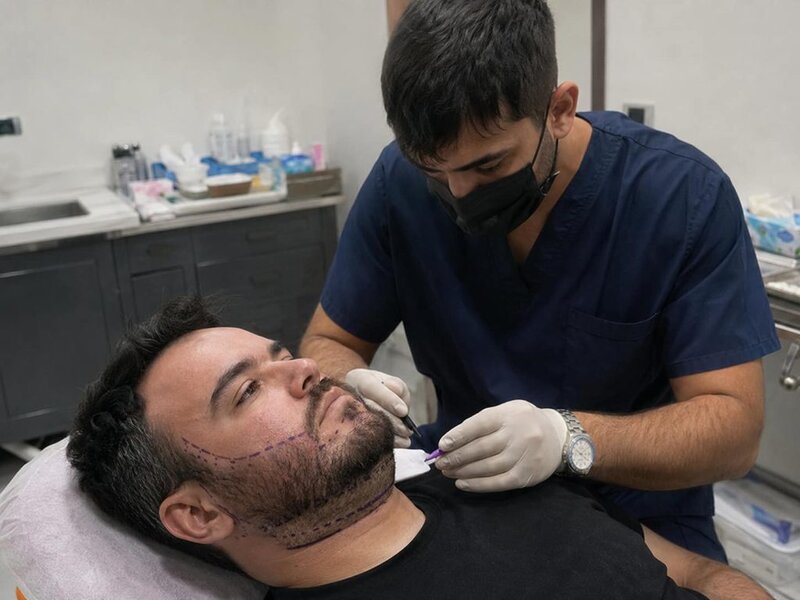
Beard transplants are generally safe and low-risk.
Safety Profile of Facial Hair Restoration
In the highly specialized field of facial hair restoration and follicular micro-grafting, determining the safety aspects of a procedure is the initial step to a successful makeover. People who want to fix patchy growth, thicken a thin mustache, or create a full, masculine beard frame will find that knowing the biological limits of the operation will give them a lot of reassurance. The main clinical data show that beard transplants are extremely safe, and the risks associated with them are very minimal.
Since the procedure is quite simple in terms of intervention and is done under local anesthesia only, it avoids the risks that come with general anesthesia. The method is based on Follicular Unit Excision (FUE), where healthy hairs are taken mainly from the rear of the head or from under the jawline, and each one is then inserted individually into the face. Despite it being a very certain outpatient operation, one has to be mentally prepared beforehand for the first few days post-operation and be aware of possible minor problems.
Minor Issues and Normal Post-Operative Changes
During the first week, while your facial tissues are healing from the trauma of the hair extraction and implantation, several biological reactions will take place, which are quite normal:
- Redness and Swelling are Usually Temporary: Placing hundreds of individual micro-grafts into the lower face area brings about localized inflammation that happens naturally. The swelling is most often around the jawline and cheeks, and it goes down gradually.
- Folliculitis (Ingrown Hairs): As the new hair fibers make their way out after months 2 to 4, a few of the hairs can get trapped underneath the skin. That is when small, pimple-like bumps can appear, but they can be removed easily by warm compresses or mild topical treatments.
- Temporary Numbness or Changes in Sensation: Since the incisions made are quite small, the tiny surface nerves in both the face and donor scalp may only be affected for a short time. In fact, it is normal for the skin to feel a bit numb, rubbery, or tight for a few weeks; local nerve pathways regenerating means that full sensation will ultimately return.
Maintaining Graft Lifespan and Preventing Inflammation
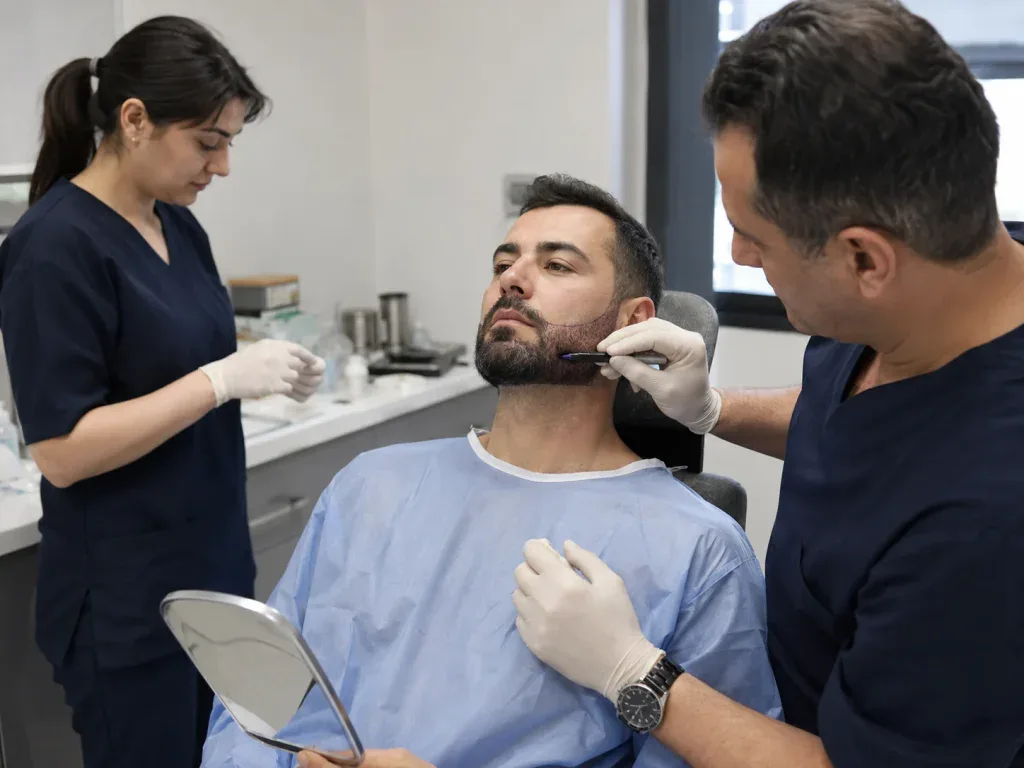
For those who are really after perfection in their contours, they should understand that keeping to strict protective and behavioral rules during their post-operative period is of utmost importance. For the first 5 to 7 days, your newly implanted beard grafts are very vulnerable, as they are kept in place only by the early fibrin bonding at a cellular level. Any excessive movement, friction, or exposure to toxic compounds biologically leads to a major penalty: one can. Besides that, the premises under which new blood vessels are being formed will be disrupted, and the roots fall out.
For your permanent beard follicles to be able to integrate into the new location with maximum structural precision, one must cut back on facial exercises completely. Eating soft foods that are easy to chew will prevent your jaw from making abrupt moves. At the same time, never touching, scratching, or rubbing the scabs is perhaps the most crucial rule in order to avoid localized infections. Apart from that, complete cessation of smoking and other tobacco product consumption is mandatory. Nicotine is a very powerful systemic vasoconstrictor that instantly shrinks the face’s microvessels and deprives the newly grafted hair follicles of crucial oxygenated blood that is necessary for their survival at the early integration stage.
The Hair Follicle Regrowth Process
Knowing the biological stages of facial graft maturation supports patients to handle recovery with complete confidence and without surprise or fear that the hairs have ended their cycle.
| Recovery Window | External Facial Presentation | Underlying Biological Activity | Primary Care Action Required |
| Days 1–7 | Tiny red scabs around each graft | Graft anchoring and early tissue healing | Spray with sterile saline; do not touch or scratch the scabs. |
| Weeks 2–6 | Hair shafts shed completely | The “Shock Loss” phase; follicles enter a brief dormant state | Resume gentle washing; do not panic as hair falls out. |
| Months 3–4 | Early, fine hair breakthrough | Follicles reactivate and generate new permanent fibers | Keep the skin clean; treat minor ingrown bumps gently. |
| Months 8–12 | Full, thick beard density | Complete hair shaft maturation and diameter thickening | You can safely shave, trim, and style your new beard normally. |
Beard Transplant in Turkey
Lining up with LIN Europe Clinic means entering one of the leading world-class medical centers where your beauty aspects, high-tech hair follicle restoration, and surgical procedures are overseen by experts having the profound skills and strong empathy with the patients. We understand that the realization of an exact aesthetic outcome, the right alignment of hair angles, and the careful timing of protective phases after a beard transplant are the elements that necessitate a very sophisticated, transparent, and highly supportive environment in which evidence-based medicine is the number one priority. LIN Europe Clinic in Turkey is an international reference point in the area of advanced hair restoration and plastic surgery aftercare. It is a calm place where your health plan is strictly kept in accordance with elite global patient safety standards.
Giving your complete confidence to our team of devoted professionals at LIN Europe Clinic in Istanbul means that your recovery factors are analyzed with absolute diagnostic accuracy. We are there to back you up with full support, individual post-operative instructions, high-resolution follicle follow-ups, and customized healing checklists serving as your guide through every phase of your tissue maturation and lifestyle integration. Our top medical team always safeguards both your cosmetic investment and systemic health, allowing you to enjoy your sharpest silhouette in complete tranquility. LIN Europe Clinic delivers a well-rounded service, and you will get the fine balance and professional handling that is the hallmark of Turkey.
FAQ:
They are very safe, in fact, because a beard transplant involves only a few steps, is done under local anesthesia, and the chance of serious medical complications is almost non-existent.
A skilled surgeon can effectively use tiny FUE punches to get hair grafts, and when so performed, those small dots of incisions will be left to heal very closely, becoming simply indistinguishable eye-level below the growing hair fibers.
The biggest side effects that people usually experience are redness that is rather temporary, some swelling that is usually very local to the jaw and cheek areas, and slight scaling or flaking during the initial days, which, besides being very minor, they resolve without any intervention subsequently.
Certainly, this is a biologically necessary phase commonly known as “shock loss.” Hair shafts are shed in order for the follicle roots to rest and reset, and then from month 3 onward, new, permanent beard hair starts to grow.
Not at all, since the transplanted follicles come from your own scalp or neck, no risk of tissue rejection or allergic reaction from your immune system.
Epstein, J. S. (2004). Facial hair transplantation: Analyzing donor extraction, risk mitigation, and acute angulation techniques. Facial Plastic Surgery Clinics of North America, 12(2), 273-277.
Umar, S. (2016). Body hair transplantation using follicular unit extraction: Managing beard graft parameters, local skin healing, and long-term survival. Aesthetic Surgery Journal, 36(3), 289-296.
Rohrich, R. J., et al. (2014). Advanced postoperative care, systemic vasoconstriction limits, and micro-graft stability in secondary facial hair contouring. Aesthetic Surgery Journal, 34(5), 587-595.