
Yes, implants can move when chest muscles flex.
If you are at the gym doing push-ups or just stretching to grab a heavy suitcase from the overhead compartment, you would be surprised to see what the mirror shows you when you check your chest muscles in the mirror. Your breasts appear to jump upwards, flatten, or get pulled apart towards the armpits. Once the muscles are relaxed, they return to their usual position. This is medically called Breast Animation Deformity (BAD), but patients often jokingly refer to it as “breast jumping,” “the flexing effect,” or “dynamic distortion.”
The answer to “do implants move when flexing?” is yes, usually if they are placed under the muscle. There is no doubt in the world that this movement will be mostly unnoticed by 99% of women when performing daily activities. However, for those who are into fitness, bodybuilding, or just happen to have naturally strong pectoral muscles, this might be really embarrassing, very uncomfortable, or simply attract unwanted attention. At Lin Europe Clinic, we believe that you should have a good grasp of the biomechanical implant placement trade-offs before you undergo surgery so that you can pick a look and movement that fits your lifestyle.
Why Does Animation Happen?

Breast Animation Deformity occurs because the breast implant is placed submuscularly (beneath the pectoralis major muscle). For primary breast augmentation, this is the preferred method of implant placement nowadays, because the muscle will provide a thick vascular layer that will serve as a good cover. Without such a cover, it would be difficult to hide the upper edges of the implant and make a beautifully natural taper. Plus, with such a cover, the chance of having capsular contracture will be lower.
The pectoralis major muscle, however, is a contractile muscle whose main function is to pull the arm across the chest. When you flex your chest muscles (i.e., when you do bench presses, push-ups, or even when you pull a door toward you), the muscle shortens and tightens. Since the implant lies under the muscle, the implant gets compressed when the muscle contracts. The implant can only deform to a limited extent, so, in fact, it is forced to move—most often upward and outwards. Therefore, if you have more muscular chest, and bigger implant in comparison with the size of muscle, the more pronounced will be the upward ‘jump’ of your implant.”
The Trade-Off: Aesthetics vs. Mechanics
This is a conundrum for both a patient and surgeon. We are essentially deciding between two different kinds of ‘imperfections’, and the correctness of the decision can be determined if one identifies their priorities:
- Under the Muscle (Submuscular/Dual Plane): The Aesthetic Benefit: The breast looks incredibly natural at rest. The transition from the collarbone to the breast is smooth, ripples are hidden, and the risk of hardening (contracture) is statistically lower.
- The Aesthetic Benefit: The breast looks incredibly natural at rest. The transition from the collarbone to the breast is smooth, ripples are hidden, and the risk of hardening (contracture) is statistically lower.
- The Mechanical Cost: The breast may distort when you move your arms vigorously. For 90% of women, this is a minor issue they happily accept for the better shape.
- Over the Muscle (Subglandular/Subfascial): The Mechanical Benefit: The breast stays perfectly still when you flex. You can be a bodybuilder posing on stage, and the implant won’t budge because it is sitting on top of the muscle, disconnected from the contraction. The Aesthetic Cost: Since there is only skin and fat coverage over the implant, it is quite likely that you will be able to see the upper edges (step-off), feel the implant wrinkling (rippling), or have a ‘stuck-on’ appearance, especially if you have thin tissue.
- The Mechanical Benefit: The breast stays perfectly still when you flex. You can be a bodybuilder posing on stage, and the implant won’t budge because it is sitting on top of the muscle, disconnected from the contraction.
- The Aesthetic Cost: Since there is only skin and fat coverage over the implant, it is quite likely that you will be able to see the upper edges (step-off), feel the implant wrinkling (rippling), or have a ‘stuck-on’ appearance, especially if you have thin tissue.
The Athlete’s Dilemma
If a patient is a weightlifter, a professional in CrossFit, a tennis player, or a bodybuilder, Animation Deformity becomes a major point of consideration. If your lifestyle involves tens of times of pectoral muscle activity with the highest intensity, then the ‘jumping’ effect will probably not only upset you but it will even be a hindrance to your performance.
In such situations, we sometimes talk openly about Subfascial placement. This is a fancy term for a situation where an implant is placed on top of the muscle, but under the fascia (the strong thin connective tissue layer which covers the muscle). This will be quite a compromise between the two extremes: a better cover than an old-fashioned ‘over the muscle’ placement and still keeping a breast that is not connected to the muscle and, therefore, not affected by its contraction. The trade-off being the use of Fat Grafting (injection of the patient’s own fat around the edges) to hide the implant and eliminate visible ripples, thus giving you the best of both worlds: a non-moving breast with soft edges.
Can “Dual Plane” Fix It?
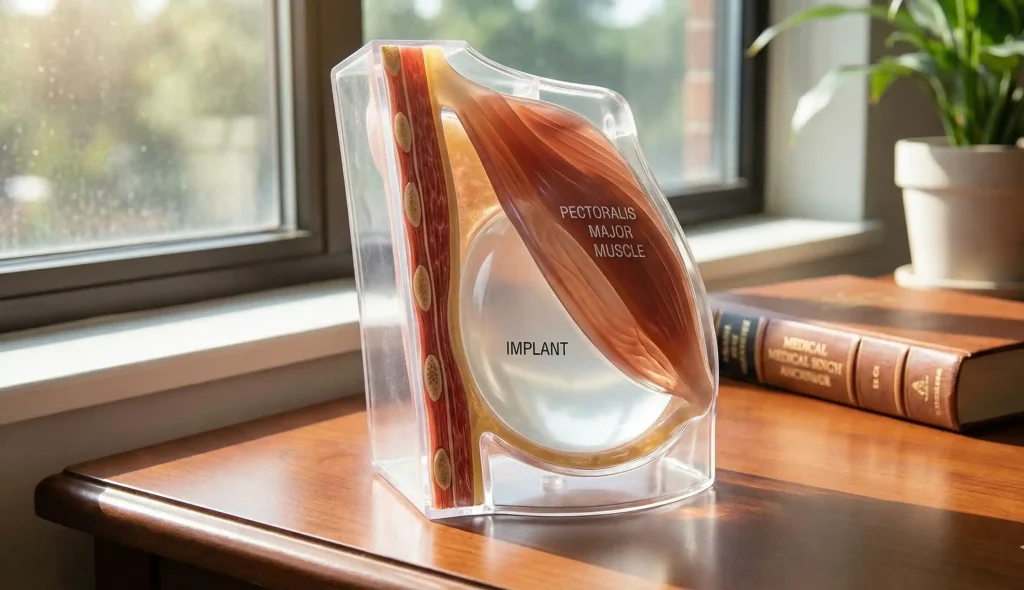
Nowadays most submuscular breast augmentations rely on the Dual Plane technique. The surgeon disconnects the muscle from the lower part of the ribs in this method so that now the muscle can move freely over the implant just like window-shades without being completely trapped in a tight pocket.
Dual Plane greatly minimizes the animation when compared to the older ‘total submuscular’ techniques, for the reason that once the muscle is released at the bottom, it is no longer tied to the implant at that point. In this way, the implant and the muscle can move to a certain extent independently from each other. The muscle however, would still remain attached to the ribs at the top and if those muscles are very strong and you are in a highly intensive activity, you will still be able to notice a little bit of movement in the upper portion of the breast.
Managing Expectations in Turkey
You come to Lin Europe Clinic in Turkey for your surgery because besides your body measurements, we also consider the level of your physical activity when deciding on the technical approach to surgery. Thanks to this approach, we can really adapt your next surgery to your lifestyle. At your consultation in Istanbul, we will ask you about your work-out routine. Based on your gardening, swimming or weightlifting experiences, we will treat this as an important medical history.
We view Animation Deformity as a continuum. For a vast majority of women, having their breasts move just a tiny bit when lifting their children is a reasonable trade-off for having a smooth, long-lasting and natural-looking cleavage. On the other hand, if a fixed chest is what you desire most, we can achieve that for you safely through our surgical strategies like subfascial placement or composite augmentation.
Frequently Asked Questions About Breast Animation
The answer is that the implants are placed under the pectoralis muscle, which gets tight and shortens during exertion. So, when the muscle contracts, it presses the implant and accidentally pushes it to the skin surface or to the side.
Indeed, some movement is good because your natural breasts also move along with the gravity when you lie down or lean forward. On the other hand, if the movement is not only jerky but also very excessive when the muscle is flexed, this situation is called Animation Deformity.
You might experience the implant sinking excessively (bottoming out), going towards the armpit (lateral displacement), or the breasts getting too close in the middle (symmastia). This obviously results in asymmetry or makes the nipple point in a direction that is not natural compared to the rest of the breast.
Implant shifting is generally the consequence of the pocket inside being made too large, or the tissues that normally act as supports are weak and get stretched over time. Engaging in high-impact activities too soon after surgery or not wearing your compression garments post-op properly can also cause implant shifting.
The first sign of trouble may be slightly different firmness, where one breast seems harder or tighter than the other. Affected by the tightening of the scar tissue, the breast might visually appear to sit higher on the chest or get a round, ball-like shape.
Spear, S. L., et al. (2003). The “dynamic” breast: The role of the pectoralis major muscle in breast augmentation. Plastic and Reconstructive Surgery.
Nigro, L. C., et al. (2018). Breast animation deformity: A review of the literature. Aesthetic Plastic Surgery.
Code, T. (2020). Subfascial breast augmentation: A solution for animation deformity. Clinics in Plastic Surgery.