No, mild shock loss is common.
Biometrics of Hair Follicles Undergoing Shock vs. Direct Growth
In the specialized field of hair restoration, post-operative hair shedding—also called “shock loss” or temporary telogen effluvium—is generally seen as a natural progression. Strictly speaking, biometrically, such shedding happens because the surgical trauma of extraction and implantation leads the hair follicle to prematurely leave its active growth (anagen) phase and enter a synchronized state of biological dormancy (telogen).
Nevertheless, there is a chance that a very small proportion of patients experience minimal or no observable shock loss at all. In the case when a patient skips this hair shedding phase, it means that the follicular units have structurally and metabolically sustained the transfer operation. The cells of the hair matrix are not exposed to biochemical stress signals that would induce them to enter the resting phase. At LIN Europe Clinic, we discuss that even though avoiding shock loss is statistically an outlier, it signifies the ultimate level of vascular preservation whereby the transplanted hairs grow uninterruptedly from their new roots.
Clinical Measures That Lessen Surgical Injury
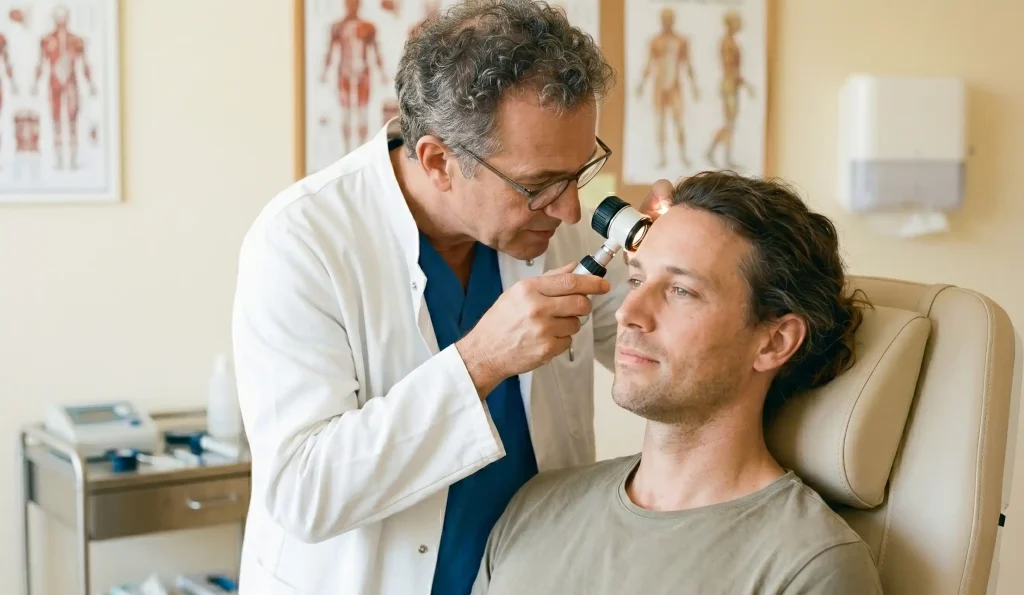
Direct growth of the hair follicle sans shedding phase is possible only if the surgical, mechanical, and ischemic trauma is minimized without any compromise. The graft’s outside-the-body time—also referred to as ischemic window—is the major factor responsible for the level of cellular shock. If the follicle is kept without oxygen for a long period of time, its internal biometrics deteriorate, resulting in a transition to the telogen phase.
In that case, advanced surgical innovations like the Direct Hair Implantation (DHI) method are used by our team at LIN Europe Clinic. As the procedure allows the surgeon to extract and immediately implant each follicular unit using specialized Choi implanter pens, it represents a synchronized process leading to reduction of the follicle in shock and several important advantages for retaining the active growth phase:
- Less Out-of-Body Time: Grafts are re-vascularized within minutes, thus avoiding the metabolic starvation that causes dormancy.
- Micro-Incision Accuracy: The extremely fine needles do away with pre-cut recipient channels and therefore cause less damage to the surrounding tissue.
- Dermal Matrix Preservation: Collagen bands along with tiny capillaries stay in totality, providing immediate fixation.
Healthy Organism and Growth Factor Stimulation
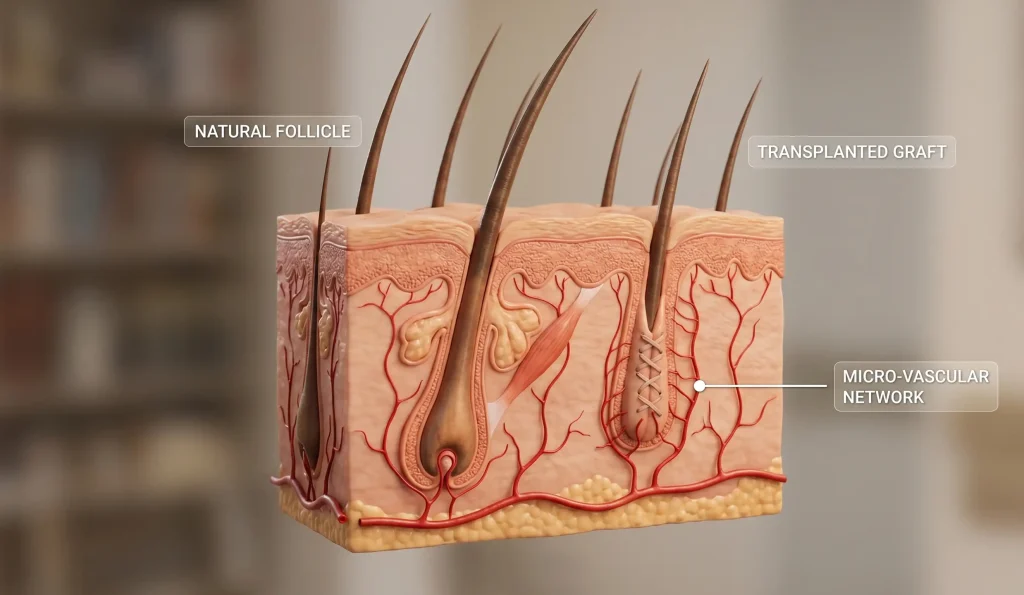
The scalp’s internal biochemical makeup greatly influences the odds of a follicle either shocking or surviving. An excellently microcirculating scalp with high systemic vitality serves as an instant biological refuge for inserted grafts. When the dermal matrix has abundant active healing proteins, the process of inosculation—i.e., the joining of native blood vessels with implanted roots—is very fast.
Besides being a comfort haven at LIN Europe Clinic, we boost the local milieu with autologous growth factors, such as Platelet-Rich Plasma (PRP), which is incorporated in the regeneration path. Proteins contained in highly concentrated platelet derivatives are present in new blood vessels, stimulating the process of new blood vessel formation (neovascularization) around the fresh grafts. This gives targeted support to the scalp, causing a biological balance within only a few hours. If follicles are flooded with nutrient-rich blood regularly, no delay is observed in fulfilling their metabolic needs. This way, on one hand, their structural integrity is sustained, and on the other hand, they will not have to undergo a resistance phase of dormancy by conventionally ending the elongation cycle.
Factors Influencing The Extent Of Shock Loss
| Biometric Variable | High Risk of Shock Loss | Direct Growth Potential (No Shock) |
| Implantation Technique | Standard FUE with pre-opened channels. | Advanced DHI with simultaneous pen placement. |
| Ischemic Duration | Grafts remaining outside the body > 2 hours. | Hyper-rapid transfer under 15–30 minutes. |
| Graft Hydration Matrix | Standard chilled saline storage. | HypoThermosol or nutrient-infused biopolymers. |
| Native Scalp Vascularity | Compromised microcirculation (smoking/scarring). | High-density capillary network with PRP support. |
| Packing Density | Over-packing (>50 grafts per $cm^2$). | Scientifically balanced architectural distribution. |
Hair Transplant in Turkey
LIN Europe Clinic is the place to go if you want a world-class medical environment where the intricacies of follicular saving are managed with top clinical skills. We consider hair transplantation to be a biological and anatomical procedure that involves relocation of hair follicles from one part of the scalp to another and therefore, there is a need for complete precision both at macro and micro levels. Turkey offers a world-class hair restoration clinic at our high-end facility, where your beauty goals will be harmonized with cellular safety, and your scalp’s structural integrity will be supported.
When you entrust your hair restoration process to LIN Europe Clinic, you are getting a full medical care system that moves away from generic fast extraction lines, prioritizing meticulous patient-centric professional care. Our secondary process of quality inspection or medical audit is of exceptional professional rigor, as we treat every single graft not only as a part of your future hairline but also as the continuation of your present hairline. You can feel the delicacy of our care at LIN Europe Clinic. The transformation to a denser, more youthful silhouette is made with utmost precision, protecting the structural harmony of your scalp from the very first day.
FAQ:
Statistically, it is very unlikely, but it can happen that you do not experience any visible shedding after a hair transplant. This would be the case if the tissue trauma is at a minimum level and the microcirculation recovers immediately.
Indeed, globs that are not shed will simply grow as they would have done from the original hairs. However, it does take up to 12 months for the complete high-definition density to develop fully.
The DHI technique drastically shortens the period during which the grafts are outside of the body doing nothing. Hence, the likelihood of cell stress which results in a temporary dormancy state is practically eliminated.
Yes, the hair around the recipient site may also be affected by localized shedding due to the inflammatory reaction caused by the surgery. The administration of pharmaceuticals can help protect your systemic vitality even at the native level.
Actually, the shedding is merely a normal biological response to the surgical procedure. The hair follicles reside healthily under the skin and will go on to produce a vigorous growth phase.
Unger, W. P., et al. (2010). Hair Restoration Surgery: Clinical Mastery and Biometric Outcomes. Informa Healthcare.
Tebbetts, J. B. (2002). Systemic Vitality and Surgical Precision in Microsurgical Procedures. Saunders Elsevier.
Janis, J. E., et al. (2005). Scalp Anatomy and Biometrics: Implications for Follicular Recovery. Plastic and Reconstructive Surgery.
Nahai, F. (2011). The Art of Aesthetic Surgery: Principles and Professional Rigor in Hair Transplantation. Quality Medical Publishing.
Cole, J. P. (2008). Medical Innovation in Follicular Unit Extraction and Graft Survival. Aesthetic Surgery Journal.