
Typically after age five.
In facial plastic surgery and pediatric reconstructive medicine, the term otoplasty refers to a surgical ear pinning or reshaping that is a structurally permanent correction of prominent or asymmetrical ears. Unlike other cosmetic surgeries which are usually done only in adulthood, otoplasty is quite different because it is often done on children. Parents and patients wondering about the best age for otoplasty usually get a clinical answer based on the biological development of the human ear. Usually, the medical “gold standard” age for otoplasty is between 5 and 7 years old. At this stage, the ear is almost fully formed (90%), and the cartilage is hard enough to hold the stitches but still soft enough to be reshaped easily.
At Lin Health Europe Clinic, we see otoplasty timing as a very important decision which requires a trade-off between anatomical robustness and psychological health. For our international patients coming to Turkey for cosmetic surgery, we tell them that otoplasty done before a child starts school can save the child from the long-term psychological effects of bullying. Our clinic is not only the best choice for high-quality auricular surgery but also a place where we take into consideration both the ear’s structural preservation and the patient’s emotional uplift, no matter how old he or she is.
The Biological Basis: Cartilage Development
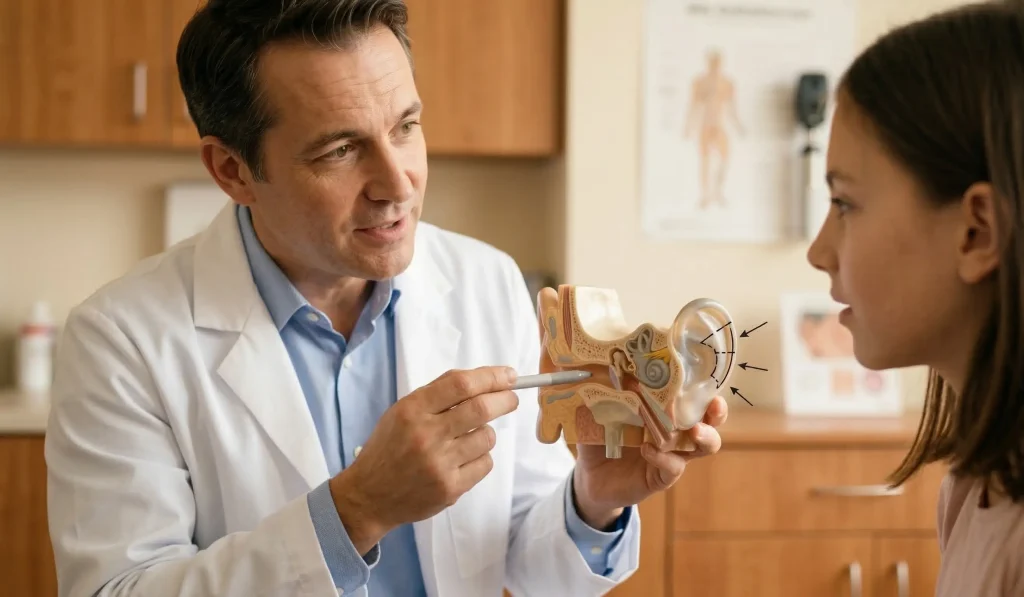
If one seeks to understand why age 5 is the clinical starting point for otoplasty, the explanation lies in the growth pattern of the human ear. While nose and jaw development continue even during teenage years, the ears have already attained their full adult size at a very early age. When a child is 5 years old, the cartilage of the ear has gained enough “tensile strength” for the internal permanent stitches to stay, such as Mustardé or Furnas sutures. Up until this age, the cartilage may be too soft or “floppy,” so there is a risk that the stitches pull through the tissue and the protruding ear comes back.
Surgeons at Lin Health Europe Clinic in Turkey check the “cartilage memory” of their young patients before they decide on which of them are ready for a permanent change.
Psychology: School Age as a Turning Point
Though the ear’s readiness is the main medical factor, the emotional pain of having protruding ears might be what scares a person most to agree to surgery. Kids start noticing differences and teasing around 5 or 6 years old. Operating on the ears right before going to the first grade is clinical advice for the child not to lose self-esteem or develop social anxiety. The child can go through the new social environment with the ears already fixed, and thus avoid a “double-ear” stigma.
Lin Health Europe Clinic‘s experts make sure that parents are aware of the timeliness of the surgery, and in the child-friendly environment of our clinic in Istanbul, we focus on restoring facial harmony before negative psychological “muscle memory” can settle.
Adolescent Otoplasty: Another Excellent Opportunity
Though it’s best to do otoplasty when kids are young, many otoplasty patients are teenagers (ages 13 to 18). Teenagers request otoplasty mainly to change their image, especially when they’re influenced by social media. In terms of clinical points, an otoplasty for a teenager is very effective as the cartilage is already mature and stable. Besides, teens are more motivated to follow the post-op “headband protocol,” which is crucial for achieving an impeccable result.
Lin Health Europe Clinic sees teenage patients as adults in terms of professionalism and accuracy in meeting their aesthetic desires and ensuring long-term structural safety.
Otoplasty in Adults: Never Too Late
Many people have the picture that only kids get otoplasty. But actually, quite a few adults who have been self-conscious of their ears for a long time or who want to rejuvenate their ears’ look due to aging seek this surgery. Adult otoplasty is not age-limited, but there are some differences in the approach compared to children. Ear cartilage grows stiffer and less flexible with age through calcification. So accomplishing the appropriate fold may require the surgeon to resort to cartilage weakening or “scoring” methods.
At our Istanbul-based Lin Health Europe Clinic in Turkey, we employ advanced tools for carefully reshaping adult cartilage, thereby producing not only a natural and tension-free result but also perfect harmony with the mature face.
Coaxing the Ears in Infants: The “Wait and See” Method

Parents noticing ear prominence in their baby right after birth should know that this is the only time when nonsurgical ear reshaping is possible. This is called neonatal ear molding. Maternal estrogen makes newborns’ cartilage very soft and malleable. If a special splint is applied during the first two to six weeks after birth, many deformities can be corrected without ever needing to resort to surgery. But if this period is missed, the cartilage undergoes hardening and the family has to wait for their child to reach 5 years for a surgical otoplasty. We tell our international visitors that though we are experts in surgery, in any situation we strive for the minimally invasive way to the perfect result if nature and time allow it.
Otoplasty in Turkey
An ideal age for an otoplasty is not the one recommended by medical guidelines, but the age at which the patient or the family feels ready to embrace the confidence that comes with a physical transformation. In Turkey, our Lin Health Europe Clinic stands as a beacon of medical excellence where the most sophisticated plastic surgeries are carried out to meet the standards of pediatric and adult care in line with international benchmarks. We perform surgeries in the state-of-the-art, JCI-accredited hospitals that are an embodiment of our status as the world leader in medical tourism and facial rejuvenation.
When you choose Lin Health Europe Clinic, you are opting for the most expert, board-certified hands in Istanbul. Our specialists, who are recognized worldwide, work with the utmost care for absolute symmetry, minimal scarring, and structural integrity of the ear for the lifetime of our international guests. Beginning with your first biometric-ear analysis to your ultimate and completely healed reveal, you will come across the professional rigor and first-class hospitality that have made us the leading name in aesthetic medicine. With us, your path to facial harmony and restored self-confidence is in the hands of the best in the world.
FAQ:
Otoplasty, the clinical gold standard, is performed between ages 5 and 7 when the ear cartilage has reached nearly 90% of its adult size. So the idea behind this surgery is that a child gets a permanent surgical correction done before the social challenges of primary school come his/her way.
Yes, a person is never too old to undergo ear pinning. Although ear cartilage in adults is stiffer and less pliable compared to that of a child, our team in Istanbul is capable of handling ear reshaping with advanced techs that bring about natural, symmetrical results no matter what the age.
Ears grow to their almost full size by age 5, so growth after that is minor and won’t affect the surgical outcome. The permanent internal sutures that we use in Istanbul are intended to keep the ears fixed in their new position for a lifetime.
Otoplasty is a very safe, low trauma procedure for kids. To make it more comfortable, it is usually done under general anesthesia. Also, recovery includes wearing a headband that supports and keeps the new shape protected while the tissues undergo neocollagenesis.
The otoplasty incisions, are carefully placed in the natural fold of the ear, where the scar is totally hidden. After the healing phase, the scar is so small and thin that it’s practically invisible, even with short hair or when hair is tied back at our Turkey clinic.
Mustardé, J. C. (1963). The correction of prominent ears using simple mattress sutures. British Journal of Plastic Surgery.
Furnas, D. W. (1968). Correction of prominent ears by conchamastoid sutures. Plastic and Reconstructive Surgery.
Gosain, A. K., et al. (2004). Otoplasty: a review of current techniques and outcomes. Plastic and Reconstructive Surgery.
Janis, J. E., et al. (2005). Anatomy of the ear. Plastic and Reconstructive Surgery.
Petersson, R. S., et al. (2008). Psychological impact of otoplasty on children and adolescents. Archives of Facial Plastic Surgery.