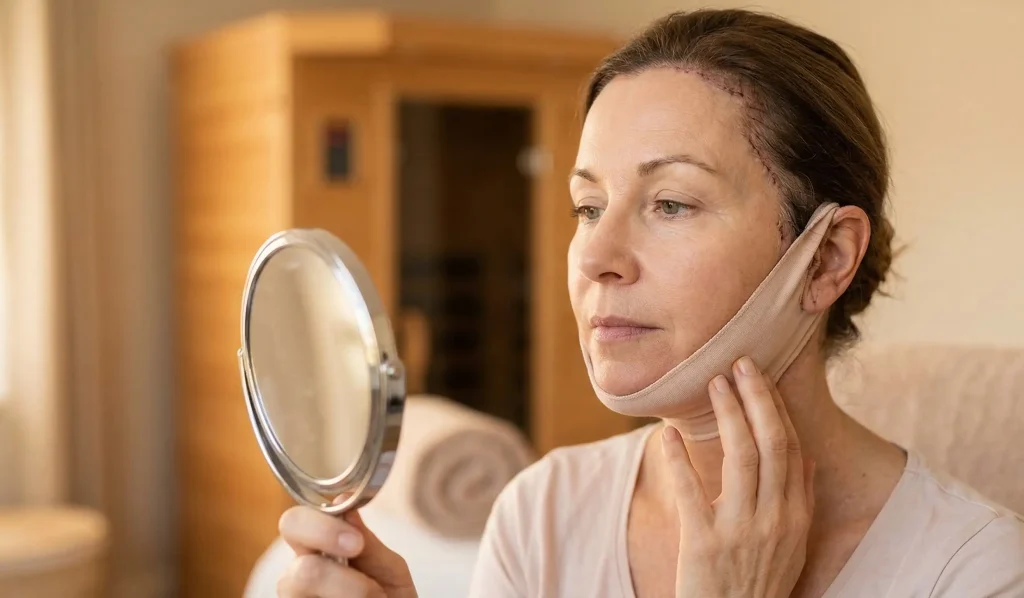
Avoid sauna during early recovery.
A facelift (rhytidectomy) is the drastic alteration of one\’s appearance through surgery in the field of aesthetic facial reconstruction. It requires an extremely well-controlled condition for the healing of the tissues. If patients ask whether they can go to the sauna after their surgery, the medical answer is a hard and necessary “No” of at least six to eight weeks. Even though saunas are highly praised for their detoxification and relaxation effects for healthy persons, the post-surgical patient will experience that the extreme heat of the sauna is a physiological challenge. Exposure to such temperatures results in massive vasodilation—the expansion of blood vessels—which may cause severe swelling and bleeding (hematomas), and the breaking of internal suture lines.
At Lin Health Europe Clinic, we regard the management of thermal exposure as a vital part of your recovery plan. For our foreign patients coming to Turkey, we point out that the newly created and youthful contours of their faces are very susceptible to heat-induced inflammation during the early phases of tissue healing. Our clinic offers state-of-the-art facilities for deep-plane rhytidectomy. We believe that the best medical care is the one that focuses on the stabilization of the vascular system so that the path to a rejuvenated and firm appearance is not interrupted by premature exposure to environmental factors.
The Danger of Vasodilation and Edema
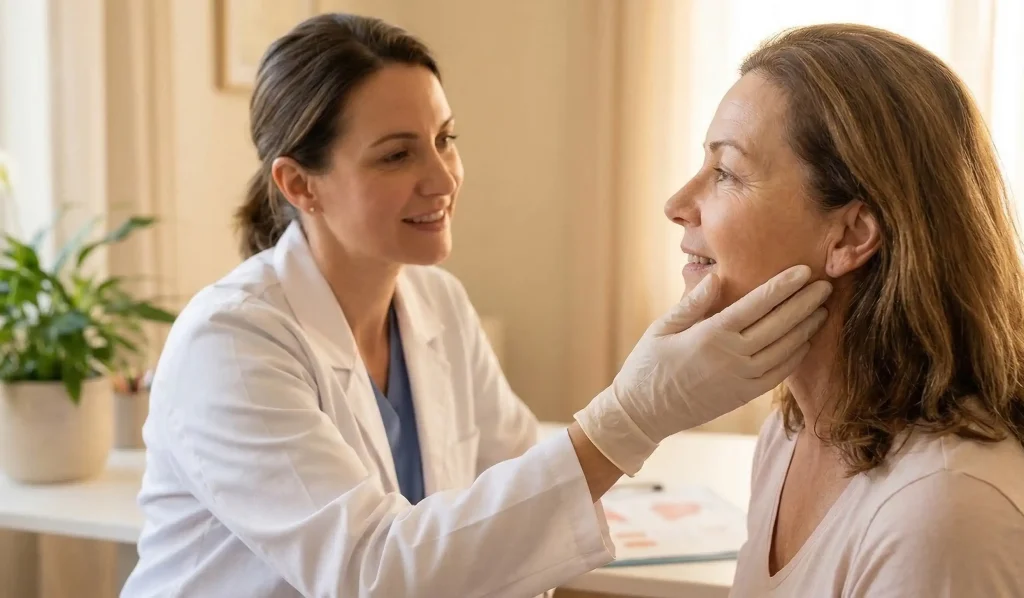
Spa prohibition can only be fully understood after knowing the body’s reaction to heat. Being in the sauna instantly elevates your body temperature, which your organism tries to lower it by vasodilation. Blood vessels located near the skin surface dilate to expand blood flow and to make sweating easier.
You have just had a facelift. The blood vessel network has been surgically interrupted and is still fragile. Making them dilate in such an aggressive way causes abrupt swelling due to edema. Besides the fact that this makes you look puffy, it is physically capable of causing stress on the incisions and even on the deep-plane SMAS suspension. At Lin Health Europe Clinic in Turkey, our team is always on the same page with our customers when it comes to “cool” healing because the excess of swelling can extend the neocollagenesis stage, and in the end, the result might not be as refined.
The Risk of Hematoma and Seroma
The principal clinical issue that the sauna raises during the early recovery is the risk of developing a hematoma (blood collection) or a seroma (fluid collection) under the elevated skin flaps.
A facelift operation involves the detachment of large facial skin areas to uncover the underlying muscles. During the initial weeks, the skin flaps are hanging and waiting to adhere to the new foundation. Being in a sauna stresses the cardiovascular system through raising the blood pressure and heart rate, which, among other things, leads to the bursting of weak capillaries. If the blood or fluid gets lodged in the “dead space” – the space between the skin and the muscle, emergency surgical drainage might be necessary, and exposure to skin necrosis (tissue death) becomes possible. When we receive our international guests in Istanbul, we tell them that the heat of the sauna is a dangerous trigger of internal fluid complications, and one should be very careful with the relaxing heat of a sauna.
Thermal Injury and Sensory Loss
Another underestimated danger of sauna use after a facelift is the temporary loss of sensation in the facial skin. Small sensory nerves are disrupted during rhytidectomy surgery, resulting in numbness or “tingling” in the cheek, ear, and neck areas. Because the skin is not able to detect temperature correctly, the person is at a high risk of suffering from thermal burns. You might be exposed to damage either by the hot air of the sauna or the hot surface of the sauna, while not being able to recognize the damage to your skin until it becomes serious. Besides that, heat also raises the metabolic level of the tissues, and if the supplying blood cannot meet this demand adequately, the skin healing process will be impaired. Our clinic’s experience has demonstrated that patients must be very cautious with the application of heat to the skin until the complete return of the sensitivity which is normally achieved by the second or third months post-op.
The Impact on Incision Maturation and Scarring
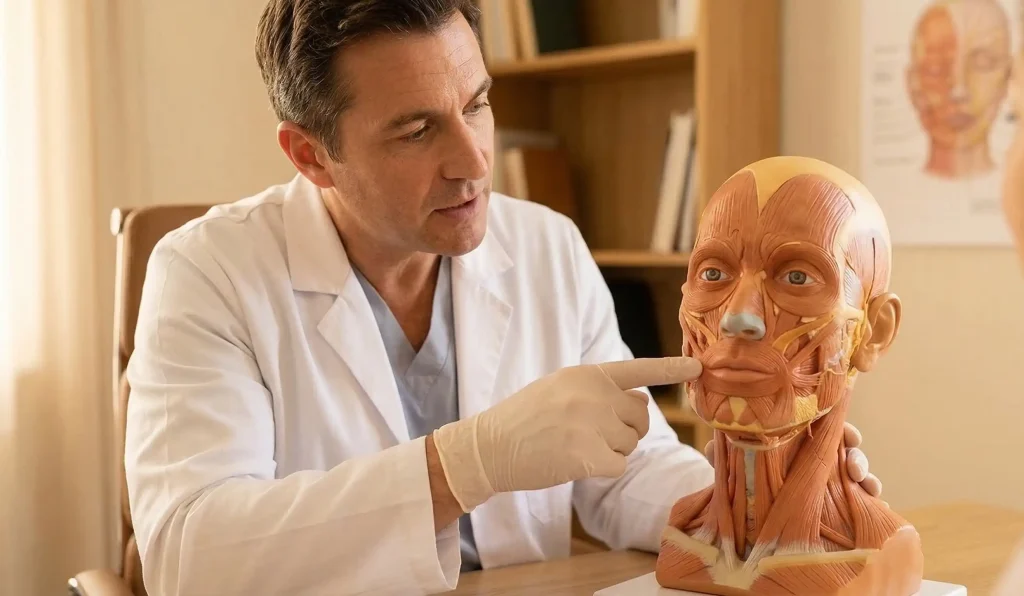
A scar that is not visible at all is the ultimate objective of a perfect facelift. Incision maturation is very dependent on maintaining a stable, tension-free environment. A clean scar has no place for heat and heavy sweating.
Sweat is naturally acidic and contains salts and bacteria that can irritate fresh incisions, leading to localized inflammation or even secondary infections. Also, the scar tissue can become hyperemic (red and angry) or hypertrophic (raised) because heat causes increased blood flow. Lin Health Europe Clinic patients are instructed to keep the incision line clean and cool at all times. By not going to the sauna while in Turkey, you are helping the collagen fibers to form an ordered pattern that will make the scars less visible as they fade along the natural folds of the ears and hairline.
When Can I Safely Return to the Sauna?
The general period of prohibition is six to eight weeks; however, the doctor’s “green light” is always based on the individual’s healing progress. The main conditions to safely return to the sauna are:
- The disappearance of all traces of swelling and bruising.
- Your wounds are fully healed and no scabs are left.
- Your doctor in Istanbul has evaluated your internal tissue strength and is satisfied.
- You have recovered the sensation of heat on the face.
Also, it is best to start your sauna reintroduction with short sessions. To begin with, only five-minute sessions at a lower temperature to test your facial tissues against the heat before going back to the regular use.
Face Lift in Turkey
At Lin Health Europe Clinic, we recognize that exceptional surgical skills are only combined with the strictest post-operative recovery discipline. Our clinic in Turkey is a beacon of medical excellence where advanced facial plastic surgery is implemented at the highest levels of patient service. We work in the latest technology, JCI-accredited hospitals that not only represent us as a global player in medical tourism but also our rhytidectomy services, which are of the highest levels.
Picking Lin Health Europe Clinic is entrusting your hands to the finest and most expertly trained professionals in Istanbul. Our specialized doctors, who have gained worldwide recognition, work with a firm stance on vascular safety and natural harmony for each guest. The time you first visit us for your biometric analysis, right up to the moment when the unarrested, your new look is revealed to you, the high level of professionalism and elite hospitality is what sets us apart from others in the field of aesthetic medicine. We are the world leader in highly skilled and safely managed aesthetic medicine.
FAQ:
In fact, it is not a good idea to use a sauna at least six to eight weeks post-op. Extreme heat causes blood vessels to dilate and can result in swelling to quite dangerous levels and can even lead to internal bleeding or fluid collections in Turkey.
Going to a sauna right after a surgical procedure may cause a sudden rise in blood pressure and swelling of the face. As a result, there will be unnecessary strain put on your internal stitches. This, in turn, can cause you to heal more slowly, raise the chance of hematomas and work against the look of the final surgical scars in Istanbul.
Saunas, both wet and dry, pose the same threat of thermal vasodilation which leads to increased inflammation. Besides, the warm moist air of a steam room can open up your wounds and make it easier for bacteria to enter, so it is necessary to avoid both during your first days of recovery at our clinic.
Usually the majority of the swelling associated with surgery will diminish within the first month. However, inflammation that is deep in the tissues may very well last for some time. Our experts in Turkey will be the ones to give you heat exposure permission only after the vascular condition has become completely stable and the incisions have reached their maximum strength provided by the tissue.
Although hot tubs and long hot baths give you a great feeling, they are also off-limits for the first six weeks due to the fact that these activities raise your body temperature and blood flow to the face. For the sake of a safe and smooth recovery in Istanbul, you should have only lukewarm showers while keeping the face away from direct steam to avoid deep heating it.
Jacono, A. A., & Parikh, S. S. (2011). The minimal access deep plane extended vertical facelift. Aesthetic Surgery Journal.
Aston, S. J., & Thorne, C. H. (2005). Contemporary rhytidectomy. Clinics in Plastic Surgery.
Stuzin, J. M., et al. (1992). The anatomy and clinical applications of the superficial musculoaponeurotic system. Plastic and Reconstructive Surgery.
Rohrich, R. J., et al. (2003). The superficial musculoaponeurotic system: clinical applications. Plastic and Reconstructive Surgery.
Baker, D. C. (2001). Rhytidectomy with SMAS plication or imbrication. Clinics in Plastic Surgery.