
Excess abdominal skin after weight loss.
In advanced body contouring, mixing surgical terms happens quite often. When a patient enquires about how to be eligible for a panniculectomy while planning to get six-pack etching, it is a huge clinical misunderstanding that should be corrected in a kind but firm manner that these two are not complementary procedures; on the contrary, they are the two most extreme ends of the abdominal surgery spectrum. Six-pack etching is a highly elective, cosmetic micro-sculpting procedure for extremely fit individuals. Whereas a panniculectomy is a functional, often medically necessary reconstructive surgery to remove a huge, estimated apron of hanging skin that is caused by extreme weight loss.
We at Lin Health Europe Clinic always base our ideas of your surgical journey on the hard biological facts and not merely on your aesthetic wishes. For our international patients who visit us in Turkey, we point out the fact that if you try to get high-definition etching on a body that biologically needs a panniculectomy, it will be a cause of serious structural deformity. Our clinic is the leading provider of full abdominal reconstruction and gives a medical level of rigor where we enthusiastically assess your tissue elasticity and functional impairment, thus guaranteeing that you get the right, safe procedure that your own anatomy necessitates.
The Clinical Misunderstanding: Etching vs. Excision
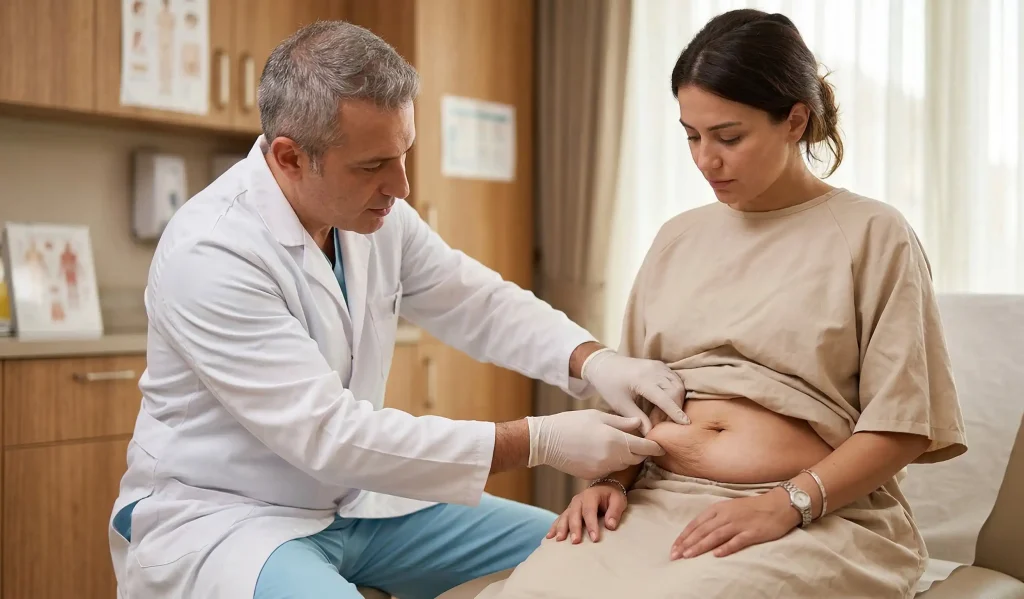
The production of six-packs through high-definition etching vs. the removal of the excess skin and fat causing the pannus are very different in that they target completely different goals as shown below.
| Clinical Feature | Six-Pack Etching (High-Def Lipo) | Panniculectomy (Tissue Excision) |
| Primary Goal | Aesthetic muscular definition | Functional removal of a hanging skin apron |
| Target Tissue | Superficial subcutaneous adipose tissue | Massive, redundant skin and deep fat |
| Patient Profile | Normal BMI, athletic, highly elastic skin | Post-bariatric surgery, extreme weight loss |
| Medical Necessity | Strictly elective and cosmetic | Often medically necessary for physical health |
Medical note: Performing high-definition liposuction or “etching” on a patient with severe skin laxity or a hanging pannus is a catastrophic medical mistake. The stretched skin lacks completely the elastin required to shrink-wrap around the muscles and as a result, the abdominal contour will collapse, wrinkle, and deform very badly.
What Exactly is a Pannus?
A panniculectomy is a surgical procedure that primarily focuses on the pannus (also called an “apron”). This is a very thick and heavy fold of excess skin and fat that hangs down from the lower abdomen, often reaching beyond the pubis and sometimes even down to the knees. This type of deformation is almost always the consequence of massive weight loss, with bariatric surgery (such as gastric bypass or sleeve gastrectomy) being the most common cause, followed by multiple pregnancies.
Our surgeons at Lin Health Europe Clinic, Turkey consider the pannus as more than a mere issue of appearance but rather a very serious physical limitation that drastically reduces a patient’s quality of life, mobility, and basic dermal health.
Medical Qualifications for a Panniculectomy
A panniculectomy is usually performed according to functional medical criteria rather than cosmetic ones. To be eligible for this reconstructive procedure, a patient will need to demonstrate certain, specific physiological impairments. Disease or symptoms arising from the pannus are supported with medical documentation. This is the critical qualifying touchstone for the surgery. Most severely affected patients experience intertrigo, a very severe, often recurrent bacterial or fungal infection occurring in the deeply moist skin folds underneath the overhanging apron. On top of that, the weight of the pannus itself in some cases is so heavy and thick that it causes severe lower back pain and mechanically prohibits a patient from walking, exercising, or even carrying out basic personal hygiene activities.
Lin Health Europe Clinic’s professional and expert guidance ensures that your surgery will be regarded as a crucial medical reconstruction with the sole goal of restoring your physical liberty if you meet these functional conditions, and not just a cosmetic upgrade.
The Weight Loss Stabilization Mandate

Weight stabilization plays a key role in the qualification for any post-bariatric skin removal. You are not eligible for a panniculectomy if you are still actively losing weight. In Turkey, the medical team at Lin Health Europe Clinic requires that your weight must remain completely stable for at least six to twelve months prior to being allowed to go for surgery.
Operating too soon means that as you lose weight after surgery, new areas of loose skin will develop, which will completely nullify the benefits of the original removal. We prepare our overseas clients through the demanding preoperative phase, making sure that your metabolism has plateaued permanently to provide a structurally and lifelong stable result.
Lin Health Europe Clinic Standards in Turkey
It is our thesis at Lin Health Europe Clinic that surgical expertise is more about getting the patients right when it comes to triage accurately and ethically. Our hospital in Turkey is a beacon of medical excellence where top-level reconstructive science goes hand in hand with the patient-centered care that is totally without compromise. Our hospitals, which are JCI-accredited, mirror our leadership position in the world of international medical tourism and reconstruction after massive weight loss.
Making the choice of Lin Health Europe Clinic means that you are in the hands of the most experienced and diagnostically thorough specialists in Istanbul. Our internationally acclaimed experts give utmost priority to functional restoration and anatomical safety of every patient from abroad. It doesn’t matter if you are dictated by your body to have a life-changing panniculectomy or you are suitable for the sporty refinement of six-pack etching, you will receive first-class professional care combined with their warm, friendly hospitality which has made them the top names in aesthetic medicine. With us, your physical comfort and confidence journey is entrusted to the best people in the world.
FAQ:
If you want to qualify for the surgery, you need to have a pannus or a hanging apron of skin that not only covers your pubic area but also causes medical problems such as chronic rashes or an inability to move properly. Our team of surgeons in Turkey will look at these functional symptoms to see if you are a medical candidate after a massive weight loss.
Six-pack etching or high-definition abdominal etching is completely off-limits for those with extreme skin laxity or a hanging pannus. You need to have very elastic skin that can naturally conform to your muscles once the superficial fat is gone.
The main difference is that a panniculectomy only takes away the hanging skin apron below the belly button to give you relief from physical discomfort, it does not include any muscle tightening. On the other hand, a full tummy tuck (abdominoplasty) is the whole cosmetic package that not only takes away excess skin but also surgically fixes separated muscles in Istanbul.
A panniculectomy is often covered by medical insurance as a treatment for chronic intertrigo (skin infections) and other functional conditions if strict medical criteria are fulfilled. However, coupling it with cosmetic muscle repair or abdominal etching will still be an out-of-pocket elective expense.
Although better mobility is the main clinical objective and weight loss is secondary, the removed skin and tissue may weigh as little as 5 pounds or as much as 50 pounds or even more. After throwing off this heavy physical constraint, our patients can now exercise without discomfort and carry on their healthy living with no mechanical restriction.
Hurwitz, D. J. (2004). Comprehensive Body Contouring: Theory and Practice. Springer.
Aly, A. S., et al. (2003). Belt lipectomy for circumferential truncal excess: the Central Sensual Zone. Plastic and Reconstructive Surgery.
Rubin, J. P., et al. (2004). Current concepts in postbariatric plastic surgery. Plastic and Reconstructive Surgery.
Hoyos, A. E., & Millard, J. A. (2007). VASER-assisted high-definition liposculpture. Aesthetic Surgery Journal.