
After pregnancy is usually better.
This is the quintessential “chicken or egg” dilemma for women in their 20s and early 30s. On the one hand, you want to enjoy your body now, at your peak youthful time; on the other hand, you also know that a pregnancy is very likely going to be in your future. You get caught up in the mental loop, “If I get them now, will pregnancy ruin them? But if I wait, I might spend the next 5 to 10 years unhappy with my chest, hiding in padded bras.” Such indecision is very normal, and medically there is no one “right” answer—just a decision between two different sets of life strategies.
Ultimately, it is all about the time you have and how much you are willing to have revision surgery. If you are thinking of babies within 1-2 years, then usually, waiting is not only the better choice from a financial point of view but also the one that keeps the aesthetics. In case pregnancy is still 5+ years away, it is not reasonable to rob yourself of confidence for a future that might never happen. Here at Lin Europe Clinic, we guide you to consider whether you should get breast implants now and enjoy them or prepare yourself for the inevitable effects of gravity and biology.
Scenario A: Getting Implants Before Pregnancy
When you decide to have implants before children, it means that you want to boost your confidence now.
- The Pro: Since your most social and active era, you get to enjoy your body. Don’t let your twenties go by feeling insecure in a bikini just because there is a possibility that you will have a baby when you are 32. This intangible benefit is huge, the value of feeling good about oneself for an entire decade cannot be underestimated.
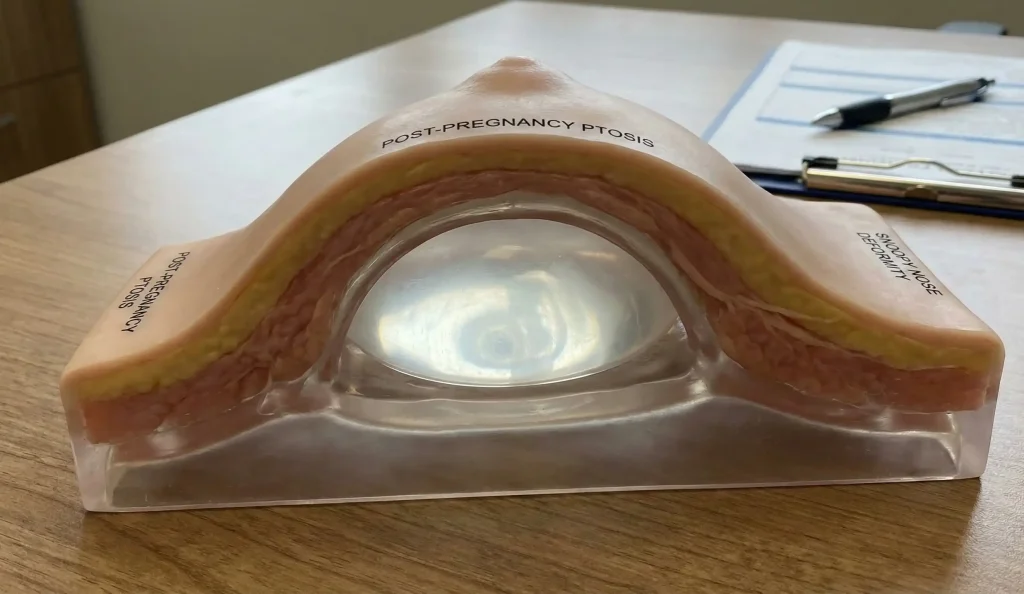
- The Con (The “Gamble”): Pregnancy makes the breasts enlarge with the milk and hormones, resulting in the skin being stretched. Once that swelling disappears after breastfeeding, the skin may not be able to return to the original state. At this point, the implants could be seen as “bottomed out” or sitting lower, in which case you will have to go for a Revision Surgery or a Breast Lift later on to get back the original perky appearance.
- The Verdict: There is no medical reason why you should wait if you are willing to have a ‘tune-up’ surgery in the future.
Scenario B: Waiting Until After Pregnancy
Waiting until your family is complete means that you can treat the “final” version of your breasts.
- The Pro: This is certainly the most foolproof method. Pregnancy can leave the breasts looking deflated (like “empty bags”) or hanging. If you wait, you will be able to deal with these problems head-on— quite often a combination of implant (to restore the volume) and lift (to correct the sagging) in one “Mommy Makeover.” Because the main hormone changes will be behind you, the results will most likely last much longer.
- The Con: You have to endure breast shape that you don’t like until you are done having children and that could be a very long time indeed, a decade or even more.
- The Verdict: It is a financially conservative option as it might save you the cost of a second operation.
The Size Factor: Impact on Sagging
Another significant variable to take into account is what breast implant size you decide to go for. Let’s say that you are planning to get a very big implant (400cc+) before the birth of your baby, then what you will be doing is that you will be mounting the considerable volume of weight on your chest wall. Your breasts will, of course, also enlarge during pregnancy due to milk production and become heavier as a consequence. So, the combined weight—heavy implant plus heavy milk—exerts very high forces on your skin’s elasticity and internal ligaments e.g. Cooper’s ligaments.
Women with bigger implants generally have more serious sagging (ptosis) and more stretch marks after a pregnancy than those that have moderate, natural-looking implants. That is why if you opt for surgery before kids, the size of the implant should probably be kept as small as possible, “ergonomic” to the body in order to lessen the damage that the 9-month pregnancy will be doing to the skin due to gravity that will be acting all the time. Keeping the load lighter gives your skin a fighting chance to snap back.
The Breastfeeding Factor: Myths vs. Reality
A person’s biggest worry is often, “If I decide to get implants, will I be able to breast-feed?”
The truth is, in most situations, yes. Thanks to contemporary surgical procedures, especially when the implant is put under the muscle (dual plane), milk ducts as well as nerves which are necessary for the production of milk, remain intact. Nevertheless, the surgical approach is of great importance. There is a slightly greater chance of dividing milk ducts with the periareolar incision (done around the nipple) as compared to the Inframammary (fold) incision. You should always inform your surgeon that you want to breastfeed so that he can take precautions against the area of the nipple/gland and at the same time keep the anatomy intact.
The fact that silicone is harmless is widely accepted but breastfeeding sensation may vary. Since implants occupy space, your breasts will be tighter, which could thus cause more frequent and/or painful engorgement (fullness).
The “Revision” Reality
It is more reasonable to think of your breast augmentation operation as a potential two-step process if you opt for implants before pregnancy. Of the women who get implants before kids, about 20 to 30% return for a lift or a change of size once their family is complete. The pregnancy “ruins” the skin “envelope” not the implant itself (the device stays intact). For example, if you put on 20kgs during pregnancy and lose it quite fast, the skin on your breasts might sag so much that it will form an “arrow” shape where the implant remains high while the nipple points down. The good news is that such kind of dress can be fixed but it requires going through the surgical procedure again.
Planning in Turkey
At Lin Europe Clinic, our proposal to patients is that they first take a glance at the calendar.
- If you are in the process of conception now: In most cases, surgery will be refused. Your body has to be stable for a surgical procedure and stay away from anesthesia when there is a possibility that you are already pregnant.
- Just delivered your baby: By the time you make an appointment for the next surgery, you need to have given up breastfeeding for at least 6 months. Involution should have taken place and this means that the milk ducts have dried up to such an extent that they cannot be a source of infection. Moreover, the tissues have to shrink to the pre-pregnancy state so that an implant size can be chosen based on actual breast size and not on milk volume, which is only temporary.
Frequently Asked Questions About Pregnancy and Implants
Pregnancy itself is the factor that stretches the skin, not the implants. Skin around the implant gets stretched due to pregnancy hormones and milk production. Breast implants may, in fact, be beneficial in making the breast appear fuller even after the milk has dried up, thereby preventing the complete “pancake” look.
Breastfeeding is perfectly fine when silicone is used since medical-grade silicone molecules are simply too large to pass into breast milk. Studies show that the milk of mothers with silicone breast implants is free of silicone and safe for babies.
It might. The hormonal escalations and inflammation which accompany engorgement (milk production) can, in some cases, cause the body to contract the scar tissue around the implant, but this is not a typical occurrence.
No, that is not always the case. If you have good skin elasticity and don’t put on too much weight, your breasts will likely return to their original shape. On the other hand, if you have a large implant and thin skin, then the force of gravity will eventually make your breasts sag, thus you will need a lift later.
To be absolutely sure that your breasts are free of bacteria and have regained their normal shape, we insist on a waiting period of 6 months after your last breastfeeding session.
Codner, M. A., et al. (2010). Upper eyelid blepharoplasty: The role of the brow. Plastic and Reconstructive Surgery.
Vandeweyer, E. (2001). Breastfeeding after breast augmentation with silicone gel implants. Annals of Plastic Surgery.