Lower blepharoplasty or fillers can treat under eye bags.
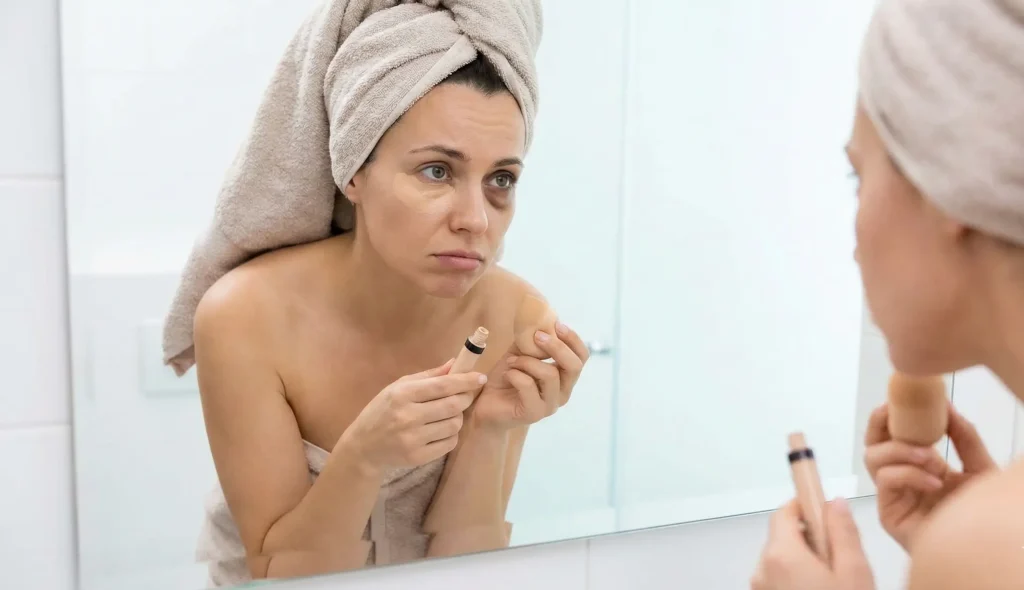
Under-eye bags are the greatest sign of tiredness and aging on the face. People keep telling the doctor that they have enough sleep and drink lots of water, but still, the eye area looks puffy and tired. The reason is that these “eye bags” are in fact very rarely a matter of lifestyle; most of the time they are a matter of facial anatomy. In particular it is orbital fat herniation which is the cause of eye bags. This means that the fat that normally serves as a cushion for our eyes protrudes in the form of eye bags.
Since the root cause is structural i.e. there is a physical displacement of fat and a weakening of the ligaments that hold the fat in place, creams, gels, and home remedies are biologically incapable of fixing the problem. The only way to get rid of the real eye bags is through aesthetic medicine or surgery. At Lin Health Europe Clinic, our expertise lies in lower blepharoplasty which is the gold-standard procedure for treating this condition. Our approach is to tailor the surgery to the patient’s needs, depending on the amount of fat prolapse, skin laxity, and tear trough hollowing, and the result is a rested, youthful look.
Understanding How The Eye Bags Occur
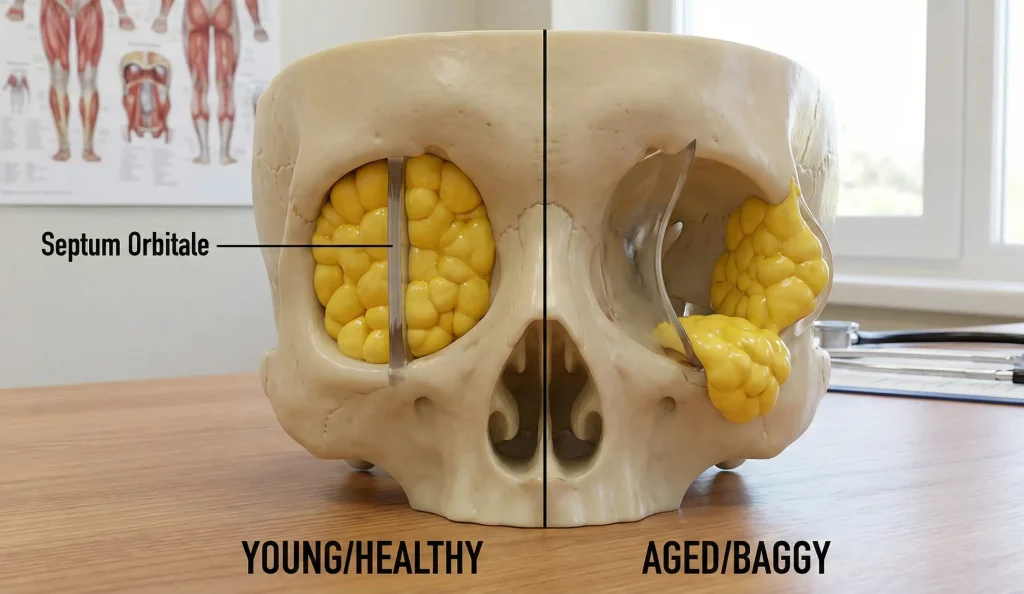
For the effective treatment of eye bags, one should treat the anatomy, not just the symptom. The eye is cushioned by three distinct compartments of orbital fat (medial, central, and lateral). These fat pads are held in place by a connective tissue wall called the orbital septum.
When a person is young, the septum is strong and tight, so the fat remains tightly pressed onto the bone of the face. Due to factors such as heredity or aging, the orbital septum becomes weak and thin (attenuation). As a result, the fat inside is pushed against the weakened septum from within, thus leading to the outer bulge or “herniation.” This is a mechanical problem. No amount of caffeine serum can tighten a ligament or dissolve a fat pad. Therefore, the final solution involves surgically getting to these compartments and managing their volume directly.
The Gold Standard: Lower Blepharoplasty with Fat Repositioning
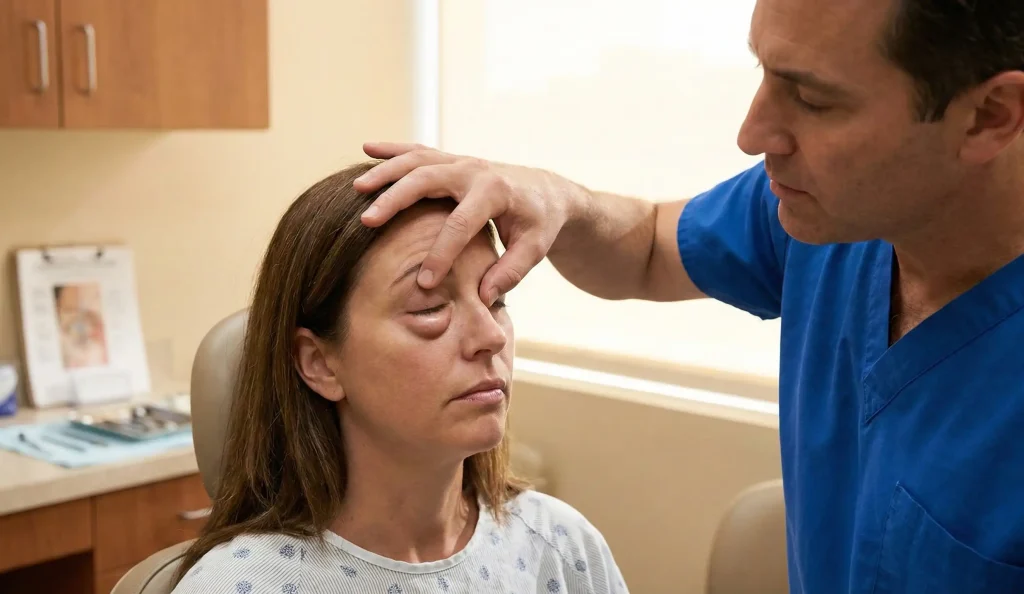
Lower blepharoplasty is the best and most permanent way to solve eye bags. Yet, the technique has undergone a big transformation over the years. Previously, doctors used to carry out a “subtractive” operation where the bulging fat was simply removed. Although this resulted in the disappearance of the bag, the patient usually ended up with sunken, skeletal or gaunt features years down the line.
Here, at Lin Health Europe Clinic, we practice a gentle, “preservationist” technique which goes by the names of arcus marginalis release or fat repositioning. We basically don’t get rid of the extra fat. Instead, we surgically open the tight ligament (the tear trough ligament) forming the dark groove under the eye bag. Then we locate the protruding fat pad and slide it down into the hollow valley. It’s like taking the patient’s own living tissue here to the next level and using it as a natural filler so as to gradually create a smooth transition between the eyelid and the cheek. By flattening the hill (the bag) and filling the valley (the tear trough) simultaneously, we eliminate the shadow that causes the “tired look” without removing essential volume.
The Scarless Method: Transconjunctival Blepharoplasty
Usually, for younger patients (generally, those who are under 40), with good skin elasticity and when the main problem is bulging fat only without the presence of wrinkles, transconjunctival blepharoplasty is the procedure of choice.
The technique is often referred to as the “scarless” eye bag surgery. The surgeon cuts the inside of the lower eyelid, just a barely visible pink layer of tissue (conjunctiva). This allows the doctor to reach the orbital fat pads without cutting the lower eyelid’s skin or the muscle orbitalis oculi that supports it. Since the muscle and the skin outside remain untouched, the eyelid retains its normal structure and there is very little risk of altered eye shape or eyelid retraction. The procedure is short and there are no telltale marks that the surgery was done, so it is the best method for younger people with inherited eye bags.
Taking Care of Skin Laxity: The “Skin Pinch” and Laser
A person who exhibits both protruding fat and loose, wrinkly skin (dermatochalasis) should not be simply given a treatment which targets getting rid of the fat. Imagine the skin under your eye as a balloon; if you let the air (fat) out without tightening the rubber (skin), then the skin will just be left to droop and wrinkle.
For such individuals, the transconjunctival excision of fat is combined with a skin pinch excision procedure. Only 1-2 millimeters of the extra skin just below the lash line is removed. Another option is the fractional CO2 laser resurfacing treatment that is done right after the surgery if the patient wishes to avoid any kind of external cutting. This laser treatment burns away the surface skin layers and triggers deep collagen shrinkage which then tightens the skin layer over the now smooth contour. As a result, the eye area looks not only flat but also tight and smooth.
Non-surgical Alternatives: Tear Trough Filler
For those who are not willing or ready to undergo an operation and who actually have a “hollow” rather than a “bag,” a non-surgical medical solution in the form of tear trough filler is available. Simply put, a low-hygroscopic (low water-attracting) hyaluronic acid (HA) gel is injected at the base of the orbital rim bone.
This is a form of make-up. Hence, by elevating the hollow tear trough to the same level as the slightly bulging fat pad, the eye bag can be hidden. Nevertheless, choosing the right patients of the utmost importance. If the fat bag is quite big or the skin is overly loose, then the filling may lead to the increase in volume of this region. This, in turn, can possibly make the eye bag look puffy and reddish blue (called the tyndall effect). Filling is just a temporary masking agent (lasting 9-12 months), while blepharoplasty is a structural correction.
Complicated Cases: Festoons and Malar Mounds
In the realm of esthetic diagnosis, it is crucial to distinguish between “Eye Bags” and ” Malar Mounds “(or Festoons). Eye bags lie immediately under the lashes. Malar Mounds are edematous fluid pockets lower on the cheekbone.
Lower Blepharoplasty cannot be used for Malar Mounds; on the contrary, it may even make them worse by injuring the lymphatic system. For safety and satisfaction, it is crucial to diagnose this correctly. The treatment options for Malar Mounds differ from those for eye bags and include doxycycline sclerotherapy (an injection that creates scarring in the spaces and closes them up) or direct surgical removal. In our clinic, apart from planning the correct procedure for you, we also make sure that there is a clear differentiation between malar edema and orbital fat.
Eye Safety: Canthopexy and Muscle Suspension
Many people are worried that by having surgery on their lower eyelids, their eyes may change shape or they may look like they have “round eyes” (which is also called scleral show). The reason why the problem occurs is when the doctor takes off too much skin or when the muscle support is weakened.
To avoid that, both at the time of the eye bag and later on, we frequently undertake a preventive canthopexy or canthoplasty. The outer corner of the eye (the lateral canthus) is tightened by placing a deep internal stitch which is then fixed firmly to the orbital bone. During the healing phase, this structure will be helped to maintain the natural curve of the eye by the support against gravity. Therefore, by strengthening the framework, one can be aggressive in the treatment of eye bags while at the same time, keep eyes safely and maintain the natural shape of the eye.
Frequently Asked Questions About Surgical Eye Bag Removal
Lower blepharoplasty (eyelid surgery) is the sole long-lasting solution to the problem of herniated orbital fat pads which structurally create eye bags. In fact if you want a permanent solution, it is the only one.
While laser treatment, for example the CO2 fractional laser, can tighten the skin and improve the skin texture, it cannot get rid of the fat pad under the skin. To get the best result, they are usually combined with surgery.
This is a surgical method where the incision is performed inside the eyelid (the conjunctiva). It makes it possible to remove the fat without an external scar and there is no damage to the orbicularis muscle.
Tear trough filler may mask slight bags by filling the indented area near them. Nevertheless, it is not an option for large fat herniations as the bag cannot be removed by this method and swelling is a risk.
Generally, patients encounter bruising and swelling for about a week to ten days. Usually, you can resume working and going out socially with the help of makeup after 10 days of undergoing lower blepharoplasty.
Rohrich, R. J., et al. (2004). The five-step lower blepharoplasty: blending the eyelid-cheek junction. Plastic and Reconstructive Surgery.
Hamra, S. T. (1995). Arcus marginalis release and orbital fat preservation in midface rejuvenation. Plastic and Reconstructive Surgery.
Goldberg, R. A. (2000). Transconjunctival orbital fat repositioning: transposition of orbital fat pedicles into a subperiosteal pocket. Plastic and Reconstructive Surgery.
Pacella, S. J., et al. (2010). Transconjunctival blepharoplasty for the treatment of lower eyelid bags. Aesthetic Surgery Journal.