
It can improve dark circles caused by fat bulges.
This is the first and main reason we get facial rejuvenation patients coming in. You might be well-rested, hydrated, and physically alert. But still, when you catch your reflection in a window or see yourself in a snapshot, your face says ‘I’ve had no sleep’. And, to make things worse, friends, co-workers, and even family members keep at you with questions like “Are you tired?” or “Have you been up all night?”
Most likely, the problematic deep, dark semicircles around the eyes. We waste our money on super-expensive, caffeine-packed eye creams, cold rolls, and thick concealers, but still, our eyes do not look fresh. Many a time, this desperation drives people to think of the surgical option: Lower Blepharoplasty. But, can eyelid surgery fix dark circles? If it does, it’s only partly true. It entirely depends on what makes your circles dark. At Lin Europe Clinic, we don’t only speak but also practice accurate identification of the problem. Surgery has the power to change the appearance of darkness due to the structure of the face a lot but cannot alter the DNA of your skin. So, the key to the right satisfaction is knowing the difference between a shadow and a stain.
The “Shadow Effect”: When Surgery is the Hero
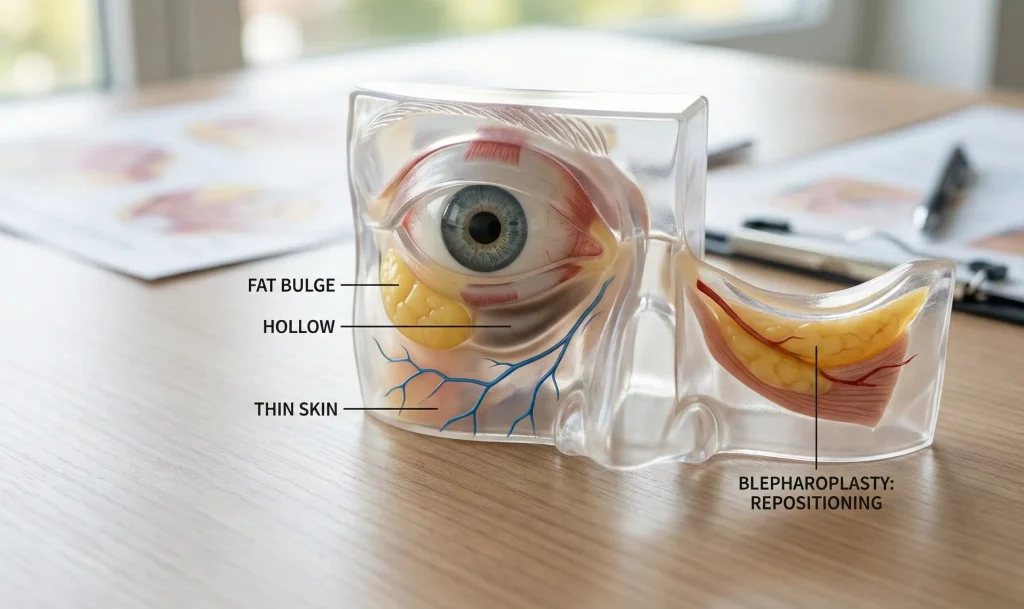
To most patients, “dark circles” are simply an optical misconception where light and shadow are in play. Orbital septum (the membrane that holds back the fat around our eyes) becomes feeble as we get older. Thus, the internal fat pads bulge through it, creating the so-called “eye bags.“
On the other hand, the volume of the upper cheek naturally decreases, thus the formation of the deep groove called the tear trough.
- The Result: You got a hill (the puffy bag) next to a valley (the tear trough). A light from above—either from the sun or the office—falls on your face and your valley turns into a shadow.
- The Fix: In this particular case, certainly, the eyelid surgery is the best solution. We can remove or re-put the fat by cut, so that we leave a flat surface instead of the puffy bag. Without the hill to screen the light, the shadow disappears. The appearance is smooth, fresh and relaxed not because the color of the skin has been changed but because the light trapping geometry has been changed.
The “Filler Trap”: Why Injections Can Make It Worse
Before opting for surgery, many patients want to eliminate the shadow with the help of dermal fillers. However, while filler may be effective for the very mild cases, under the eyes it is often counterproductive.
When filler is put too close to the surface, it can cause the Tyndall Effect—the deposit of the clear gel in the skin that diffracts light giving it a bluish tint. This will in fact darken and tinge the areas covered with dark circles anyway. Besides that, fillers are water-loving. Hence if one uses fillers over the period of time the under eye may chronically swell up or develop a so-called “malar edema” condition. So, you will look even more tired than you were before. Surgery overcomes that by therefore fixing the anatomic problem and not merely covering it with further gel.
The “Pigment Problem”: What Surgery Cannot Do
On the other hand, the nature of the dark circles for which surgery is not a good idea: True Hyperpigmentation.
The skin under the eyes of some people is naturally darker or has higher levels of melanin (pigment). Their skin tone is brown or gray. These people are not only the ones with higher levels of melanin in the skin but genetically are more prone to hyperpigmentation (one can often see this on Mediterranean or Middle Eastern patients).
- The Reality: Surgery is about removal of skin and fat; it does not mean the bleaching of the skin. So even if you remove the dark skin, the rest of the skin will still be dark. If it does not change color when you stretch the skin in good light, it is pigmentation and a surgery alone would not solve this problem – chemical peeling, laser, and surgery together would give you the best results.
The “Thin Skin” Issue: The Blue Hue

Another reason for dark circles is that the skin is very thin. The skin of the lower eyelid is the thinnest of all the skin on the body. There are some patients in which the skin is that thin and translucent that one can see the reddish-purple muscle (orbicularis oculi) and the blue blood vessels through that.
- The Solution: Sometimes traditional cutting surgery may worsen this problem by removing the fat buffer. A small amount of fat is obtained from your body and after liquefying it to form an emulsion we inject a thin layer below the episdermis with the aid of Nanofat Grafting at Lin Europe Clinic. This yellow fat acts as a natural “concealer” from the inside, thickening the dermis and hiding the purple muscle underneath.
Fat Repositioning: The Modern Approach
Previously, surgeons used to remove the eye bags completely. As a result, although the shadow was gone, an individual usually looked hollow and wasted – a “skeletonized” face which is in a way going against the natural aging process.
Nowadays at Lin Europe Clinic in Istanbul, we perform a method called Fat Repositioning (also known as Transposition). We release the ligaments holding the tear trough and slide the fat down into the valley instead of throwing it out and throw it away. As a filler, your own “eye bag” is used to fill the depressed part. The transition between the eyelid and the cheek is, therefore, smoother. By eliminating the shadow completely and also, adding a youthful plumpness to the under-eye area that reflects light better than a hollow eye, we not only even the playing field but also restore the youthful glow.
Frequently Asked Questions About Eyelid Surgery and Dark Circles
Blepharoplasty can remove dark circles most effectively when the darkness is due to the shadow caused by puffy eye bags. However, it won’t help in case of dark circles due to skin pigmentation or genetics.
Usually, the best surgery for dark circles is lower blepharoplasty with fat repositioning, which eliminates the hollows producing shadows that are the main reason behind the appearance of dark circles.
In Korean beauty culture, the top choice to treat dark circles is transconjunctival fat repositioning that is sometimes accompanied by nanofat grafting aimed at skin brightening and the complete removal of dark circles.
Continuous appearance of dark circles suggests a deficiency in Vitamin B12, Iron, or Vitamin K, as lack of these nutrients results in poor oxygen supply, thus making the dark circles more visible.
Treatments with creams are limited to slight improvements only; however, medical procedures such as hyaluronic acid fillers, laser resurfacing, and eyelid surgery are the only ones that not just significantly but also in the long run reduce dark circles.
Goldberg, R. A. (2005). The three periorbital hollows: A paradigm for periorbital rejuvenation. Plastic and Reconstructive Surgery.
Rohrich, R. J., et al. (2004). The tear trough and lid/cheek junction: Anatomy and implications for surgical correction. Plastic and Reconstructive Surgery.
Hidalgo, D. A. (2011). An integrated approach to lower blepharoplasty. Plastic and Reconstructive Surgery.