The scar is usually tiny and barely visible.
When patients are deciding between “Open” and “Closed” rhinoplasty, the choice is often influenced by just one fear: The Scar. It is a big deal and one scary thing to have a cut right in the middle of your face. People picture a scary, dark, and jagged line on the lower part of their noses that forever shows what they did to their nose.
It is indeed that Open Rhinoplasty (External Rhinoplasty) incorporates making an incision on the outside of the nose while Closed Rhinoplasty is totally done through the nostrils. However, the fear of such a scar is generally disproportionate to the reality. When the operation is done by a good surgeon, the open rhinoplasty scar is actually one of the most invisible scars from any plastic surgery. The scar is so well healed that even the patients themselves have a hard time locating it in the mirror after a year. At Lin Europe Clinic, we think that it is the outcome you want that should guide your choice of surgical method instead of your fear of a 4-millimeter line that will almost be invisible.
The Anatomy of the Cut: The Columella
To gain access during open rhinoplasty, the doctor will take a small cut on the Columella. This is the small piece of skin and cartilage between the two nostrils.
There are two reasons why this is the best place for the cut. For one thing, it is the narrowest part of the base of the nose. Also, it is on the “underside” of the nose. In case you don’t live your life with your head constantly tilted backward or you are far taller than everybody you meet, this part of the nose is naturally out of the range of people’s eyes. Talking face-to-face, the columella is located in the shadow.
The “Inverted V” Technique: Breaking the Line
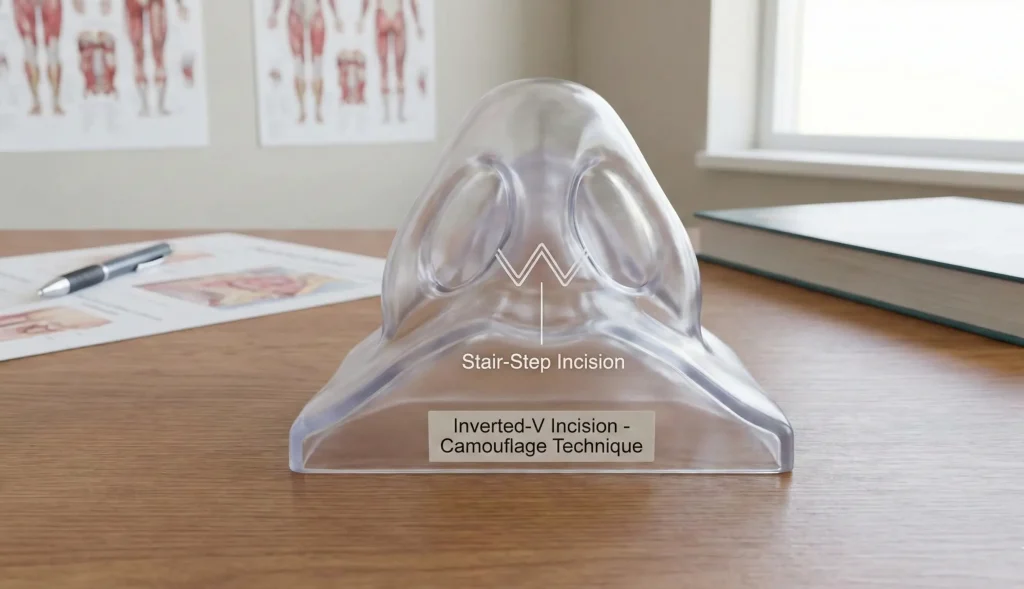
In case the surgeon performs a straight incision on the columella, it would probably result in a notch that is visible after healing. To avoid this, only skilled surgeons employ the “Inverted V” or “Stairstep” incision method.
Rather than just a straight cut, it is a zig-zag one. It gives the flesh a break from the stress of a single, unbroken stretch that the eye follows as it would a scratch on a car. When the scar is viewed as a series of tiny angles, the eye is tricked. The jagged line almost becomes one with the natural skin surface and pores. The locking shape also means that once the skin is stitched back together, the edges will be perfectly aligned with no slipping so that the scar will not widen or become depressed.
The Healing Timeline: Red to Invisible
The scar on the columella, just like any other bodily injury, will show the typical healing stages.
- Weeks 1-4 (The “Angry” Phase): At the time of stitch removal, the scar may be either red or bright pink. There might be a little elevation of the wound or the area may be crusty. This is inflamed tissue and it is entirely normal.
- Months 2-6 (The Fading Phase): The pink of the scar is getting duller and it is easy to cover it up with a shade of concealer.
- Year 1 (The Maturation Phase): The scar is there but in a much thinner and white line. Skin on columella has unique qualities – it is thin with a good blood supply, which means that it rarely gets keloids or thick scars (hypertrophy) unlike the other parts of the body such as the chest and ears.
Why Choose Open If There Is a Scar?
If a scar is always going to be there, then why not just use Closed Rhinoplasty all the time? The answer is Precision. Taking off the nasal tip skin (the “Open” method) exposes the cartilage framework directly without any hindrance from the skin. It’s like opening the hood of your car when there’s something wrong with the motor and getting inside to check it, instead of trying to fix it through the exhaust pipe.
For complicated situations – where the tip is crooked, the nose is too bulbous and needs to be made more pointed, or one is going for a revision surgery – the surgeon can’t compromise with visibility. The exchange is very straightforward: would you be willing to have a scar that is 99% unnoticeable if it means that you would have a nose that is 100% perfect and symmetrical? The majority of patients and doctors concur that the open approach’s control is well worth an unnoticeable scar.
The Social Distance Test
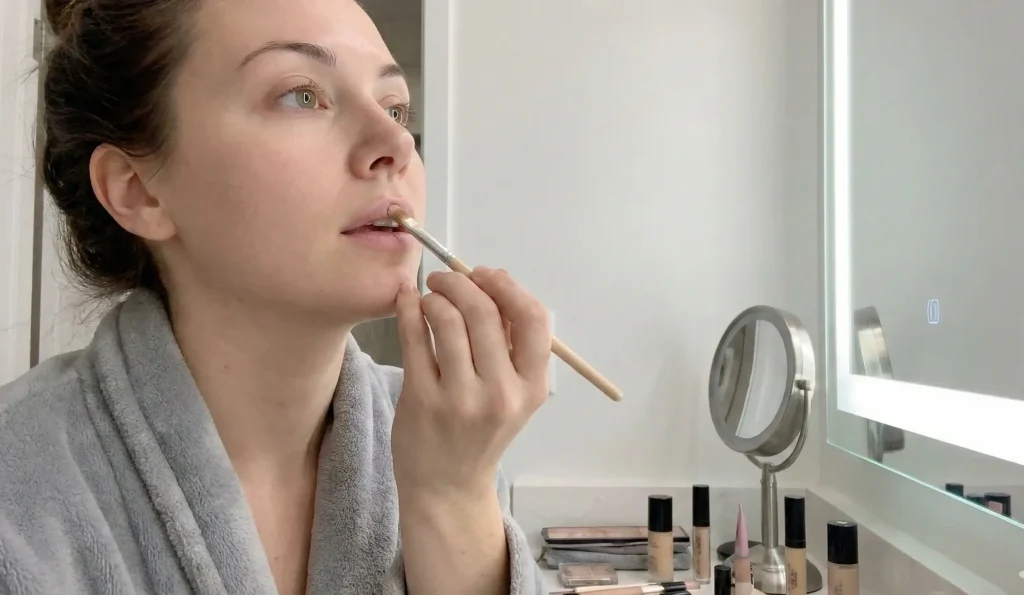
We always recommend that patients try the “Social Distance Test.” Simply, stand in front of the mirror at the distance of your arm’s length – the same distance that you keep from a friend or colleague. Can you see the pores on your nose? Most likely no. Can you see the columellar scar? Absolutely no.
The scar is only visible to someone who is within “intimate distance” (kissing distance), and looks for it carefully under strong light. In fact, throughout the majority of life, it will not be a problem at all.
Experience the Lin Europe Difference: Microsurgical Closure
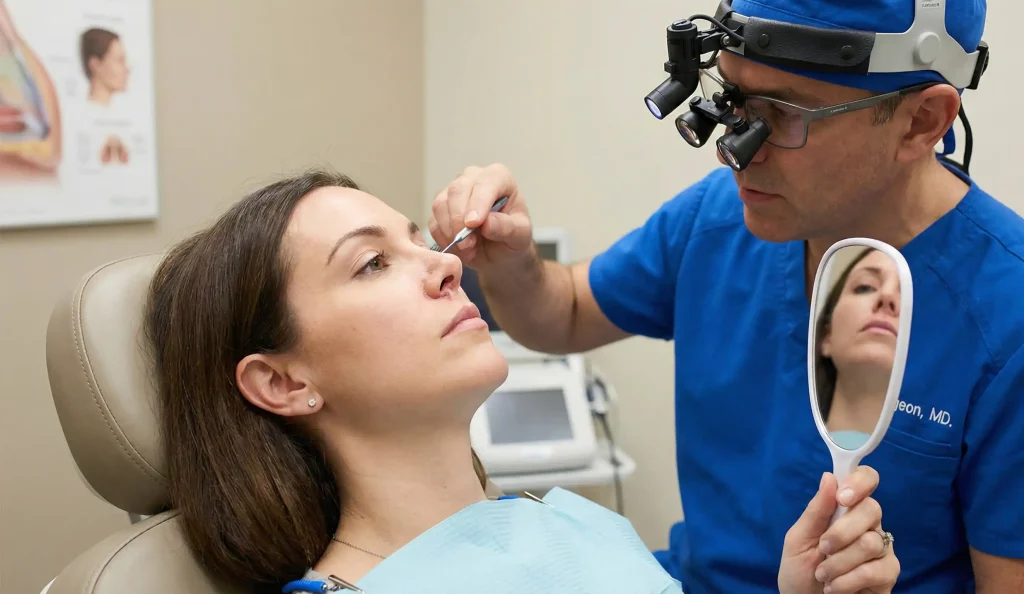
At Lin Europe Clinic, we consider the most important stage of the surgery to be the closure of the incision. We don’t perform the stitches in a hurry. Our sutures are so thin that they are barely visible to the human eye and we work with the help of magnification loops.
Besides that, we are also focusing on sun protection by educating our clients. A scar that has just formed is most vulnerable to sun rays which will make it darker (hyperpigmentation). We recommend putting a sunscreen with a high SPF mainly on the columella during the first summer after the surgery so that it stays white and fades properly. With our careful work and your careful aftercare, the scar will only be a faint memory next to your metamorphosis.
Frequently Asked Questions About Rhinoplasty Scars
It is hardly ever the case that the scar becomes painful. You might notice some stiffness or numbness around the scar for a couple of months but it doesn’t cause any long-term pain.
Yes, silicone gel membranes or tissue gels used for scars are beneficial to start around week 3 (when the scab has naturally fallen off) and will keep the scar tissue hydrated and flattened.
Keloids on the columella are hardly ever seen, even in patients who have them in other parts of the body. In case a raised scar does happen, it would be simple to treat it with a steroid injection which would flatten the raised scar.
Usually, the external stitches on the columella are taken off on Day 6 or Day 7 after the surgery. The internal stitches in the nose are most likely to be dissolvable.
As the tip of the nose is directly exposed, open rhinoplasty often causes slightly more swelling there than a closed one because the lymphatic drainage is momentarily disturbed by the incision, but this swelling gradually goes away.
Adamson, P. A. (1987). Open rhinoplasty. Otolaryngologic Clinics of North America.
Foda, H. M. (2003). External rhinoplasty: a critical analysis of 500 cases. The Journal of Laryngology & Otology.
Inanli, S., et al. (2009). Columellar incision scars in open rhinoplasty: a comparison of transverse and inverted-V incisions. Aesthetic Plastic Surgery.